
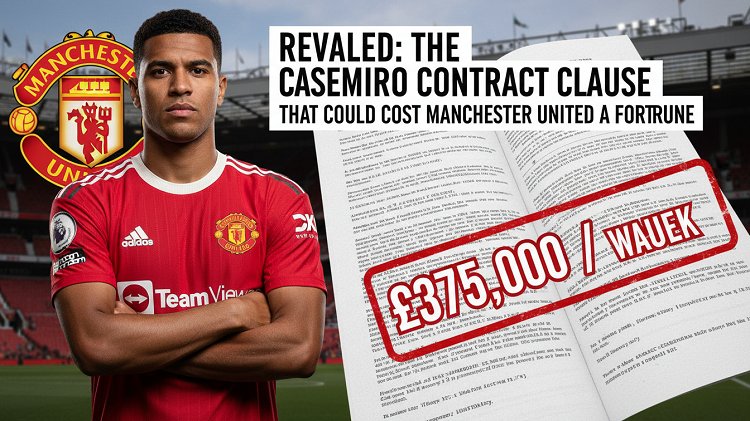
Manchester United may soon find themselves facing a delicate contractual dilemma involving one of their most high-profile and highest-paid players. A clause buried within Casemiro’s contract could see the Brazilian midfielder remain at Old Trafford for an additional season on wages approaching £375,000 per week unless the club takes decisive steps to prevent it.
Casemiro, who will turn 34 next month, joined United in 2023 on a lucrative three-year deal after leaving Real Madrid. At the time, the move was seen as a statement signing, bringing elite-level experience, leadership, and a serial-winning mentality to a midfield that had long lacked steel and authority. As part of that agreement, however, an option for a fourth year was included one that can be activated automatically based on appearances rather than club discretion.
The Clause That Changes Everything
Under the terms of Casemiro’s contract, a one-year extension will be triggered if he starts 35 matches across all competitions during the current campaign. Should that threshold be reached, United would be obligated to retain the midfielder for the 2026–27 season on his original wage structure, which is understood to be around £350,000 to £375,000 per week.
While Casemiro’s reported salary was initially close to £350,000 per week, his earnings are believed to have dropped to below £300,000 following United’s failure to qualify for the Champions League. Performance-related clauses and competition-based salary reductions were written into several senior contracts, including Casemiro’s, as part of a broader wage-control strategy.
However, if the extension clause is activated, his wages would automatically revert to their higher level a significant financial commitment for a club already attempting to rein in costs.
A Likely Summer Exit But Not Guaranteed
Despite his experience and recent improvement in form, Casemiro is widely expected to leave Manchester United at the end of the season. The club’s hierarchy is believed to be keen on reducing the wage bill, refreshing the squad, and lowering the average age of the midfield. From that perspective, allowing a 34-year-old defensive midfielder to remain on elite wages for another season is far from ideal.
Yet the problem for United is that the power to trigger the extension does not lie solely with them. Casemiro’s minutes and specifically his number of starts could determine whether the clause is activated automatically.
So far this season, the Brazilian has started 18 matches in all competitions. With United already eliminated from both the Carabao Cup and the FA Cup, opportunities to reach the 35-start threshold have been significantly reduced. To trigger the clause, Casemiro would now need to start every remaining Premier League fixture 17 in total an outcome that currently appears unlikely.
Balancing Performance and Protection
Although Casemiro has enjoyed something of a resurgence this season after a difficult previous campaign, managing his workload will be crucial. At 33, he no longer possesses the relentless physical durability of his prime years, and the club’s medical and performance staff are expected to be cautious with his minutes.
From United’s perspective, rotation could serve a dual purpose: protecting the player’s fitness while also ensuring the extension clause is not inadvertently activated. Whether this approach becomes policy, however, depends largely on results and the priorities of the new coaching staff.
Carrick’s Arrival Adds Another Layer of Uncertainty
Adding further intrigue to the situation is the arrival of new head coach Michael Carrick. Appointed earlier this week after beating Ole Gunnar Solskjaer to the role, Carrick begins his tenure amid intense scrutiny and with immediate pressure to push United back toward European qualification.
It remains to be seen how central Casemiro will be under Carrick’s leadership. While the Brazilian brings invaluable experience, Carrick may prefer greater mobility and energy in midfield, particularly as United look to implement a more progressive style of play.
Casemiro was notably left out of last weekend’s clash with Brighton but is expected to return to the starting XI for Saturday’s Manchester derby a match that will serve as Carrick’s first in the Old Trafford dugout. That decision alone could offer an early indication of how much trust the new manager places in the veteran midfielder.
Carrick Sets the Tone
Speaking to the media for the first time at Carrington on Friday, Carrick played down any notion that the club’s ownership or executive leadership had imposed specific targets for the remainder of the season. Nonetheless, he acknowledged that European qualification must remain the overarching ambition.
“We want to be near the top of the league, we want to be competing at the top,” Carrick said. “That’s obvious, but we have to take the right steps to get there. European football would be a clear step forward, and we’ve got to keep pushing.”
Carrick also confirmed that he has held extensive discussions with the club’s football leadership, including Jason Wilcox and Omar Berrada, as well as representatives of the ownership group. Those conversations are believed to have covered both short-term objectives and longer-term squad planning an area where Casemiro’s future will inevitably feature.
A Difficult Run of Fixtures Looms
United currently sit seventh in the Premier League, and Carrick faces an immediate baptism of fire. Following the Manchester derby, the Red Devils have daunting fixtures against Arsenal, Fulham, and Tottenham matches that will go a long way toward defining their season.
Results during this run could indirectly influence Casemiro’s situation. If United are chasing points and stability, Carrick may feel compelled to rely on experience. If, however, the focus shifts toward transition and planning for the future, opportunities may arise for younger midfielders reducing Casemiro’s starts and keeping the extension clause dormant.
A Calculated Risk for Both Sides
Ultimately, Casemiro’s contract clause represents a classic modern football dilemma: performance incentives designed to reward contribution can sometimes clash with long-term strategic planning. For United, the challenge will be to strike the right balance between competing in the present and protecting the club’s financial future.
For Casemiro, meanwhile, the equation is simpler. If selected regularly, he earns another year at the highest level on elite wages. If not, his Old Trafford chapter may quietly draw to a close this summer.
With so many variables at play managerial philosophy, results, fitness, and form the coming weeks will determine whether Manchester United can prevent a costly extension from being triggered, or whether circumstances will force their hand.