
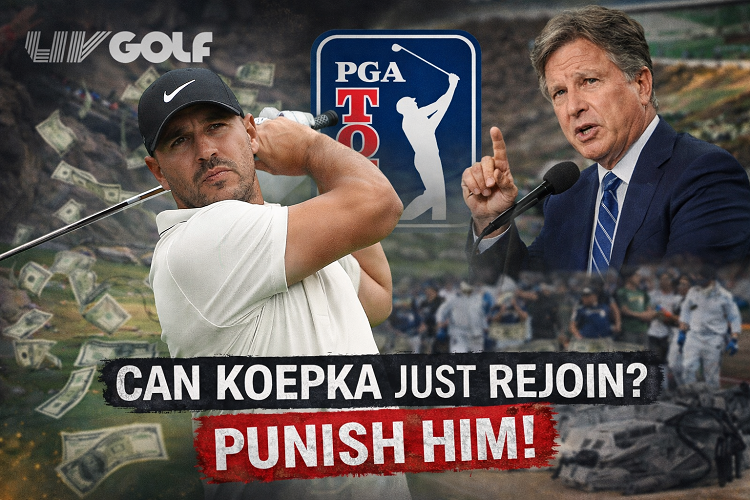
Brooks Koepka’s reported decision to step away from LIV Golf after more than three seasons has reignited one of professional golf’s most polarizing debates: should players who defected to the Saudi-backed league be allowed to return to the PGA Tour without consequences?
The question has drawn sharp reactions across the golf world, and few voices have been as direct as veteran golf analyst Brandel Chamblee. In a strongly worded commentary this week, Chamblee pushed back against fans and pundits calling for Koepka’s seamless reintegration into the PGA Tour, arguing that allowing such a move without penalties would undermine the very foundation on which the tour operates.
Koepka, a five-time major champion, joined LIV Golf during the 2022 season, becoming one of the league’s most prominent signings and lending instant credibility to the upstart circuit. His departure from LIV, announced this week, sent shockwaves through the sport, reopening long-simmering questions about loyalty, contracts, and the future structure of professional golf.
Koepka’s LIV Chapter
During his time with LIV Golf, Koepka was far from a marginal participant. He competed for more than three seasons, won five individual events, and, perhaps most notably, captured the PGA Championship in 2023 while playing as a LIV golfer. That victory marked a defining moment in the schism between LIV Golf and the PGA Tour, as it demonstrated that players competing outside the traditional tour structure could still succeed at the highest level.
Koepka’s success became a key talking point for LIV supporters, who pointed to his major win as proof that the league had not diluted competitive excellence. Critics, however, argued that such achievements only deepened the disruption by legitimizing a breakaway model they viewed as destabilizing.
Now, with LIV announcing that Koepka is stepping away to prioritize family needs and remain closer to home, speculation has surged over whether the American star could one day return to the PGA Tour. That possibility has been met with resistance from those who believe such a move should come with conditions.
Chamblee’s Case for Accountability
Writing on social media platform X, Chamblee made clear that he does not support the idea of Koepka returning to the PGA Tour as if nothing had happened.
“I certainly disagree with this,” Chamblee wrote, referring to calls for Koepka’s penalty-free return. He argued that allowing a player of Koepka’s stature to rejoin without consequence would erode the PGA Tour’s meritocratic principles not because of who Koepka is, but because of what his return would symbolize.
According to Chamblee, LIV Golf was not merely a competing league offering golfers an alternative place to play. Instead, he described it as a force that fractured tournament fields, diluted competitive meaning, triggered years of legal disputes, destabilized sponsorship relationships, and forced structural changes across the professional game.
In that context, Chamblee said Koepka’s role mattered greatly.
“Koepka was not a passive bystander,” he wrote. “He was a marquee legitimizer.” Chamblee emphasized that Koepka’s global reputation, major championship pedigree, and post-LIV success made the breakaway league appear viable and normalized the idea of defection among elite players.
Influence Without Punishment?
Chamblee was careful to distinguish between punishing a player for influence and acknowledging that influence exists. He argued that while Koepka should not be singled out simply for being successful, the PGA Tour cannot ignore the broader impact of his decision to leave.
“You don’t punish him for being influential,” Chamblee noted, “but you cannot pretend his influence didn’t matter.”
In his view, allowing an immediate, unconditional return would send a damaging message: that elite players can leave, accept guaranteed money, and later re-enter the system without accountability simply because of their popularity or talent.
That, Chamblee warned, would fundamentally alter the PGA Tour’s identity.
What a Penalty Could Look Like
Importantly, Chamblee did not call for a harsh or punitive punishment. Instead, he suggested measured consequences that would recognize player choice while maintaining institutional integrity.
Among the options he outlined were requiring Koepka to re-qualify for PGA Tour membership, limiting his eligibility for a season, or imposing a suspension tied to contractual breaches associated with leaving the tour. While Koepka’s five-year exemption for winning the PGA Championship would still apply for major championships, Chamblee argued it should not automatically restore his PGA Tour status.
“A penalty would not so much be a punishment as it would be an acknowledgment of choice,” Chamblee wrote, adding that consequences do not need to be severe to be meaningful.
He also emphasized fairness to players who remained loyal to the PGA Tour during years of uncertainty. Those players, Chamblee said, endured weaker fields, reputational risk, and increased pressure to preserve the tour’s continuity while others accepted guaranteed contracts elsewhere.
Protecting the Tour’s Identity
At the heart of Chamblee’s argument is a broader philosophical question: does commitment still matter in professional golf?
“If excellence alone erases consequences,” he wrote, “then the PGA Tour ceases to be a meritocracy and becomes a marketplace of convenience.”
In that scenario, rules would apply only to those without leverage, while star players would operate above the system. Chamblee believes such an outcome would be corrosive to the tour’s credibility and long-term stability.
“Great players most certainly deserve respect,” he acknowledged, “but institutions deserve protection.”
A Sport Still Healing
Koepka’s departure from LIV Golf comes at a moment when professional golf is still grappling with the aftershocks of the split. While negotiations and framework agreements have hinted at eventual reunification, many details remain unresolved, leaving players, sponsors, and fans uncertain about what the future holds.
For some, Koepka’s exit underscores the personal toll of years spent in a fractured sport. LIV Golf cited family considerations and a desire to remain closer to home as the reasons behind his decision, a reminder that even the biggest names face pressures beyond the leaderboard.
Still, his situation has become a flashpoint in a larger debate that extends far beyond one player. How the PGA Tour handles potential returns from LIV golfers may set precedents that shape professional golf for decades.
An Unsettled Future
Whether Koepka ultimately seeks a return to the PGA Tour remains to be seen. For now, his decision to step away from LIV has reopened questions that golf’s power brokers cannot avoid indefinitely.
As the sport inches toward some form of reunification, voices like Chamblee’s are urging caution, consistency, and accountability. The challenge, he argues, is not choosing sides but ensuring that choices carry meaning.
In a sport built on tradition, rules, and competitive balance, the stakes are about more than one player’s career. They are about defining what professional golf stands for in a post-LIV era and whether its institutions can protect their integrity while adapting to change.