
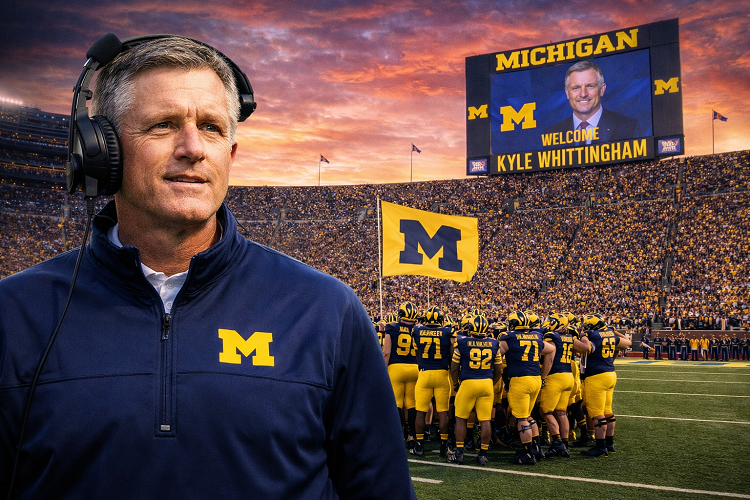
The University of Michigan moved swiftly to stabilize its football program, announcing Kyle Whittingham as the next head coach of the Wolverines just weeks after the shocking dismissal of Sherrone Moore. The hire comes amid a period of turbulence for one of college football’s most storied programs, as Michigan leadership looks to restore stability, credibility, and competitive excellence following controversy that rocked the athletic department late in the season.
Michigan officially confirmed the hiring late Friday night, bringing an end to a rapid and closely watched coaching search. Whittingham agreed to a five-year contract, according to reports, and will replace interim head coach Biff Poggi, who stepped in after Moore’s firing earlier this month.
The decision signals Michigan’s desire for an experienced, steady hand someone with a proven track record of leadership and long-term program building rather than a short-term or experimental option. In Whittingham, the Wolverines believe they have found a coach capable of navigating both the pressures of elite college football and the off-field expectations that come with leading a high-profile program.
A Program Reeling From Sudden Change
Sherrone Moore’s tenure as Michigan’s head coach ended abruptly following allegations of an inappropriate relationship with a staff member. University officials cited violations of institutional conduct policies, and Moore was later arrested, further intensifying scrutiny of the program. The controversy came at a particularly sensitive moment for Michigan, which has spent the past several seasons operating under the shadow of NCAA investigations and lingering fallout from the sign-stealing scandal tied to the Jim Harbaugh era.
Moore, once viewed as Harbaugh’s successor and a rising star in the coaching ranks, had already served a suspension related to NCAA inquiries before his dismissal. His firing forced Michigan into an urgent search for leadership, with the program facing questions about culture, accountability, and direction heading into the future.
Biff Poggi, a respected figure within the football community, was named interim head coach and made a strong case for the permanent position during his brief stint. Ultimately, however, Michigan opted for a more established résumé, prioritizing experience and stability over continuity.
Whittingham’s Arrival Marks a New Chapter
Kyle Whittingham arrives in Ann Arbor with one of the most respected résumés in college football. The 66-year-old coach spent two decades leading the Utah Utes, becoming synonymous with the program’s rise from a regional contender into a consistent national presence. Earlier this year, Whittingham announced plans to step away from Utah, ending a 20-year run that included conference championships, multiple major bowl appearances, and a reputation for physical, disciplined football.
Michigan will be just the second head coaching stop of Whittingham’s career, underscoring the significance of the move for both parties. Over his career, he compiled a 177–88 record, earning widespread respect for his defensive acumen, toughness, and ability to develop players.
Before becoming Utah’s head coach, Whittingham worked under notable figures such as Ron McBride and Urban Meyer, experiences that helped shape his coaching philosophy. He first joined the Utah staff in 1994 as a defensive line coach, steadily rising through the ranks before taking over the program. His longevity and consistency are qualities Michigan leaders emphasized throughout the hiring process.
Michigan Leadership Emphasizes Character and Stability
Athletic director Warde Manuel praised Whittingham’s credentials and leadership qualities in a statement announcing the hire, emphasizing the importance of character and program integrity in the wake of recent events.
“Kyle Whittingham is a well-respected and highly successful head coach who is widely recognized as a leader of exceptional character and principled leadership,” Manuel said. “Throughout our search, he consistently demonstrated the qualities we value at Michigan: vision, resilience, and the ability to build and sustain championship-caliber teams.”
Manuel added that Whittingham’s approach aligns with Michigan’s traditional identity, citing his emphasis on toughness, discipline, and accountability.
“Kyle brings not only a proven track record of success, but also a commitment to creating a program rooted in physicality, respect, and excellence,” Manuel said. “We are excited to welcome him as he takes the helm of Michigan Football.”
Whittingham Embraces the Challenge
Whittingham expressed enthusiasm and humility upon accepting the position, acknowledging both the weight of Michigan’s tradition and the responsibility that comes with leading one of college football’s premier programs.
“We are honored to lead the outstanding student-athletes, coaches, and staff who represent Michigan Football each day,” Whittingham said. “Michigan is synonymous with tradition and excellence both on the field and beyond and our entire program is committed to upholding those values while striving for greatness together.”
He also emphasized player development and leadership, reinforcing Michigan’s broader mission beyond wins and losses.
“My family and I are thrilled to join the University of Michigan community,” Whittingham added. “We look forward to helping our players grow, develop, and reach their highest potential on the gridiron, in the classroom, and as leaders.”
A Storied Program, Recent Turmoil
Despite recent scandals, Michigan remains one of the most coveted coaching jobs in college football. The Wolverines boast a massive fan base, elite facilities, and a history defined by success at the highest level. Just two seasons ago, Michigan completed one of the most dominant campaigns in program history, finishing 15–0 and winning the national championship behind quarterback J.J. McCarthy.
That title marked Michigan’s first undefeated season since 1997 under Lloyd Carr, who also led the Wolverines to a national championship that year. The program’s ability to reach such heights even amid controversy underscores its immense potential.
Still, the last several years have tested Michigan’s resilience. Jim Harbaugh’s suspension related to the sign-stealing scandal, combined with ongoing NCAA scrutiny, placed sustained pressure on the program. Moore’s dismissal added another layer of uncertainty, making Whittingham’s task as much about rebuilding trust as it is about winning games.
The Road Ahead for Michigan
Whittingham becomes the fifth head coach at Michigan since Carr’s retirement following the 2007 season, a reminder of the program’s ongoing search for long-term stability. His immediate priorities will include assembling a coaching staff, addressing roster questions particularly with the transfer portal in full swing and restoring confidence among players, recruits, and alumni.
Expectations will be high from the outset. Michigan fans are accustomed to competing for Big Ten titles and national championships, and patience is often limited. At the same time, Whittingham’s reputation as a program builder suggests the university is willing to prioritize sustainability over short-term splash.
As Michigan turns the page on a turbulent chapter, the hiring of Kyle Whittingham represents both a reset and a calculated gamble. The Wolverines are betting that experience, discipline, and steady leadership can guide the program back to firm footing and perhaps, once again, to the top of college football’s mountain.