
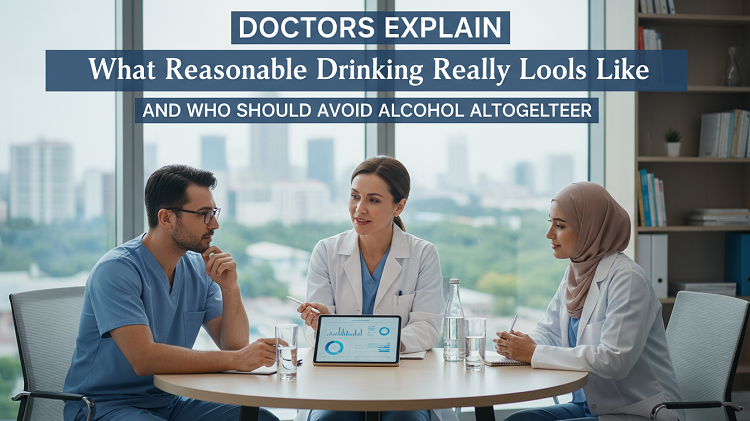
As more people rethink their relationship with alcohol, the question of what constitutes “reasonable” drinking has moved firmly into the spotlight. A growing body of research suggests that even modest alcohol consumption carries health risks, yet for millions of adults, drinking remains a deeply ingrained social and cultural habit. With an estimated 40% of adults resolving to cut back on alcohol in 2026, according to recent survey data, many are searching for guidance on how or whether to continue drinking in a healthy way.
Medical experts agree that there is no one-size-fits-all answer. A person’s age, genetics, mental health history, and lifestyle all influence how alcohol affects the body and brain. While total abstinence may be the safest option from a purely medical standpoint, doctors say that realistic, practical advice must account for how people actually live.
The “Safest” Level Versus the Realistic Level
Dr. Ezekiel Emanuel, a Pennsylvania-based oncologist and bioethicist, has been at the center of the conversation about balancing health science with real-world behavior. In his recent book, Eat Your Ice Cream: Six Simple Rules for a Long and Healthy Life, Emanuel argues that some pleasures including alcohol may not be ideal for daily consumption but can still have a place in a well-lived life when approached thoughtfully.
“There has been extensive research on alcohol,” Emanuel explained in a recent interview. “And from a strictly scientific perspective, the safest level of alcohol consumption is probably zero.”
However, Emanuel also emphasized that public health guidance must be grounded in reality. Roughly 60% to 65% of adults drink alcohol, he noted, and advising everyone to quit entirely is unlikely to be effective.
“You’re not going to move from 65% of people drinking to zero,” he said. “So the challenge is to give people reasonable advice advice they can actually follow.”
According to Emanuel, reasonable drinking does not include binge drinking, nor does it include drinking alone. Both behaviors are associated with higher risks of addiction, mental health problems, and physical harm.
Instead, he suggests that occasional alcohol consumption in social settings may offer benefits that go beyond the drink itself.
“If alcohol is being used as a social lubricant which is how many people use it then the real benefit may come from the social interaction,” Emanuel said. “Human connection matters.”
When Social Drinking Turns Risky
While social drinking can feel harmless for many people, experts caution that alcohol affects individuals very differently. What feels like casual enjoyment for one person can quickly become dangerous for another.
Dr. Andrew Huberman, a neuroscientist at Stanford University and host of the popular “Huberman Lab” podcast, has spoken extensively about alcohol’s effects on the brain. In a recent episode, Huberman was joined by Dr. Keith Humphreys, a professor of psychiatry and behavioral sciences at Stanford School of Medicine, to discuss how alcohol use can cross from pleasure into risk.
One key issue, Huberman explained, is how alcohol interacts with the brain’s dopamine system.
“About 10% of people experience alcohol as extremely dopaminergic,” Huberman said. “They feel spectacularly good when they drink.”
For these individuals, alcohol can feel unusually rewarding, creating a powerful incentive to continue drinking and making it harder to stop. Others, by contrast, experience clear signals to slow down or stop such as nausea, dizziness, blackouts, or severe hangovers.
“Some people can drink five or six drinks and show up at work the next day feeling fine,” Huberman said. “That variability makes the conversation difficult, because people respond so differently.”
Who Faces the Highest Risk?
Both Huberman and Humphreys stress that certain groups face a significantly higher risk of developing alcohol-related problems.
One of the strongest predictors of future alcohol dependence is early exposure. Huberman pointed out that having a first drink before the age of 14 dramatically increases the likelihood of developing alcoholism later in life.
“For some people, that first drink feels like a magic elixir,” he said. “And once that switch is flipped, it can be incredibly difficult to turn it off.”
Family history is another major factor. Humphreys noted that genetics play a powerful role, particularly when alcoholism runs in immediate family members.
“The strongest genetic link we see is father to son,” Humphreys said. “Men, in general, drink more than women — whether or not they have a problem.”
Women, however, face unique risks of their own. Research shows that alcohol increases the likelihood of developing hormone-related cancers, including breast cancer, even at relatively low levels of consumption. As a result, what might be considered “moderate” drinking for men can carry higher health consequences for women.
Is Any Amount of Alcohol Actually Beneficial?
The idea that certain alcoholic beverages particularly red wine may offer health benefits has long been debated. Some studies have suggested potential cardiovascular benefits, but experts caution against oversimplifying those findings.
“I would love to believe that red wine is healthy,” Humphreys said. “But it’s not. Why would there be a benefit in red wine that doesn’t exist in other forms of alcohol?”
While small amounts of alcohol may offer limited heart-related effects, Humphreys emphasized that the human body cannot be evaluated organ by organ.
“We don’t get to live our lives as single organs,” he said. “We have a whole body.”
When cancer risk, liver damage, brain health, and mental well-being are factored in, Humphreys said the net effect of alcohol is negative. Even drinking two standard drinks per week defined as a 12-ounce beer, a 4-ounce glass of wine, or a 1-ounce shot of liquor carries a small but measurable health risk.
“That level of drinking poses a very small risk,” he said. “But it’s still not something I’d recommend, because it’s simply not good for you.”
The Social Trade Off
Despite the risks, both experts acknowledged that alcohol plays a meaningful role in social life for many people. Shared meals, celebrations, and gatherings often revolve around food and drink, and those experiences can enrich emotional well-being.
“Getting together with friends is enjoyable,” Humphreys said. “Good food and good wine taste good. I value those things.”
He compared alcohol consumption to other activities that carry inherent risk but are still widely accepted.
“It’s probably dangerous for someone my age to hike up a mountainside,” he said. “But if the view is spectacular, I may decide that the risk is worth it.”
Changing the Culture Around Saying No
One of the most concerning aspects of modern drinking culture, according to Humphreys, is the pressure people feel to justify abstaining.
“If someone stops drinking, they often feel like they have to explain themselves,” he said.
Huberman agreed, noting that declining alcohol at social events is still often viewed with suspicion.
“If you don’t drink at a party, people assume something is wrong with you,” he said.
Both experts believe this mindset needs to change. Given what is now known about alcohol’s risks, choosing not to drink should be as socially acceptable as refusing a cigarette.