
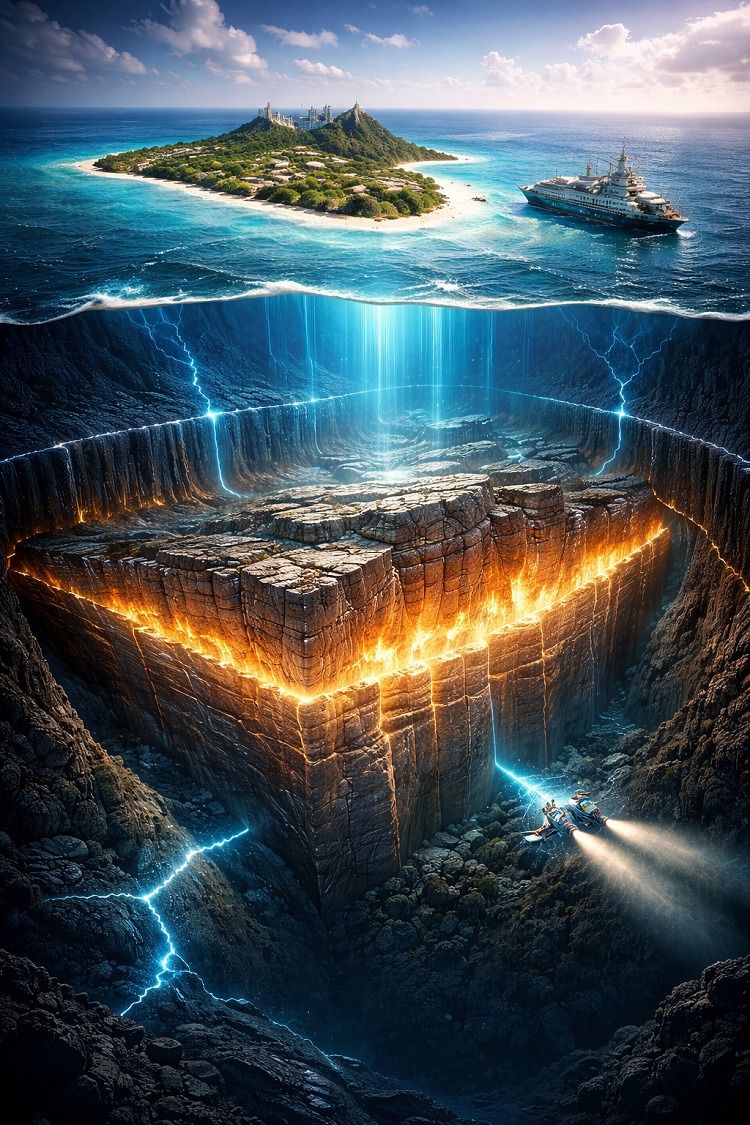
For decades, the Bermuda Triangle has captured the public imagination as a place where ships vanish, aircraft disappear, and explanations drift into the realm of myth. But while those legends continue to circulate, scientists have uncovered a far more astonishing mystery beneath the waves one that has nothing to do with the supernatural and everything to do with the deep structure of our planet.
Researchers studying the geology beneath the island of Bermuda have identified an enormous, previously unknown rock formation buried deep below the ocean floor. The structure, unlike anything documented elsewhere on Earth, could finally explain why Bermuda rises so dramatically from the Atlantic Ocean despite having no active volcano for tens of millions of years.
The discovery reveals a 20-kilometer-thick (12.4-mile) layer of rock lodged beneath the oceanic crust, lifting the island roughly 500 meters (1,640 feet) above the surrounding seabed. According to the scientists who made the finding, no other geological feature of this size and type has ever been observed in a comparable setting.
A Geological Puzzle Hidden in Plain Sight
Bermuda sits atop what geologists call an oceanic swell a broad, elevated region of oceanic crust that rises higher than the surrounding seafloor. Typically, these swells are associated with volcanic hotspots, such as the one responsible for the Hawaiian Islands. In those cases, hot material rises from deep within the Earth’s mantle, melts its way upward, and pushes the crust above it into a dome-like shape.
The problem is that Bermuda doesn’t fit this pattern.
There is no evidence of active volcanism on the island, and geological records show that the last eruption occurred more than 31 million years ago. Any uplift caused by volcanic activity should have slowly subsided over that immense span of time. Yet Bermuda remains stubbornly elevated, standing out in the middle of the Atlantic as a geological anomaly.
For years, scientists were unable to explain why.
Listening to Earth’s Deep Echoes
The breakthrough came when researchers began examining how seismic waves the vibrations generated by earthquakes—travel beneath Bermuda. Using data from a seismic monitoring station on the island, the team tracked waves produced by powerful earthquakes occurring thousands of miles away.
As these waves passed through the Earth’s interior, they behaved strangely beneath Bermuda. Instead of moving in smooth, predictable paths, some waves slowed down, bent, or changed direction entirely an unmistakable sign that they were passing through material with different physical properties than expected.
By carefully analyzing these distortions, scientists were able to map a massive, low-density layer of rock sandwiched between the oceanic crust and the mantle below.
Dr. William Frazer, a seismologist at Carnegie Science and one of the study’s authors, explained that this discovery rewrites expectations about oceanic crust structure.
“Normally, you would expect the oceanic crust to sit directly on top of the mantle,” Frazer said. “But beneath Bermuda, there is an additional layer embedded within the tectonic plate itself. That is highly unusual.”
A Frozen Raft of Ancient Magma
According to the researchers, the mysterious layer likely formed when molten rock surged upward during Bermuda’s last volcanic episode. Instead of erupting fully to the surface, this magma became trapped within the crust, spreading outward and cooling into a vast, buoyant slab.
Because this rock is less dense than the surrounding material, it acts like a geological raft pushing the crust above it upward and keeping Bermuda elevated long after volcanic activity ceased.
This mechanism offers a compelling explanation for why Bermuda’s oceanic swell never collapsed, resolving one of the island’s most enduring scientific mysteries.
A Clue from Earth’s Deep Past
The discovery also sheds light on Bermuda’s unusual chemical composition. Earlier studies of the island’s ancient lava flows revealed low levels of silicon, suggesting that the magma originated from a part of the Earth’s mantle with very low carbon content.
Scientists believe this carbon-poor material may date back to the breakup of the supercontinent Pangea, which began between 900 and 300 million years ago as the Atlantic Ocean slowly opened. During this period, deep mantle material could have risen toward the surface, leaving behind chemical signatures that still persist beneath Bermuda today.
This history sets Bermuda apart from hotspot islands in the Pacific and Indian oceans, which formed above younger ocean basins and follow more familiar geological rules.
Is Bermuda Truly One of a Kind?
The implications of the discovery extend far beyond a single island. Researchers are now investigating whether similar hidden structures exist beneath other oceanic islands—or whether Bermuda is genuinely unique.
If comparable layers are found elsewhere, it could force scientists to rethink long-held assumptions about how oceanic crust evolves over geological time. If not, Bermuda may represent an extreme example of processes that usually occur on a much smaller scale.
“Studying an extreme case like Bermuda helps us understand what’s normal,” Dr. Frazer explained. “It allows us to distinguish between everyday geological processes and the rare events that reshape entire regions of the planet.”
A Scientific Mystery Bigger Than the Triangle
While the public tends to associate Bermuda with mysterious disappearances, geologists argue that the island’s real enigma lies deep underground, not in the skies or seas above it.
Shipwrecks like the famous SS Sapona fuel legends of the Bermuda Triangle, but scientists maintain that these incidents are better explained by natural ocean phenomena rather than paranormal forces.
Oceanographer Dr. Simon Boxall of the University of Southampton has pointed to rogue waves massive, unpredictable walls of water as a likely cause of many maritime disasters in the region. These waves can reach heights of up to 30 meters (100 feet) and strike suddenly, often from unexpected directions.
“A large vessel hit by a rogue wave could sink in minutes,” Boxall said, noting that such events leave little time for distress signals or evidence.
Redefining Bermuda’s Legacy
The discovery of a colossal, hidden structure beneath Bermuda reframes the island’s reputation. Instead of a supernatural danger zone, Bermuda may be one of the most geologically fascinating places on Earth a natural laboratory revealing how ancient forces still shape the planet today.