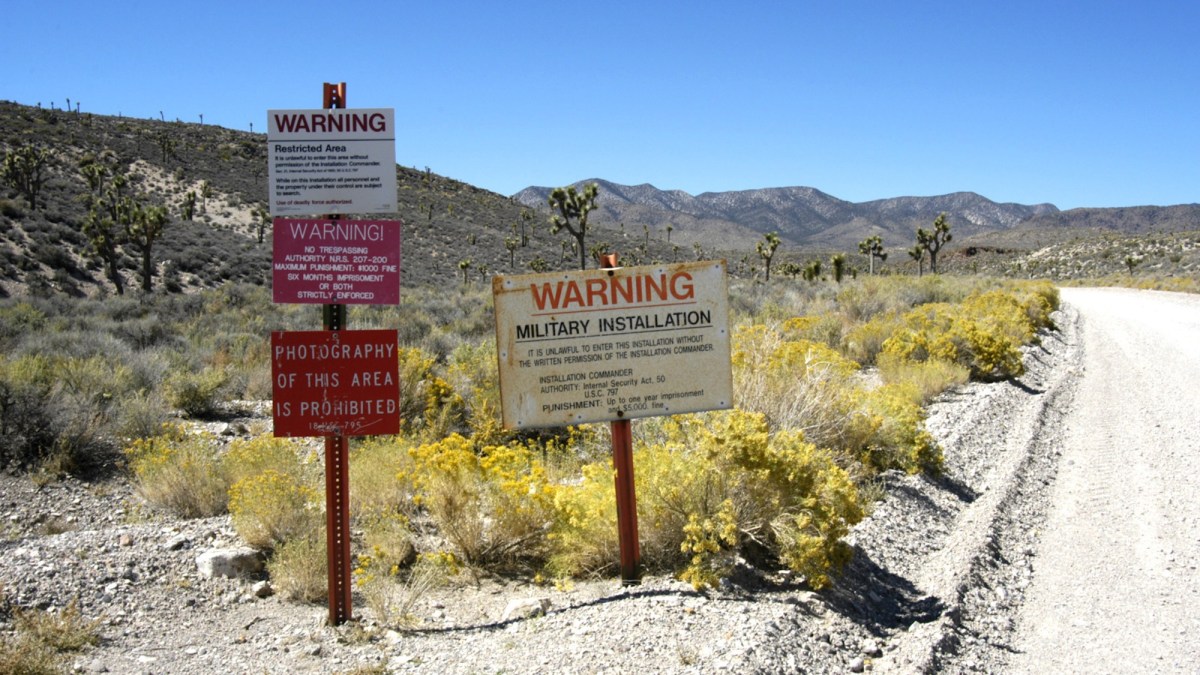

Something strange is happening underneath Area 51. According to United States Geological Survey data earlier this week, over 100 people have reported at least 17 earthquakes within the span of only 24 hours not far from the infamous, highly classified military base. The comparatively shallow events about 2.5 miles below the ground ranged between 2.5 and 4.4 in magnitude, with the strongest reportedly recorded in “an unusual place to get an earthquake,” according to geophysicist Stefan Burns.
Conspiracy theories are already spreading online about aliens, UFOs, and other spooky phenomena, but one hypothesis at least initially sounds more plausible and unnerving. Based on the region’s past along with recent domestic policy reversals, there is technically a not-zero chance that the U.S. re-started underground nuclear tests. That said, don’t go racing to the underground bunkers just yet.
What is Area 51?
Disregarding sensational extraterrestrial rumors, Area 51 operated for decades as the national nexus of cutting-edge weapons development and experimental aircraft engineering. Located inside the Nevada Test and Training Range about 83 miles northwest of Las Vegas, the facility opened in 1955 at the direction of the Central Intelligence Agency for Project AQUATONE. The endeavor culminated in the construction of the Lockheed U-2 reconnaissance aircraft and marked a major moment in the Cold War.Later covert onsite operations included the development of the A-12 spy plane, F-117 Nighthawk, and the D-21 drone. Area 51 earned its reputation as a UFO hotspot largely due to decades of these stealth aircraft test flights, whose inexplicable speeds and maneuvering capabilities often confounded unexpecting onlookers.
If all that weren’t enough, Area 51 shares a border with Yucca Flat, which the U.S. military used for years to test dozens of nuclear weapons. While many were above ground, researchers soon realized the comparatively safest method was subterranean detonations, since it greatly reduced exposure to atmospheric radioactive fallout. In 1951, engineers detonated the first underground nuclear weapon—1.2 the kiloton “Buster-Jangle Uncle”—17 feet below ground level. After over a decade of rising geopolitical tensions, the U.S., U.K, and U.S.S.R. signed the Limited Test Ban Treaty in 1963 to prohibit any further above-ground nuclear development. The deepest nuclear test ever recorded in the U.S. took place at a depth 6,000 feet beneath Camchika, Alaska, in 1971.
The last nuclear explosion in the U.S. occurred in 1992, and the Comprehensive Nuclear-Test-Ban Treaty of 1996 virtually ended all sanctioned weapons advancements among world superpowers. Since its signing, only 16 confirmed detonations have been recorded from the non-signatory nations of India, Pakistan, and North Korea. Despite these, armed nations have dramatically reduced their nuclear stockpiles.
Don’t panic
President Donald Trump has repeatedly expressed interest in restarting domestic underground tests, and the last remaining nuclear arms treaty between the U.S. and Russia expired in February 2026. However, that’s easier said than done. From a simple logistical standpoint, reversing nearly 40 years of global precedent would require at least 36 months of prep time at the Nevada Test Site, and Trump most recently commented on the subject in October 2025. Then there’s the Comprehensive Nuclear-Test-Ban Treaty Organization (CTBTO) itself. Formed in conjunction with the treaty, the multinational project constantly monitors for any new nuclear detonations—and its equipment is extremely sensitive.
“The CTBTO’s International Monitoring System (IMS) is capable of detecting nuclear test explosions with a yield equivalent to or greater than approximately 500 tonnes [492 tons] of TNT,” CTBTO executive director Robert Floyd explained shortly after the Russia–U.S. treaty expired in February. “Below 500 tonnes is roughly three percent of the yield of the explosion that devastated Hiroshima.”
While underground nuclear detonations are more difficult to flag, it’s certainly not impossible. Past research shows advanced signal detection technology can also pinpoint a 1.7 ton buried explosion with 97 percent accuracy.
“It’s almost certainly not nukes lol,” Martin Pfeiffer, a semiotic anthropologist and nuclear weapons researcher, wrote to Popular Science. “Nukes have a relatively distinctive seismic signal.” He added the nuclear option is also unlikely because the U.S. typically detonated underground nukes at very shallow depths.
So, while certainly dramatic, the odds that the U.S. suddenly detonated over a dozen nuclear devices underground near Area 51 this week are extremely low. That said, the jury that means the still out on the extraterrestrial theory…

2025 PopSci Best of What’s New