
Tensions between Moscow and Kyiv escalated sharply this week after Russia accused Ukraine of launching a large-scale drone attack against a residence associated with President Vladimir Putin an allegation Ukrainian officials have categorically denied. The claim has emerged at a sensitive moment, as diplomatic efforts aimed at ending the nearly three-year war appear increasingly fragile ahead of high-level discussions involving former U.S. President Donald Trump.
According to Russian authorities, Ukrainian forces launched an overnight drone assault targeting a presidential residence in Russia’s Novgorod region, deploying what Moscow claims were 91 long-range unmanned aerial vehicles. Russian air defense systems allegedly intercepted all the drones before they could reach their intended targets. The Kremlin swiftly labeled the incident a “terrorist act,” arguing it undermines already tenuous prospects for peace negotiations.
The accusation threatens to derail momentum surrounding a proposed ceasefire framework, particularly as Ukrainian President Volodymyr Zelenskyy pushes a 20-point peace plan that directly counters elements of a broader 28-point proposal advanced by Trump’s team before Thanksgiving. Zelenskyy was expected to discuss the plan in detail during a face-to-face meeting with Trump at Mar-a-Lago, a visit the Ukrainian leader has described as part of some of the most intense diplomatic activity of the year.
Russia’s Allegations and Kremlin Response
The Russian Defense Ministry claimed the drones were launched early Monday morning and were directed toward a state-owned residence in the Novgorod region, which the Kremlin identifies as one of several properties linked to Putin’s official use. While Russian officials did not say whether Putin was present at the site during the alleged attack, they emphasized the symbolic gravity of targeting a presidential facility.
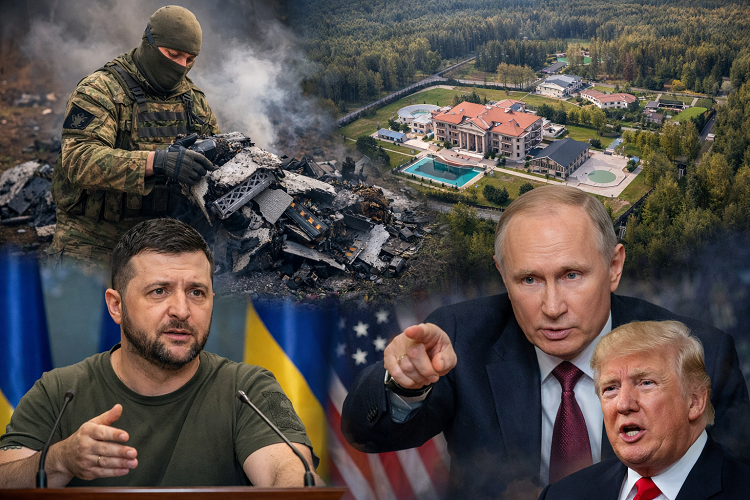
Footage released by the ministry showed a masked Russian soldier standing beside what was described as drone debris. Officials claimed the recovered drone carried a high-explosive warhead filled with shrapnel-like components intended to maximize damage, potentially endangering civilians.
Kremlin spokesperson Dmitry Peskov said the alleged strike was designed to sabotage diplomatic efforts. Speaking to reporters, Peskov warned that the incident would inevitably harden Moscow’s stance at the negotiating table.
“This was a deliberate attempt to collapse the negotiation process,” he said. “The diplomatic consequence will be a tougher negotiating position from the Russian Federation.”
Russian officials have framed the episode as further evidence that Kyiv cannot be trusted in talks, a narrative Moscow has repeatedly used throughout the conflict to justify military escalation or delays in diplomacy.
Ukraine Flatly Rejects the Claims
Ukrainian leaders swiftly and forcefully rejected Russia’s account, calling it fabricated and politically motivated. Foreign Minister Andrii Sybiha said Moscow had provided no credible evidence to support its claims and accused the Kremlin of deploying a familiar tactic.
“Russia has a long record of false accusations this is their signature approach,” Sybiha wrote on social media. “There is no proof because there is no attack.”
Zelenskyy echoed that sentiment, telling reporters that Ukrainian officials had reviewed the allegation with U.S. counterparts. According to Zelenskyy, American intelligence capabilities allowed Washington to assess the claims independently.
“They’ve gone through the details,” Zelenskyy said. “We understand it’s fake. Thanks to their technical capabilities, they can verify that it’s fake.”
Kyiv argues that the accusation fits a broader Kremlin playbook: using unverified or false claims to justify future military action or to portray Russia as a victim just as diplomatic pressure mounts. Ukrainian officials have warned that Moscow may use the alleged incident as pretext for renewed strikes on Ukrainian cities or government buildings, including potential attacks on Kyiv.
Peace Proposals at a Crossroads
The timing of the allegation is particularly sensitive given the competing peace frameworks currently under discussion. Zelenskyy’s 20-point proposal calls for Western-backed security guarantees similar to NATO’s Article 5, an immediate halt to hostilities along existing front lines, and the establishment of internationally monitored demilitarized zones.
The plan also firmly rejects recognizing Russian sovereignty over occupied Ukrainian territory a core demand Moscow has insisted upon and a point where Zelenskyy’s proposal diverges sharply from elements of the U.S.-backed framework floated by Trump’s team.
Moscow has long opposed international peacekeeping forces or security guarantees that would bind Western nations to Ukraine’s defense, viewing such measures as unacceptable infringements on Russian security interests.
Trump Drawn Into the Dispute
The controversy has also pulled Trump directly into the dispute. After meeting with Zelenskyy in Florida, Trump later spoke by phone with Putin, who raised the alleged drone incident during their conversation.
Trump told reporters he was angered by the situation but emphasized that the facts were still being reviewed.
“I was very angry about it,” Trump said. “We’ll find out what really happened.”
Matthew Whitaker, the U.S. ambassador to NATO, confirmed that Washington is examining Russia’s claims. Speaking on Fox Business, Whitaker said intelligence agencies are working to determine whether the alleged attack occurred at all.
“It’s unclear whether it actually happened,” Whitaker said. “We’re going to get to the bottom of the intelligence.”
A Familiar Pattern, Critics Say
Analysts and former defense officials have suggested the episode bears hallmarks of past Kremlin narratives used during critical diplomatic moments. Roger Zakheim, a former Pentagon official, described the situation as emblematic of Putin’s negotiating style.
“This is classic Putin,” Zakheim said, arguing that accusations like these are often used to gain leverage or to shift blame as talks approach a critical stage.
Whether the incident proves real or fabricated, its impact is already being felt. The dispute has injected fresh mistrust into an already fragile diplomatic environment, raising questions about whether upcoming talks including Zelenskyy’s engagement with Trump can produce meaningful progress.
As both sides dig in, the alleged attack underscores the deep skepticism and hostility that continue to define the conflict. With competing peace plans, escalating rhetoric, and unresolved claims hanging over the negotiations, hopes for a breakthrough appear increasingly uncertain as the war drags into another year.