
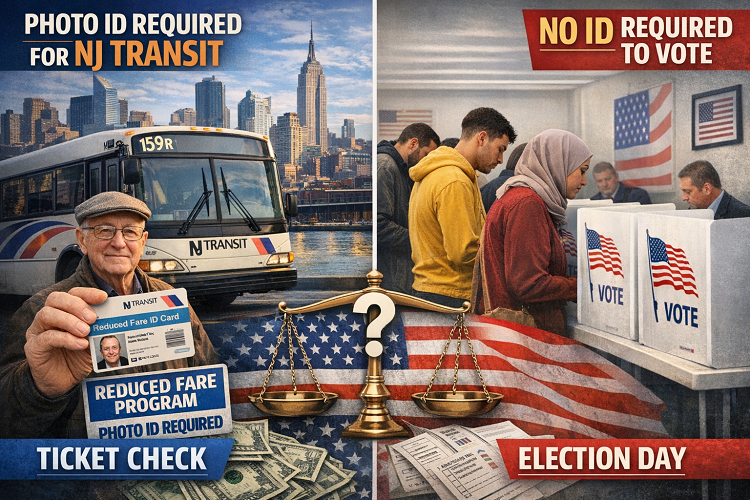
As the New Year begins, Democratic-led states are once again at the center of a heated national debate over identification requirements, fraud prevention, and government priorities. A growing controversy highlights what critics call a glaring inconsistency: states that do not require photo identification to vote are now demanding it for reduced public transportation fares. At the same time, Minnesota is struggling to contain a widening fraud scandal involving taxpayer-funded programs, further intensifying scrutiny of oversight failures in blue states.
Together, these developments have reignited questions about whether access is being prioritized over accountability and whether that balance is being applied evenly across public systems.
New Jersey Introduces Photo ID Requirement for Reduced Transit Fares
Starting January 1, New Jersey Transit (NJ Transit) will require riders seeking reduced-fare tickets to present a photo identification card issued by the agency. Reduced fares are typically available to senior citizens, people with disabilities, military personnel, and other qualifying individuals. Under the new policy, all existing non-photo reduced-fare ID cards will become invalid.
Riders must now apply for the updated ID card online, by mail, or in person. The application process requires proof of age or disability, along with a recent photograph. NJ Transit officials emphasized that the new photo ID will be issued free of charge and is designed to prevent misuse of discounted fares.
While transportation officials describe the change as a practical step to curb fraud, critics argue it exposes a contradiction in state policy—particularly when compared with New Jersey’s election laws.
Voting Without Photo ID Remains the Norm in New Jersey
Despite the new transit requirement, New Jersey remains one of only 14 states that do not require voters to present photo identification at polling places. When registering to vote, residents are asked to provide a driver’s license number. However, those without one may still register and vote using alternative documentation.
In many cases, voters who lack a driver’s license can present a utility bill, bank statement, paycheck, or government-issued document—many of which do not include a photograph. First-time voters who did not include identification information on their registration may be asked for ID at the polls, but the standards remain far less stringent than those now required for discounted train and bus rides.
This contrast has become a focal point for critics who argue that elections should be subject to at least the same level of verification as state-subsidized transit programs.
Minnesota Fraud Scandal Adds Fuel to the Debate
The controversy in New Jersey is unfolding alongside a major fraud investigation in Minnesota, another Democratic-controlled state. Minnesota officials are grappling with allegations that millions of dollars in public subsidies were improperly paid to organizations that were insufficiently vetted. Many of the groups under scrutiny are reportedly tied to Somali-led nonprofits and interests, raising questions about oversight and verification processes.
The investigation has drawn national attention, particularly after former White House press secretary Karoline Leavitt vowed accountability for those involved. “People will be in handcuffs,” she said, a remark that resonated with critics who believe lax controls in blue states create opportunities for abuse across multiple systems.
For opponents of relaxed voter ID laws, Minnesota’s situation serves as a cautionary example of what can happen when safeguards are weakened.
Online Backlash Highlights Public Frustration
Public reaction to New Jersey’s new transit ID policy has been swift and vocal, particularly on social media. The issue gained traction after Shore News Network published a headline noting that photo ID would be required for reduced fares but not for voting.
“This is how ridiculous Democrat-run states are,” one user wrote on X. “Beginning January 1, a photo ID will be required for the Reduced Fare Program, but it is still not required to vote.”
Others echoed similar sentiments, arguing that such policies undermine confidence in elections and fuel perceptions of unfairness. Some went further, accusing state leaders of maintaining lax voting laws for political advantage.
Watchdog Groups Question State Priorities
Several good-governance and advocacy organizations also weighed in on the issue. The New Jersey Project, a volunteer watchdog group, criticized the state’s priorities in a pointed statement: “Photo ID needed for NJ Transit discounts but not for voting. Priorities, Trenton?”
Another group, Wake Up NJ, highlighted the inconsistency between arguments used against voter ID laws and the state’s new transit policy. State officials have frequently claimed that voter ID requirements disenfranchise minorities and low-income residents who may struggle to obtain identification.
“If that argument holds,” critics ask, “why is it acceptable to require photo ID for transit discounts used by seniors and the disabled?”
Media Commentary Adds to the Pressure
Local media outlets and political blogs have added to the criticism. New Jersey News pointed out that the same populations cited as vulnerable in voter ID debates are also the primary users of reduced-fare transit programs.
“State leaders say voter ID laws disenfranchise minorities,” the outlet wrote. “Guess they won’t be riding the train either.”
Such commentary has amplified pressure on state officials to explain why identification standards differ so sharply between elections and other public services.
Significant Financial Savings Drive Transit Oversight
Supporters of the NJ Transit policy argue that the potential for abuse justifies stricter oversight. Reduced fares offer substantial savings. A short “Zone 1” bus trip costs just 85 cents with a reduced-fare ID, compared to the standard $1.85 fare.
For longer trips, the difference is even more pronounced. A “Zone 3” trip into the suburbs near New York City drops from $5.30 to $2.40 for reduced-fare riders. On NJ Transit’s limited-stop service along the Garden State Parkway, a full-fare ticket from New York to Atlantic City can cost more than $46. With a reduced-fare ID, that price falls to just over $20.
Officials say such discounts make photo ID verification necessary to protect taxpayer-funded programs. Critics counter that if financial integrity matters for transit, it should matter even more for elections.
Calls Grow for Consistency in Public Policy
Fox News Digital reached out to the New Jersey Secretary of State’s office, which oversees elections, seeking comment on the apparent inconsistency between transit and voting ID requirements. As of publication, no response had been provided.
As Minnesota continues its fraud investigation and New Jersey enforces new identification rules for transit riders, the broader debate over voter ID laws shows no signs of fading. Critics warn that perceived double standards risk eroding public trust, particularly as the nation approaches another contentious election cycle.
A Symbol of a Larger National Divide
What began as a transit policy update has become a symbol of a deeper political divide. For many Americans, the idea that photo identification is required to save money on a train ride but not to vote raises fundamental questions about governance, accountability, and fairness.
As blue states navigate these challenges, the tension between accessibility and security remains unresolved. For now, the controversy serves as a stark reminder that even everyday policies can become flashpoints in America’s ongoing debate over trust in public institutions.