
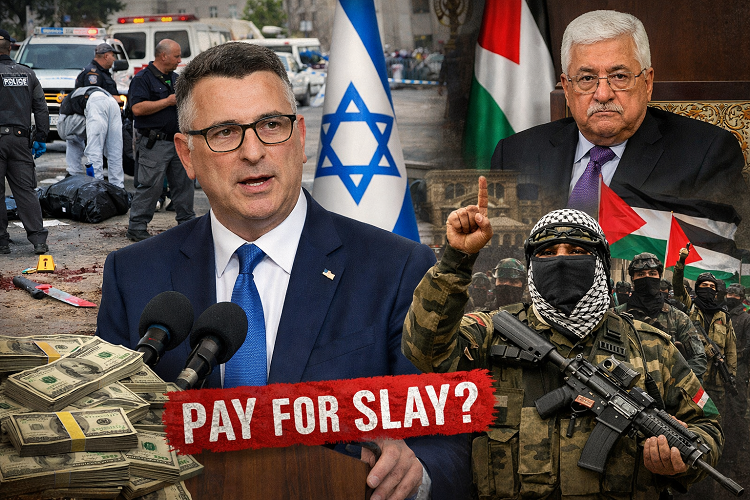
Israel’s Foreign Minister Accuses Palestinian Authority of Fueling Terrorism Through ‘Pay-for-Slay’ Policy After Fatal Attack
Israel’s foreign minister, Gideon Sa’ar, has issued a fierce condemnation of the Palestinian Authority (PA), accusing its leadership of actively encouraging terrorism through its long-criticized “Pay-for-Slay” program following a deadly attack that claimed the lives of two Israeli civilians.
The remarks came in the aftermath of a violent incident on Friday in northern Israel, where a Palestinian assailant carried out a combined car-ramming and stabbing attack. The victims were identified as 19-year-old Aviv Maor from Kibbutz Ein Harod and 68-year-old Mordechai Shimshon from Beit She’an. Israeli security forces quickly responded to the scene in the city of Afula, launching an investigation and reinforcing patrols amid heightened security concerns.
Speaking publicly after the attack, Sa’ar accused the Palestinian Authority of bearing indirect responsibility by continuing financial policies that reward convicted terrorists and the families of attackers. He argued that these payments serve as a powerful incentive for violence, undermining any genuine effort toward peace or stability in the region.
Renewed Focus on ‘Pay-for-Slay’
At the center of Israel’s criticism is the PA’s long-standing system of stipends paid to Palestinians imprisoned for terrorism-related offenses, as well as to the families of those killed or injured while carrying out attacks against Israelis. The payments, often scaled according to the length of a prison sentence, have been condemned by Israel, the United States, and several Western governments, who argue that the policy effectively glorifies violence.
The issue gained widespread international attention following the 2016 killing of Taylor Force, a 28-year-old U.S. Army veteran and West Point graduate. Force was stabbed to death by a Palestinian terrorist while visiting Tel Aviv as part of an MBA program at Vanderbilt University. In response, the U.S. Congress passed the Taylor Force Act in 2018, signed into law by then-President Donald Trump, which restricted American economic assistance to the Palestinian Authority unless the payments were ended.
Despite repeated assurances from Palestinian officials over the years that the policy would be reformed or abolished, Israeli officials insist the payments continue under different names and bureaucratic structures.
Sa’ar Warns International Community
Even before Friday’s attack, Sa’ar had issued pointed warnings to the international community, accusing Palestinian Authority President Mahmoud Abbas of deception. In a post on social media, Sa’ar urged foreign governments not to be misled by claims of reform, asserting that payments to terrorists, released prisoners, and their families are ongoing.
According to Sa’ar, the PA has merely repackaged the system, allegedly transferring funds through alternative institutions and reclassifying recipients as pensioners or welfare beneficiaries within the Palestinian security services. “This distortion must end,” Sa’ar wrote, calling on donor nations to demand full transparency and accountability.
Mahmoud Abbas, now 90 years old, has led the Palestinian Authority for nearly two decades. While he has publicly condemned attacks on civilians and claimed to oppose terrorism, critics argue that his government’s financial policies tell a different story.
Experts Cast Doubt on Claimed Reforms
Security analysts in Israel have echoed Sa’ar’s accusations. Kobi Michael, a senior researcher at Israel’s Institute for National Security Studies and a fellow at the Misgav Institute for National Security and Zionist Strategy, told reporters that there has been no substantive change in PA policy regarding payments to terrorists.
“They are creating the impression of reform, but it is largely cosmetic,” Michael said. He described the changes as a “façade” designed to placate international donors while preserving the core incentive structure. According to Michael, the payments are now more difficult to track, making oversight by foreign governments and aid organizations increasingly challenging.
Michael added that the Palestinian Authority continues to frame convicted attackers as social welfare cases rather than perpetrators of violence, a narrative he believes perpetuates incitement against Israel and discourages genuine reform.
Palestinian Authority Pushes Back
The Palestinian Authority has rejected Israel’s accusations. A PA-linked organization, the Palestinian National Economic Empowerment Institution, also known as Tamkeen, issued a statement in December disputing claims that “Pay-for-Slay” remains in effect.
Tamkeen asserted that the system linking payments to the length of prison sentences has been “completely and permanently abolished” and accused Israeli officials of spreading deliberate misinformation. The organization insisted that any current assistance programs are based solely on economic need, not criminal activity.
Repeated requests for comment from Palestinian Authority officials went unanswered, as did inquiries sent to Tamkeen seeking clarification on the structure and oversight of the payments.
International Pressure and Political Fallout
The controversy has intensified amid broader geopolitical developments. Several Western European countries moved in 2025 to recognize an independent Palestinian state, a decision that Israeli officials and security experts say was made without sufficient safeguards against terrorism sponsorship.
Michael sharply criticized European leaders, arguing that recognition without conditions only emboldens the Palestinian Authority to maintain controversial policies. He singled out the leaders of the United Kingdom, France, and Spain, accusing them of prioritizing political symbolism over accountability.
In contrast, Michael praised the Trump administration’s approach, describing it as the only U.S. government to apply sustained financial pressure on the PA over terrorism-related concerns.
Hamas, Gaza, and the Wider Conflict
Israeli officials have also warned that failure to dismantle Hamas, the U.S.-designated terrorist organization that controls Gaza, will further destabilize the region. Michael argued that allowing Hamas to remain armed would represent a strategic victory not only for the group itself but also for the broader network of militant organizations operating under the Palestinian political umbrella.
Images of armed militants parading openly in West Bank refugee camps continue to alarm Israeli authorities, who say such displays underscore the depth of the problem.
Silence from Washington
As the debate escalates, U.S. officials have remained largely silent. The State Department and the American Embassy in Jerusalem did not immediately respond to media inquiries regarding the latest attack or Israel’s accusations against the Palestinian Authority.
For Israel, the issue remains existential. Officials argue that as long as financial rewards for violence exist—whether openly or covertly—terrorism will continue to claim lives. Friday’s deadly attack, they say, is the latest tragic reminder of the human cost of political inaction and unresolved accountability.
As tensions rise, Israel is urging the international community to move beyond statements of concern and adopt concrete measures to ensure that foreign aid does not, directly or indirectly, incentivize violence. Whether those calls will result in meaningful change remains uncertain.