
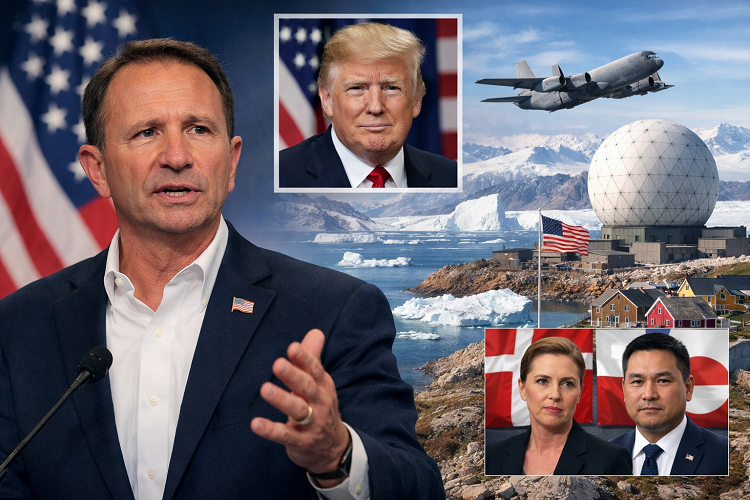
The Trump administration’s newly appointed special envoy to Greenland has sought to ease international tensions following renewed debate over America’s strategic interest in the Arctic territory, emphasizing that Washington is not pursuing conquest or annexation, but rather dialogue and cooperation with Greenland’s people.
Louisiana Governor Jeff Landry, who was named U.S. special envoy to Greenland by President Donald Trump over the weekend, addressed the controversy during a Tuesday appearance on Fox News’ “The Will Cain Show.” In his remarks, Landry underscored that the administration’s approach centers on listening to Greenlanders and understanding their priorities, while also strengthening U.S. national security interests in the rapidly changing Arctic region.
“The most important thing is having conversations with the people who live there,” Landry said. “What are they looking for? What opportunities have they not been given? Why haven’t they received the level of protection and investment that they deserve?”
Landry’s comments came amid sharp criticism from Danish officials, who have reacted strongly to Trump’s decision to appoint a special envoy to Greenland and to his repeated public statements suggesting the island is vital to U.S. security. Greenland is an autonomous territory within the Kingdom of Denmark, and any suggestion of U.S. control has historically been a sensitive diplomatic issue.
Emphasizing Dialogue, Not Takeover
Landry was careful to stress that the administration is not seeking to impose its will on Greenland or undermine Danish sovereignty. According to the envoy, the United States has no intention of “conquering” the Arctic island or forcibly changing its political status.
“The United States has always been a welcoming partner,” Landry said. “We are not going in there trying to conquer anybody. We’re not going to take over anybody’s country. That’s simply not what this is about.”
Instead, Landry framed the initiative as a diplomatic and strategic effort to deepen engagement with Greenlanders themselves, particularly as global interest in the Arctic increases due to climate change, new shipping routes, and competition among major powers such as Russia and China.
Expanding ties with Greenland, Landry argued, presents both national security benefits and economic opportunities, including infrastructure development, energy cooperation, and stronger defense partnerships.
Strategic Importance of Greenland
Greenland occupies a critical position in the Arctic, sitting between North America and Europe. The island hosts a key U.S. military presence at Pituffik Space Base (formerly Thule Air Base), which plays a major role in missile warning systems, space surveillance, and Arctic defense operations.
Trump has long emphasized Greenland’s strategic value. In a post on Truth Social earlier this week, the president wrote that Landry “understands how essential Greenland is to our National Security” and would “strongly advance our Country’s Interests for the Safety, Security, and Survival of our Allies, and indeed, the World.”
The administration recently moved a major Greenland military installation under U.S. Northern Command, a shift widely viewed as signaling an increased focus on Arctic defense amid growing geopolitical competition in the region.
Supporters of stronger U.S.–Greenland ties argue that the island’s location makes it indispensable for monitoring transpolar threats, securing Arctic sea lanes, and countering the expanding military presence of rival nations.
Danish Leaders Push Back
Despite assurances from Landry, Danish leaders reacted forcefully to the envoy’s appointment and to Trump’s rhetoric surrounding Greenland.
In a joint statement released Monday, Danish Prime Minister Mette Frederiksen and Greenlandic Prime Minister Jens-Frederik Nielsen reiterated that Greenland’s status is not open for negotiation.
“We have said it before, and we say it again: national borders and the sovereignty of states are rooted in international law,” the statement read. “These are fundamental principles. You cannot annex another country not even under the argument of international security.”
The statement reflects long-standing Danish concerns that U.S. discussions about Greenland risk undermining the island’s autonomy and Denmark’s sovereignty, even if framed in terms of cooperation or security.
Danish Foreign Minister Lars Løkke Rasmussen escalated the response on Tuesday, calling Trump’s remarks “completely unacceptable” and announcing that he would summon the U.S. ambassador for an explanation.
“The Danish kingdom is sovereign,” Rasmussen wrote on Facebook. “We cannot accept that others question this sovereignty.”
Trump’s Past Remarks Resurface
The controversy has been fueled in part by President Trump’s previous public statements about Greenland. In December 2024, Trump posted on Truth Social that “ownership and control of Greenland is an absolute necessity” for U.S. national security, reviving a debate that first gained global attention during his earlier presidency.
In another post from January 2025, Trump praised Greenland as an “incredible place” and suggested its residents would “benefit tremendously if, and when, it becomes part of our Nation,” before adding the slogan, “MAKE GREENLAND GREAT AGAIN!”
Those remarks, while popular among some of Trump’s supporters, have repeatedly drawn criticism from Danish officials and raised questions among international observers about the administration’s long-term intentions.
Intelligence Concerns Add to Tensions
Relations between Washington and Copenhagen have also been strained by recent media reports suggesting U.S. intelligence agencies conducted covert operations in Greenland. While details remain limited, Danish leaders have expressed concern over alleged surveillance activities, with Frederiksen previously stating that “you cannot spy against an ally.”
These reports have added another layer of mistrust at a time when diplomatic messaging has become increasingly sensitive.
Looking Ahead
Despite the diplomatic friction, Landry said he remains optimistic that constructive engagement is possible. He emphasized that listening to Greenlanders and respecting existing international frameworks will be central to his role as envoy.
“The people of Greenland deserve to be heard,” Landry said. “Any conversation about the future of the Arctic has to include them first and foremost.”
As climate change accelerates Arctic transformation and global powers compete for influence in the region, Greenland is likely to remain at the center of strategic discussions. Whether the Trump administration can balance its security ambitions with diplomatic realities remains an open question.
For now, Landry’s message appears aimed at calming immediate concerns: the United States, he insists, is seeking partnership not possession.