
CRANBERRY TOWNSHIP, Penn. — In the days leading up to this first-round bout, Sidney Crosby had tried to put it into words. The mercurial, indescribable feeling that comes with first stepping into the chaos of playoff hockey.
“You’ve got to prepare as best you can, but until you’ve actually experienced it, there’s only so much you can do to try to prepare,” the Pittsburgh Penguins captain had said. “Anybody who’s played in the playoffs, you remember that first game, that’s for sure. You remember that first shift, that first period — those tend to stick out.”
Amid all the weathered experience and trophy-laden resumés housed in the Penguins’ locker room, for one member of the squad in particular, it’s felt especially novel.
Rookie Ben Kindel wasn’t even alive the first time Crosby played in a playoff game. The young Penguin was in fact born on the same day his captain was eliminated from his first post-season series — 19 years ago today — a Game 5 loss to Ottawa in April 2007.
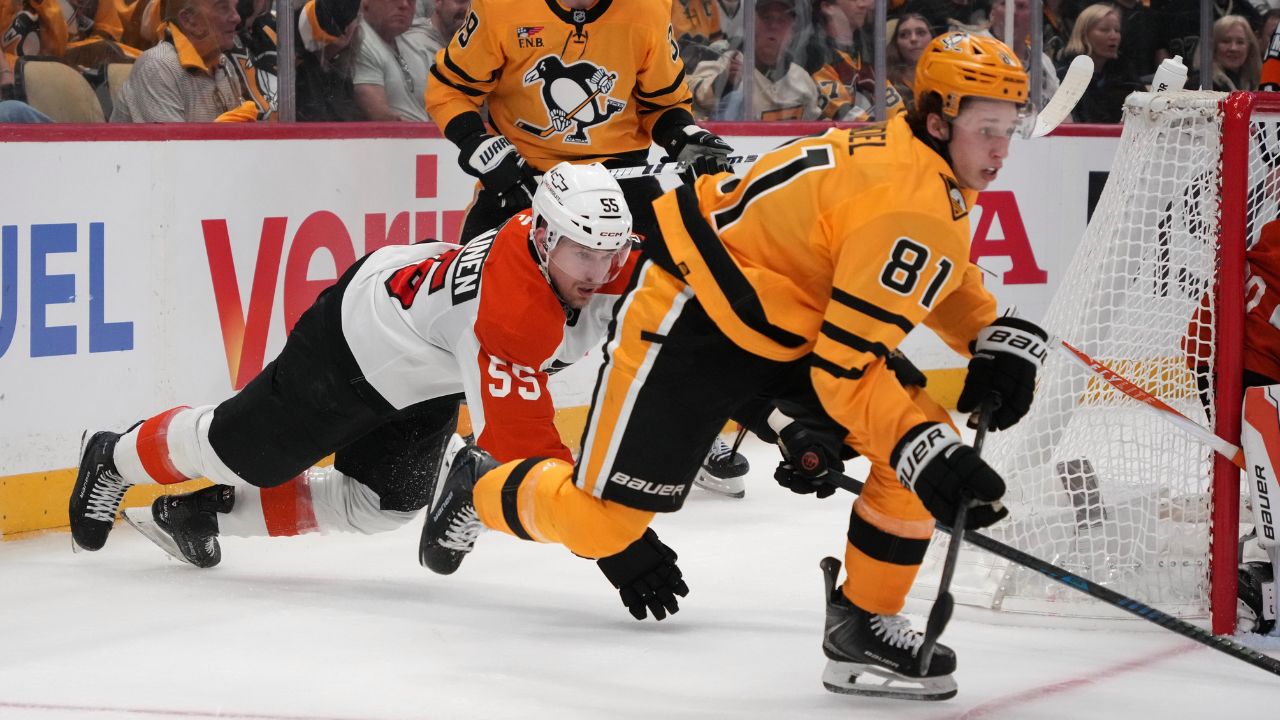
On Saturday, the teenager got his first taste of the chaos himself, as the Penguins and Philadelphia Flyers waded through a hard-fought Game 1 to open their first-round series. He got his first experience of the frenzy around the playoffs, too — the raucous crowd filling the PPG Paints Arena stands, the 18,000 golden towels waving in unison, the larger-than-life cut-outs of his own face plastered against the glass as he skated out for warmups.
“It was a great experience,” the birthday boy said Sunday, fresh off an hour-long skate at the Penguins’ practice facility. “I mean, it was very intense. Very fun to play in that game. The crowd was great, brought a lot of energy to the building. Just looking forward to the next one.”
For a series so steeped in history, so deeply intertwined with the decades-long rivalry between these two cities and their fanbases, Game 1 was all about the fresh-faced newcomers. On the other side of the sheet, Philadelphia’s own teenage phenom, Porter Martone, wound up the story of the night, the 19-year-old wiring home the eventual game-winner in the dying minutes.
Much has been made of Martone’s immediate impact on the Flyers since joining their group three weeks ago — the Peterborough, Ont., product put up four goals and 10 points in his first nine NHL games to close out the regular season, before coming up with Saturday’s heroics. And while the Penguins’ own teenager impacts the game in a quieter, more nuanced fashion, Kindel has been no less critical to his club’s efforts this season.
Originally not expected to crack the big club at all this year after being tabbed with the 11th-overall pick in the 2025 NHL Draft, Kindel has been a revelation for the Penguins since Day 1 in Pittsburgh. The Coquitlam, B.C., native didn’t necessarily tear up the score sheet in Year 1 as an NHLer, but what he did accomplish in a Penguins sweater was no less impressive, establishing himself as a reliable, everyday centreman in the big leagues and allowing the Penguins to roll out a dangerous third line that played a key role in booking this team’s playoff ticket.
On Saturday night came the next step, the next test, as the Penguins battled through an exceptionally physical opening bout against the Flyers. The five-foot-11, 182-pound Kindel didn’t back down from any of it.
“Obviously it’s a physical game. That’s just how it’s going to be in the playoffs,” he said from the Penguins’ locker room Sunday. “You’ve got to be physical yourself. And I don’t think our team, or myself personally, shied away from that. I think we were on the attack all night as well. So we’ve just got to continue to do that. It’s a long series. We’re going to wear them down.”
If there was any question of whether the youngster would be able to cut it in the grind of the post-season, Kindel put those doubts to bed early in Game 1, roughing it up with Rasmus Ristolainen — who clocks in at six-foot-four, 208 pounds — in the opening minutes of the tilt, after the Flyers defender took down Kindel’s teammate Elmer Soderblom.
“You know, when it comes to the stuff that happens in between whistles, the physicality part, he’s done a pretty good job this year,” Penguins head coach Dan Muse said Sunday. “One, protecting himself, but also being engaged in battles. I mean, he’s going to back up a teammate when the time is necessary. I don’t think he’s going to shy away from that stuff.
“He’s got a full season in the NHL now under his belt, too. I think he’s starting to figure those things out.”
For Kindel, it wasn’t only about defending Soderblom — who’s got four inches and 40 pounds on Ristolainen, and likely would’ve been just fine — it was about sending a message to Pittsburgh’s opponent.
“It doesn’t really matter your size, or the size difference — I think no matter what, you’ve just got to play bigger than you are, and engage physically, and not back down,” Kindel said. “I think that’s important. To show that you’re strong, show the other team that you’re not going to back down. It’s a mental game as well.”
For Pittsburgh, part of that mental game is the question of how much to engage with that physicality against a Flyers team that did well in goading the Penguins into a scrappy Game 1 — a style that benefited the visitors more than the hosts. Then there are the other wrinkles to iron out: how to quell a Flyers team that used its elite transition game to stack breakaways on Stuart Skinner, how to get the Pens’ usually elite power play humming once more, how to generate more offensively in general.
It could be an overwhelming slate for a teenager to keep at the top of his mind heading into Game 2. But Kindel has the advantage of playing alongside some of the game’s most seasoned vets — playoff regulars and Stanley Cup champions.
Kris Letang has played in nearly 30 Game 1’s over the course of his two decades in Pittsburgh, some won, some lost. Regardless, every time, the approach heading into Game 2 has been the same.
“That’s the playoffs. You have to be able to turn the page quick,” the veteran defender said Sunday. “You forget about Game 1. It’s just one game. You have to focus on the aspects you didn’t do well, and build your game from there.”
In his view, that means ramping things up come Monday night.
“I think it’s just to go quick,” he said. “I think we slowed the pace down a little bit in the neutral zone. As defencemen, we can get the red line quicker, transition quicker. … We just have to focus on what we do well. And what worked all year long for us. Which is having a great forecheck, playing with a lot of speed. I think we have to focus on that.”
For Muse, who himself is navigating his first playoff series as an NHL head coach, that even-keeled approach from his veterans has been crucial. So has his group’s short memory.
“The emotions of the playoffs are different, but at the same time, I think throughout the course of the regular season, we moved from one day to the next fairly well. Actually, we did it very well — and we kept getting better at it as the year went on,” Muse said Sunday. “I think in the playoffs, it becomes especially important that you’re ready to turn the page quickly. And that can be coming off a game that you really like, or that can be coming off a game that you don’t like, like last night.
“So, that’s what we had to do. Guys came in, they came ready to work, they had good energy. I thought we got something out of our day today. Now, we move on to tomorrow.”