
Lawmakers divided as president’s bold action ignites renewed debate over war powers, executive authority, and U.S. intervention abroad
By Ashley Oliver
Fox News
Published January 6, 2026 | 8:00 a.m. EST
President Donald Trump’s dramatic authorization of a surprise U.S. military operation inside Venezuela has sparked an intense constitutional and political clash in Washington, reopening long-standing debates about presidential authority, congressional war powers, and America’s role in foreign regime change.
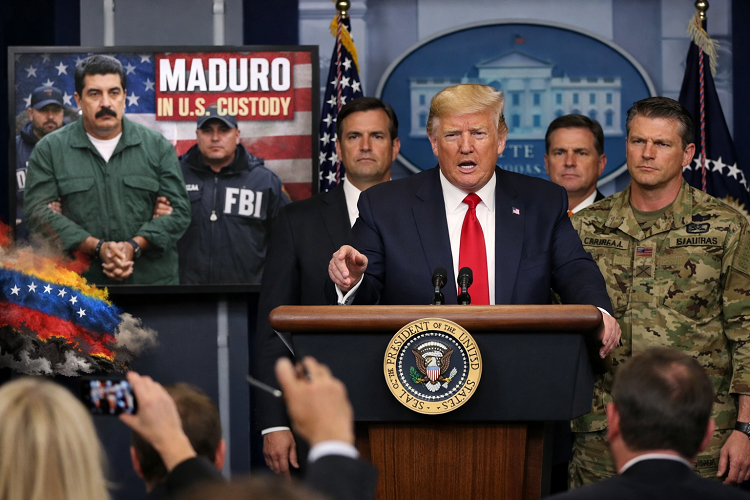
The overnight mission, carried out late Saturday into early Sunday, involved at least seven coordinated U.S. military strikes across Venezuela, including key locations in and around Caracas. The operation culminated in the capture of Venezuelan President Nicolás Maduro and his wife, Cilia Flores. Both were transported to New York, where they now face multiple federal charges, including narco-terrorism conspiracy, cocaine importation, and weapons-related offenses.
A Shock Operation With Global Reverberations
Initial reports indicate the strikes resulted in the deaths of dozens of foreign military and law enforcement personnel aligned with Maduro’s government. The speed, scale, and secrecy of the operation stunned international observers and U.S. lawmakers alike, immediately placing Trump’s decision under intense legal and political scrutiny.
Although presidents from both parties have historically bypassed Congress to launch limited military actions, Trump’s Venezuela operation stands apart due to its ambition and the president’s own remarks afterward. Trump made clear that the mission extended beyond apprehending an indicted foreign leader, openly discussing the United States’ intention to influence Venezuela’s political future and leverage its vast oil resources.
That rhetoric intensified fears among Democrats and some Republicans that the operation could mark the beginning of a prolonged U.S. intervention in South America.
“This wasn’t just about arresting Maduro,” Trump said following the operation. “Venezuela has been destroyed by corruption, and we’re going to make sure it’s run properly.”
Celebration Abroad, Alarm at Home
While Trump’s comments sparked unease in Washington, scenes of celebration unfolded abroad. Thousands of Venezuelans living in exile gathered in Madrid’s Puerta del Sol to celebrate Maduro’s arrest, waving flags and chanting slogans against the former regime. Similar celebrations were reported in Miami and other cities with large Venezuelan expatriate populations.
At home, however, the mood was far more cautious.
Clark Neily, senior vice president at the libertarian CATO Institute, said the initial operation may fall within constitutional limits but warned that Trump’s post-operation rhetoric pushed the boundaries of executive authority.
“The arrest itself could arguably be legal,” Neily said. “But once you talk about regime change, long-term control, or deploying U.S. troops on the ground, that’s a decision the Constitution clearly assigns to Congress.”
The Constitution and the Question of War Powers
Under the U.S. Constitution, Congress alone holds the authority to declare war. Yet presidents have routinely relied on Article II powers to justify military actions deemed necessary to protect U.S. interests or personnel. Neily pointed to President George H.W. Bush’s 1989 invasion of Panama, which resulted in the capture of Manuel Noriega, as a relevant though still controversial precedent.
Supporters of Trump argue that Maduro’s arrest fits within that historical framework.
Sen. Mike Lee, R-Utah, suggested the operation was narrowly focused on protecting U.S. personnel executing an arrest warrant.
“This likely falls within the president’s inherent authority under Article II to protect American forces from imminent threats,” Lee said.
Democrats Push Back With Legislative Tools
Democrats were far less receptive. Sen. Tim Kaine, D-Va., condemned the operation as “illegal” and vowed that Congress would act to prevent further military involvement in Venezuela without explicit authorization.
“There are two levers we intend to use,” Kaine said. “The War Powers Resolution and the power of the purse.”
Kaine said lawmakers plan to advance a bipartisan war powers resolution aimed at blocking additional military action in Venezuela. The measure includes support from Republican Sen. Rand Paul and Senate Minority Leader Chuck Schumer. A similar resolution narrowly failed last year after Trump authorized strikes on Iranian nuclear facilities.
Kaine also warned that Congress could withhold funding for Venezuela-related operations in the upcoming defense appropriations bill, which must be finalized by the end of January.
Concerns Over Venezuela’s Political Future
Adding to congressional unease is Trump’s apparent endorsement of Delcy Rodríguez, Maduro’s longtime deputy, to help oversee Venezuela’s transitional leadership. Kaine criticized the move, predicting Rodríguez would resist U.S. influence and continue authoritarian governance.
Trump issued a blunt warning in a recent interview, stating that if Rodríguez failed to cooperate, she would “pay a very big price probably bigger than Maduro.”
Those remarks heightened fears that the U.S. could become deeply entangled in Venezuela’s internal politics.
Trump Signals Continued U.S. Involvement
During a press conference at his Mar-a-Lago residence, Trump stood flanked by Secretary of State Marco Rubio, Secretary of Defense Pete Hegseth, CIA Director John Ratcliffe, and Joint Chiefs Chairman Gen. Dan Caine.
“These people standing behind me are going to oversee the transition,” Trump said, reinforcing concerns that the U.S. intended to remain heavily involved in Venezuela’s governance.
Rubio later attempted to clarify the administration’s position, emphasizing that the operation was primarily a law enforcement action rather than an act of war.
“This was about capturing an indicted drug trafficker,” Rubio said on “Meet the Press.” “We are not at war with Venezuela. We are at war with drug trafficking organizations.”
Rubio acknowledged that the U.S. intends to push for policy changes in Venezuela but framed those efforts as necessary for American national security.