
The fashion industry is ecologically tacky, to put it mildly. Textile manufacturers guzzle around 200 million liters of water every year, while animal leather generates its own immense environmental burdens. But out of everything we wear on any given day, shoes are some of the most unsustainable accessories. As much as 95 percent of all footwear ends up in landfills, where all that rubber, plastic, and foam takes generations to decompose.
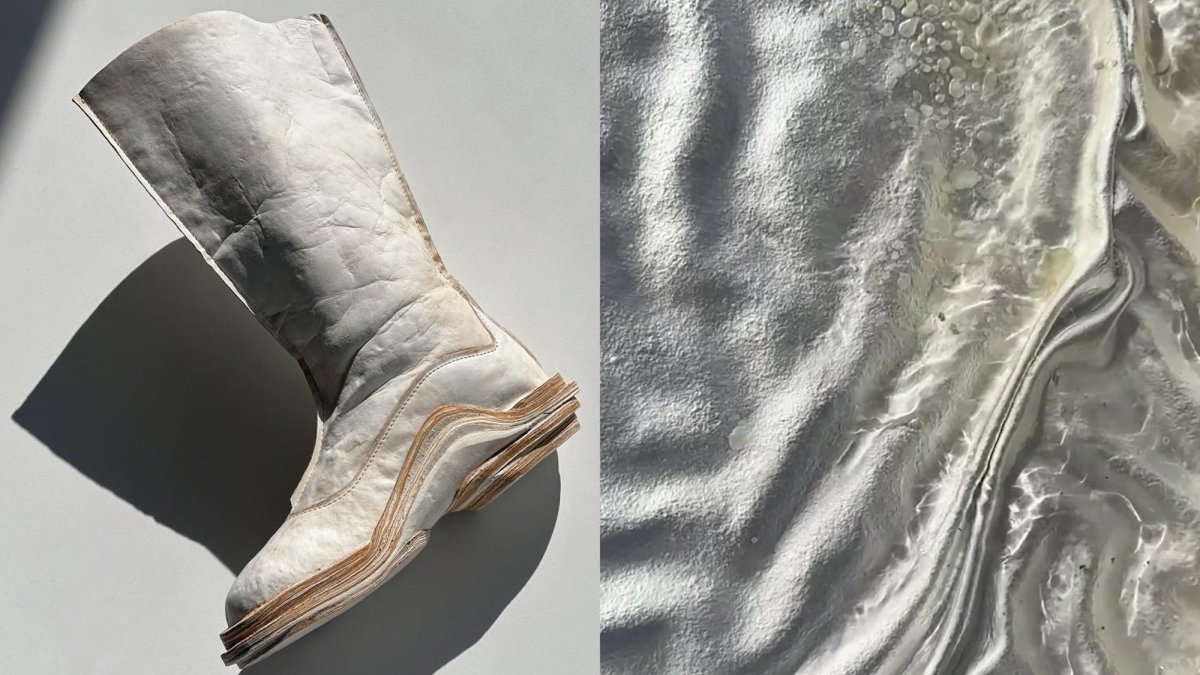
While there is no easy recipe for crafting a greener shoe, researchers at Belgium’s Vrije Universiteit Brussel (VUB) hope to find a solution in fungi. Together with La Monnaie/De Munt opera house’s head shoemaker, Marie De Ryck, the team unveiled a new experiment ahead of Milan Design Week: the world’s first boot crafted entirely from mycelium.
Fungi is most recognizable above ground in the form of spongy mushrooms, but they’re only a fraction of the organisms’ larger story. Below the soil, fungi are frequently connected by miles of fibrous webs of mycelium. These networks transport vital environmental information between fungi on precipitation, soil health, sunlight access, and more. The communications are so detailed that many mycologists consider these webs a form of intelligence.
Fungi and their mycelial networks are now being applied in some exciting spaces, including organic computing and even mushroom-powered toilets. But according to VUB microbiologists, those fungal roots can also be engineered to form every necessary component in a shoe. This goes beyond previous experiments that utilized mushrooms only for surface materials or leather substitutes.
There is a reason such a project hasn’t succeeded in the past—mycelium simply isn’t easy to utilize. It took over two years of trial-and-error to find a balance between natural growth and resilience. Ultimately, the biggest issue was figuring out a way to take mycelia grown as flat sheets and transform them into a three-dimensional, supportive sole of a shoe. In the end, designers settled on two types of fungi—one to supply the foamlike, malleable sole, and another for the shoe’s leathery upper section.
“This is a conceptual object intended to frame what is currently possible with the material,” VUB designer Lars Dittrich explained in a statement. “It reflects…addressing how we grow and craft this material, made from a microorganism, into a functional three-dimensional form.”
“While the initial material samples posed a real challenge and did not immediately meet the technical requirements of a complex shoe construction, the progress we have made is truly inspiring,” added De Ryck.
While the early prototype may not exactly be ready for a haute couture runway show, it’s a certainly promising step forward towards truly sustainable footwear.

2025 PopSci Best of What’s New