
 By admin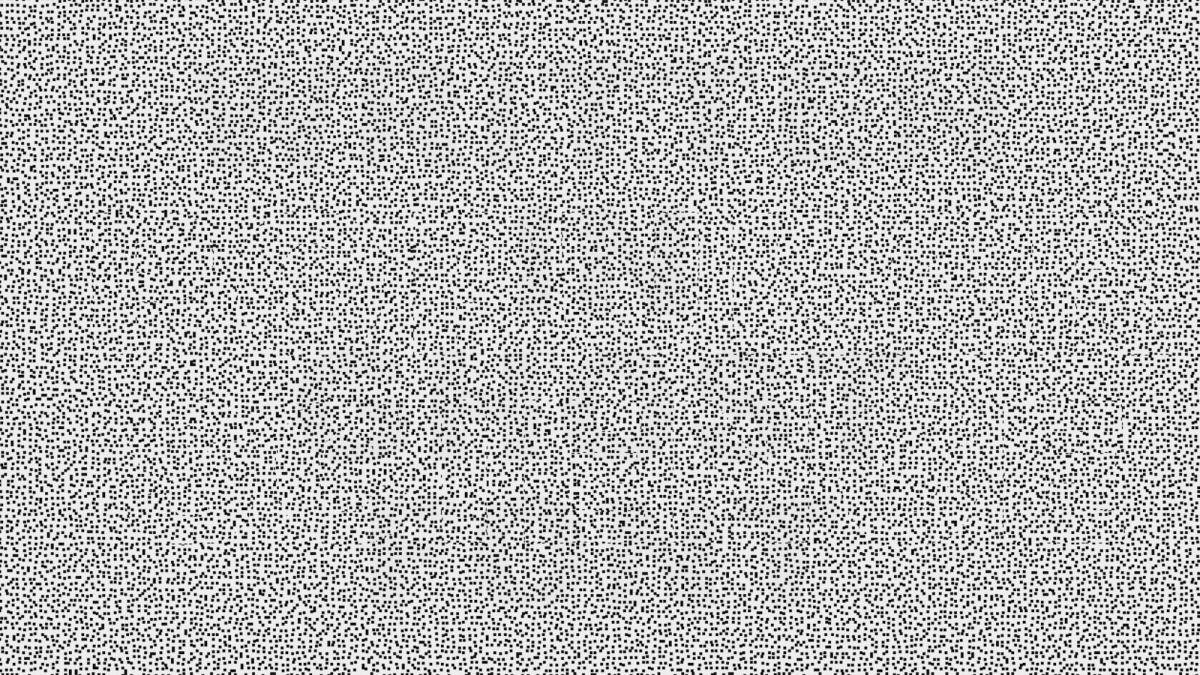
Despite increasing pushback from the public and some lawmakers, there still isn’t much preventing tech companies from training their generative artificial intelligence programs on internet content without the author’s consent. So until meaningful legislation and oversight is introduced, people are largely on their own when it comes to guarding original their online material.
While designer Eric Lu’s Ghost Font isn’t necessarily the silver bullet needed to stop AI from completely devouring the internet, it’s still an ingenious proof-of-concept experiment that highlights human creativity. It also shows just how far AI has to go when it comes to parsing concepts like optical illusions.
Ghost Font’s underlying mechanisms are deceptively simple. Text is entered by a user and overlaid within hundreds of moving dots in a short video animation. The dots composing the words move up the screen while the rest of the pinpoints move downward, generating a visual opposition that the human mind can detect and discern. Pausing the video creates a stationary picture that allows the words to disappear amid the overall clutter. AI (or the human eye, for that matter) can’t decipher the message in the still image, but that’s also where people get the upper hand.

Ghost font anti-AI demonstration
While the human brain interprets motion as a fluid pattern, multimodal AI still examines videos by their individual frames. Think of it like a flipbook.Humans will see the cumulative animation while running through the pages, but AI is still forced to look at the image on each individual page. As an added protection, Ghost Font files also include the static decoy message “written in Ghost Font,” which further confuses AI by making it seem like that’s the only actual text to scan.
Lu claims to have tested the program using Anthropic’s Claude Fable and OpenAI’s GPT-5.6 Sol Ultra, both of which failed to find the real text. Further trials conducted by Creative Bloq also appeared to best AI.
By Lu’s own admission, Ghost Font isn’t a cure-all to ongoing AI issues. It’s limited to extremely short messages, and may become obsolete if generative AI develops the ability to examine videos as optical flows instead of individual frames. It also only takes a few seconds of staring at a dizzying Ghost Font video to realize it’s not the easiest on the eyes, and probably is useless for anyone with visual disabilities. Regardless, it’s still a fun and free way to celebrate human ingenuity—and AI’s deficiencies.
Disclosure: Ziff Davis, Popular Science’s parent company, filed a lawsuit against OpenAI in April 2025, alleging it infringed Ziff Davis copyrights in training and operating its AI systems.

2025 PopSci Best of What’s New