
Bullet point summary by AI
- One of soccer’s most storied rivalries reignites this week as two World Cup contenders prepare for a decisive round of 32 clash in Northern Mexico.
- The tension runs deeper than recent form — it stems from a generation of players who chose one nation over the other, altering both teams’ destinies.
- A key figure in this shift now stands between the two sides, and Monday’s result could cement a new era for international football.
Both Netherlands and Morocco are capable of making deep runs at this summer’s World Cup, but one will crash out in the round of 32. The Dutch were semifinalists at the Euros two years ago, while the Atlas Lions got to the last four at the most-recent World Cup in Qatar, the first-ever African nation to achieve this.
The pair’s sole previous competitive meeting came during USA ’94, with goals from Dennis Bergkamp and Bryan Roy securing a 2-1 win for the Oranje at the Citrus Bowl in Orlando. Netherlands head coach Ronald Koeman was the captain that day. Fast forward 32 years, the pair meet again, but this latest clash in Northern Mexico could be even more hotly-contested than one may expect.
Morocco’s squad members with Dutch connections
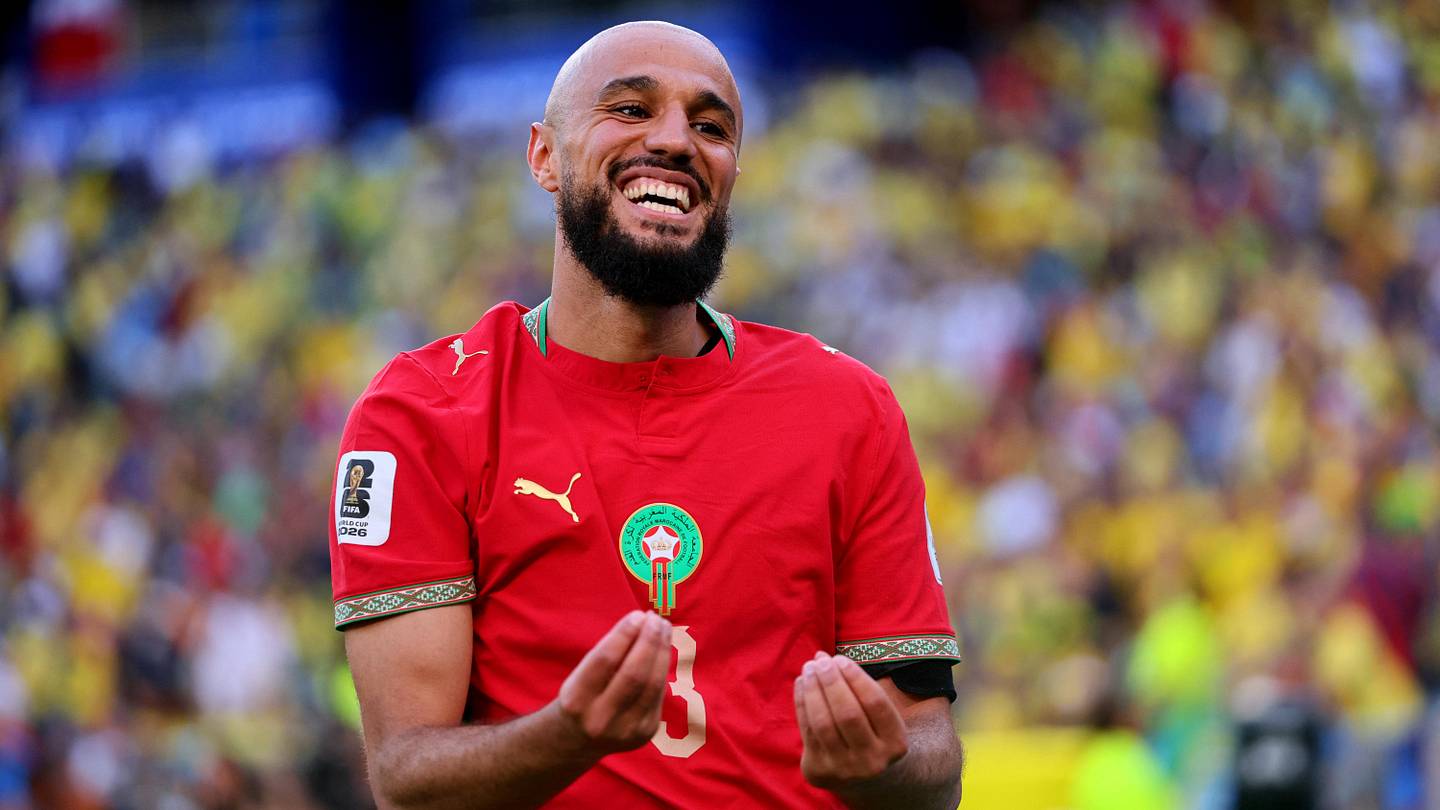
A key reasons behind Morocco’s rise as a soccer power, reaching the World Cup semis in 2022 and the Africa Cup of Nations final earlier this year, has been a mass recruitment of dual-nationals. Of Mohamed Ouahbi’s 26-man squad, just seven were born in Morocco, the rest born across Europe, aside from first-choice goalkeeper Yassine Bounou, raised in Canada until the age of three.
Against Brazil in their opening group game at MetLife, Morocco became the first team in World Cup history to name an entire XI of players born outside their own country. Well, of these players, three key starters have Dutch connections.
Morocco World Cup 2026 squad members eligible for Netherlands
|
Player |
Position |
Morocco caps |
Dutch youth caps |
|---|---|---|---|
|
Noussair Mazraoui |
Full-back |
48 |
0 |
|
Anass Salah-Eddine |
Left-back |
11 |
49 |
|
Sofyan Amrabat |
Defensive midfielder |
76 |
4 |
Three of Morocco’s most-important players were all born in the Netherlands, behind France, Belgium and Spain in terms of duals-nationals in this squad. This is all a sign of the changing landscape of international football. In the past these players who have pursued a career with the Oranje, rather than declaring to play for the North African nation.
Of course, each person’s individual circumstances and beliefs about nationality are individual and deeply personal. However, the trend is clear. In the late-90s, Dries Boussatta won three caps for the Netherlands, all in friendlies, before switching to Morocco, only after falling out of favour.
More-recently, Khalid Boulahrouz, Ibrahim Afellay, Anwar El Ghazi, Adam Maher and Otman Bakkal all chose the Oranje over the Atlas Lions, a streak broken by Ḥakīm Ziyech. After six youth team caps for the Dutch, Ziyech declared his choice to represent Morocco in 2015, a decision met with much confusion. Playing in the Eredivisie at the time, he said “I’ve always felt Moroccan, you choose with your heart”, going on to accumulate 64 caps for Morocco, scoring 25 goals, including netting against Canada during the last World Cup.
Well, it seems as though Ziyech was a trailblazer, not just when it comes to Dutch Moroccans, but for those all across Europe eligible for the North African side. Thus, victory for Morocco at Estadio BBVA on Monday would mean more than just a place in the World Cup round of 16. It would be validation, underlining that Morocco are here to stay, and that the power no longer solely lies in Europe.
More World Cup news and analysis:
 Add us as a preferred source on Google