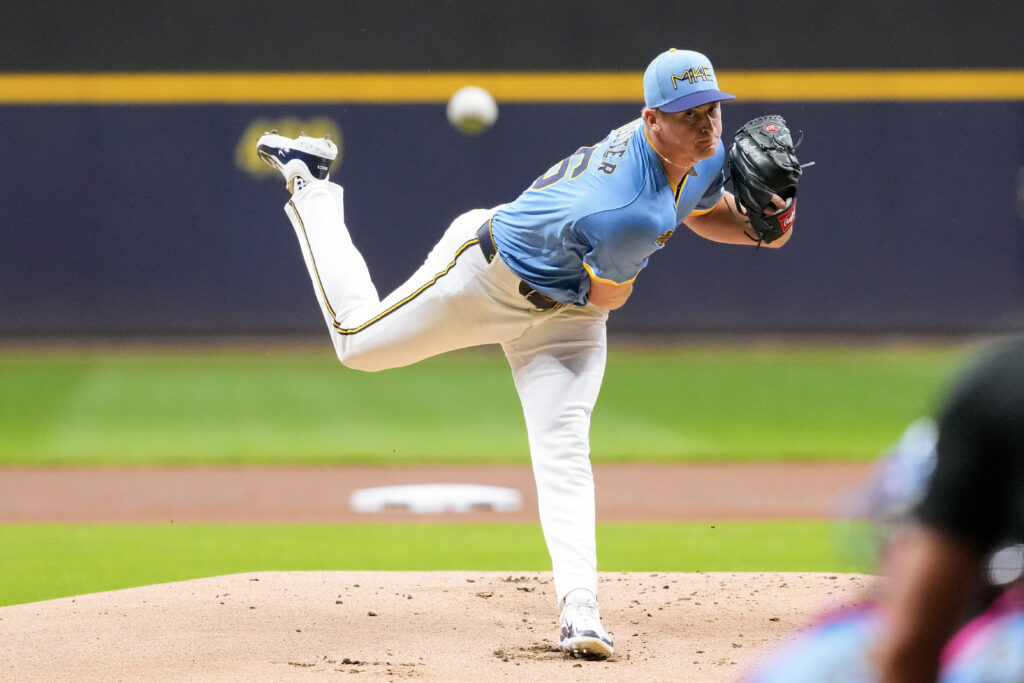

Brewers right-hander Quinn Priester will undergo thoracic outlet decompression surgery on Monday, Priester himself tells Adam McCalvy of MLB.com (video link). Priester, who’s spent the entire season on the injured list, will miss the remainder of the season as a result.
Priester has been dealing with thoracic outlet symptoms since spring training. As the righty himself explained, diagnosing thoracic outlet syndrome is often a “process of exclusion,” meaning the best way to definitively diagnose it is to eliminate other potential causes. They’ve done that and attempted various alternate treatments in hopes that Priester could avoid going under the knife, but while Priester has gotten to the point of being pain-free at times, he’s not able to consistently repeat his mechanics because of the nerve issues that are plaguing him. Priester made eight minor league rehab appearances but walked 25% of his opponents and plunked another 4.1% of them.
Some fans may wonder why Priester didn’t get the surgery in spring training, when his symptoms first arose. That stems from the exclusionary nature of the diagnosis process but also is likely due to the expected timetable for recovery. Priester said he’ll be down from throwing for three months following the surgery and will need a total of eight to ten months before he’s game-ready.
That eight-month timeline would’ve wiped out his entire season anyhow, even if he’d had surgery in late March. He’s now hoping to be ready when pitchers and catchers report next spring, though that’ll depend on his recovery. It’s obviously possible that his rehab could push later into spring training or even early in the season.
Priester is already on the 60-day IL. He’ll spend the entire season there, accruing major league service time and pay while he’s on the mend. He’ll finish the season with 2.134 years of major league service, which could put him on the bubble of Super Two eligibility. That’d make him arbitration-eligible for the first time this coming winter and for each of the three subsequent offseasons. If he falls just shy of Super Two designation, he wouldn’t be arb-eligible until the 2027-28 offseason.
Even with Priester missing the season and possibly being arb-eligible, there’s no scenario in which he’d be a non-tender candidate. The former first-round pick and top prospect came to Milwaukee in what’s become a potential heist with the Red Sox. Minor league outfielder Yophery Rodriguez, minor league righty John Holobetz and the Brewers’ Competitive Balance draft selection in 2025 went back to Boston in that swap. The Sox selected righty Marcus Phillips with that pick. Boston’s return still has potential. Phillips and Holobetz entered the season ranked ninth and 14th among Red Sox farmhands, per Baseball America.
Priester, however, broke out as a high-end, playoff-caliber starter with Milwaukee last year and is still controlled four years after the current season. The 6’3″, 225-pound righty pitched 157 1/3 innings for manager Pat Murphy and logged a sharp 3.32 ERA. Priester’s 20.2% strikeout rate was a bit shy of average, but he countered that with good command (7.7% walk rate) and one of the highest ground-ball rates in the game (56.1%). Priester took some time to find his footing, but after a shakier start in the rotation, he closed out the season with a 2.95 ERA and even better rate stats over his final 17 appearances.
With Priester out for the season, the Brewers will lean more heavily on Cy Young candidate Jacob Misiorowski and lefty Kyle Harrison, whose 2026 breakout closely mirrors that of Priester. (Like Priester, Harrison is a former first-rounder and top prospect who’d been traded from his original organization to the Red Sox — only to be dealt a second time to Milwaukee.) The rest of the rotation has been more fluid, in part due to injury. Robert Gasser, Brandon Sproat and Shane Drohan have rotation spots right now, but Brandon Woodruff, Logan Henderson and Coleman Crow have all started games for Murphy and are currently on the injured list. Chad Patrick has bounced between the rotation and bullpen, giving the Brewers another solid back-end option.