
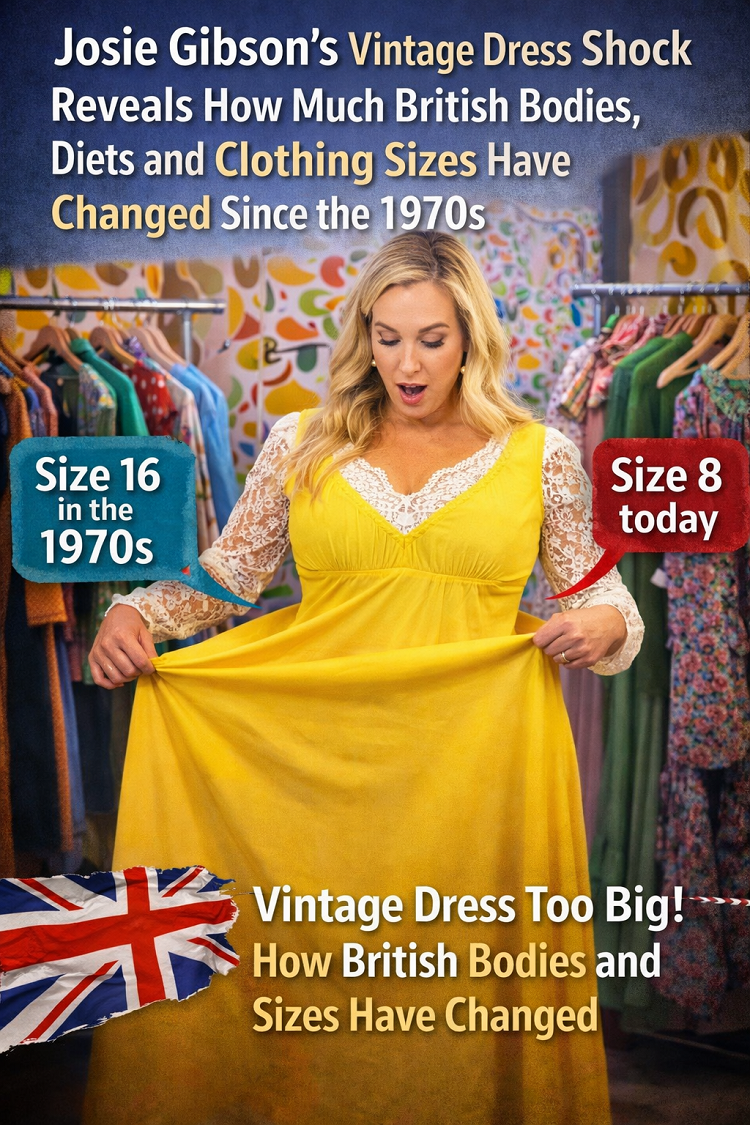
Television presenter Josie Gibson has uncovered a surprising truth about modern fashion, food, and fitness after attempting to squeeze into a vintage dress from the 1970s an experiment that left her stunned and slightly stuck. The moment, captured in a new Channel 5 documentary, highlights just how dramatically clothing sizes, eating habits, and everyday lifestyles in Britain have shifted over the past half century.
The revelation comes in 1970s Diet: Could It Work For You?, airing Wednesday at 7pm on Channel 5. In the programme, Gibson explores what daily life looked like for the average Brit in the 1970s, from portion sizes and exercise routines to dress measurements and expectations placed on women. What she discovers is a stark contrast between then and now one that challenges many assumptions about health, weight, and wellbeing.
A Humbling Moment in a Bristol Vintage Shop
One of the documentary’s most eye-opening moments takes place in a vintage clothing store in Bristol, where Gibson sets out to try on a retro dress labelled a size 14 the same size she comfortably wears today. Expecting it to slip on without much trouble, she is quickly confronted with an uncomfortable reality.
Despite her best efforts, the zip refuses to budge. After struggling to get into the dress, Gibson ultimately needs help from a shop assistant to escape the tightly fitted garment.
“This is supposed to be a size 14,” Gibson says in disbelief. “I honestly thought this would fit me.”
The shop assistant, Zara, confirms that the label is correct but explains that sizing standards in the 1970s were dramatically different from those used on today’s high street.
Why a 1970s Size 14 Is Now a Size 8–10
Using a tape measure, Zara demonstrates that the waist of the dress measures between 26 and 28 inches a measurement that today would correspond to a UK size 8 or 10, not a 14. In contrast, a modern size 14 typically fits a waist closer to 32 inches.
The difference, the documentary explains, reflects a combination of changing body shapes, population growth patterns, and the rise of so-called “vanity sizing,” where clothing brands label garments with smaller numbers to appeal to consumers.
“Sizing has changed a lot since the 1970s,” Zara explains. “People are taller, bodies are different, and the petite size back then was much smaller than what we’d consider petite today.”
How British Bodies Have Changed Over Time
Research cited in the programme supports this observation. A 2017 working paper from the University of Oxford revealed that average heights in England have increased more over the past century than at any other time in recorded history. By 1970, English men were already among the tallest populations in the world and heights have continued to rise since.
But height is only part of the story. The documentary points out that average body weight has increased significantly since the 1970s, a trend linked to changes in diet, physical activity, and daily routines.
In the 1970s, only around 10 per cent of the UK population was considered obese. Today, that figure has climbed to roughly 25 per cent, with associated rises in heart disease, diabetes, and other chronic health conditions.
Testing a 1970s Diet for Two Weeks
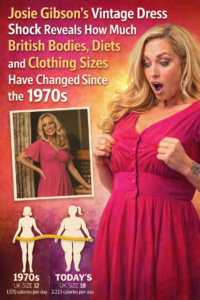
To better understand how eating habits have changed, Gibson commits to following a typical 1970s meal plan for two weeks. Designed by doctor and nutritionist Dr Helen Lawal, the diet includes familiar throwback foods such as Spam, beef stew, tinned fruit, and Angel Delight.
While the menu may seem outdated by modern standards, Dr Lawal explains that the diet itself wasn’t particularly low in calories. In fact, it was relatively high in fat and included carbohydrates with nearly every meal, as well as more red meat than is commonly recommended today.
“The difference wasn’t necessarily what people ate,” Dr Lawal explains. “It was how much they ate.”
Portion Sizes: Then vs Now
According to a 1974 government survey, the average person in the UK consumed around 2,300 calories per day — a figure comparable to modern recommendations. However, lifestyles in the 1970s were far more active, and portion sizes were significantly smaller.
Plate sizes alone tell part of the story. In the 1970s, the average dinner plate measured around 22 centimetres in diameter. Today, plates closer to 28 centimetres are the norm, subtly encouraging people to serve and eat more food.
Gibson experiences this firsthand when she is allowed a traditional chippy meal on day 10 of the experiment. While fish and chips were a staple of the 1970s high street, servings were far more modest.
Today, the average portion includes about 200 grams of fish and nearly 300 grams of chips roughly double what would have been served 50 years ago. Following the rules of her experiment, Gibson halves her portion and is surprised to find she feels completely full.
“I feel so full so very full,” she says. “It really shows that 70s portions were more than enough.”
Everyday Movement as Built-In Exercise
Another key difference highlighted in the programme is how much people moved in their daily lives. In the 1970s, walking was an essential part of everyday routines, particularly for short trips to the shops or visits to friends.
Today, people in the UK make around 20 per cent fewer walking trips than they did back then. To replicate the era more accurately, Dr Lawal challenges Gibson to complete six 20-minute brisk walks each week.
The result is a noticeable improvement in fitness even without changes on the scale.
Fitness Before Gyms Took Over
Gibson also takes part in an aerobics class with women who lived through the 1970s. They explain that fitness at the time was less about sculpting physiques and more about enjoyment, community, and socialising.
“Gyms were for serious weightlifters,” one woman recalls. “They weren’t really places women went.”
Instead, fitness classes were held in church halls and school gyms, offering a space where women could move, chat, and laugh together. Housework also played a major role in keeping people active, with women in the 1970s spending up to 40 hours a week cleaning their homes.
The Surprising Impact on Josie’s Body
Despite two weeks of smaller portions, daily walks, and increased activity, Gibson’s weight remains unchanged at 102kg. However, scans conducted by Dr James Bruner from Kingston University’s Sports Science Department reveal subtle but meaningful improvements.
Her leg muscle mass increases by 0.1kg, and her ability to use oxygen during exercise improves clear indicators of enhanced physical fitness.
Lessons From a Simpler Era
By the end of the experiment, Gibson says she has developed a deep respect for people who lived through the 1970s.
“They just got on with it,” she reflects. “Everyone I spoke to said they found happiness in simple things.”
She notes the absence of social media pressures and constant comparisons, acknowledging how demanding modern life can be for women trying to balance careers, families, and personal expectations.
While she admits she missed spices and bolder flavours describing some of the 70s food as hearty but bland Gibson says the experience has made her rethink modern habits around food, movement, and satisfaction.