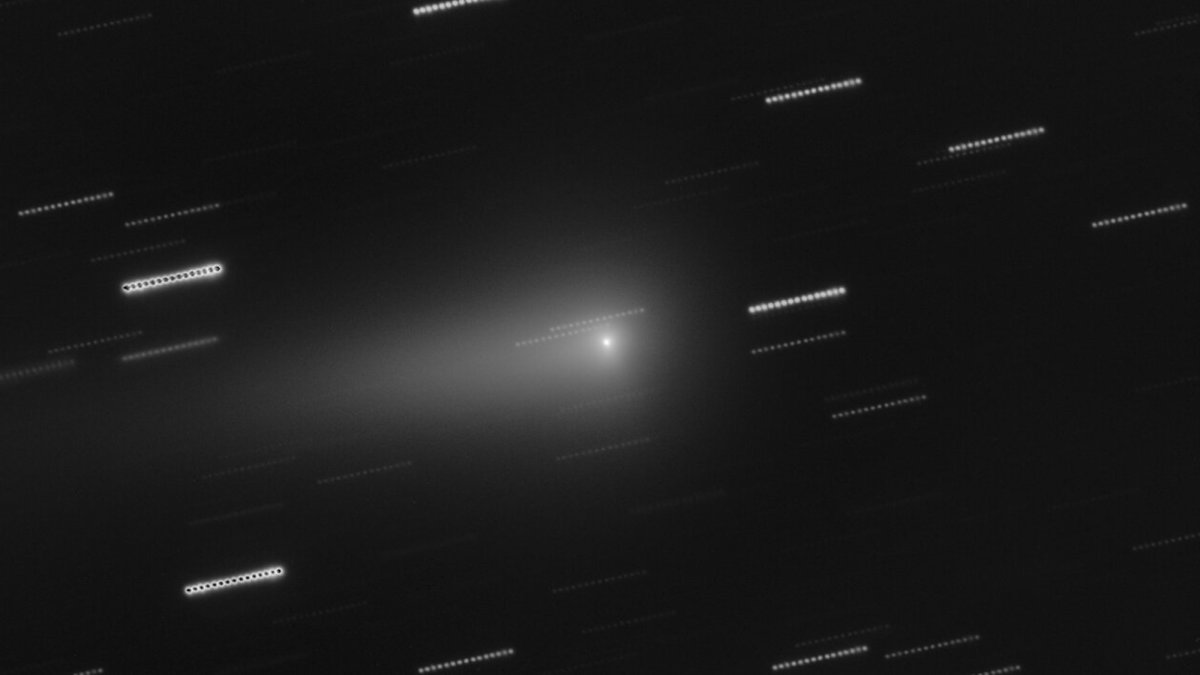

During last year’s brief visit from the comet 3I/ATLAS, astronomers got an extremely rare glimpse into the cosmos beyond our solar system. As only the third known interstellar object to pass by Earth, the frigid, dusty rock has already provided researchers with new and unexpected data about deep space. But in addition to recently learning about the comet’s surprisingly alcohol-laden, ice volcano-covered composition, astronomers now say they have a better sense of its age. According to chemical traces detailed in a study published today in the journal Nature Astronomy, 3I/ATLAS is very, very old.
“3I/ATLAS is a really exciting opportunity to probe the composition of another planetary system, one that formed long before our Sun and solar system even existed,” Rosemary Dorsey, an astrophysicist at the University of Helsinki and study co-author, said in a statement.
3I/ATLAS was extremely bright upon its approach to Earth in July 2025, unlike the previously documented interstellar objects 1I/ʻOumuamua and 2I/Borisov. This allowed Dorsey and colleagues a never-before-seen chance to examine details like its isotopic ratios—varying amounts of different forms of the same element. Using the European Southern Observatory’s Very Large Telescope, they paid particular attention to the carbon and nitrogen isotopes inside cyanide molecules swirling within 3I/ATLAS’ gas cloud. These traces are very susceptible to conditions present during a comet’s formation period, but afterwards do not alter much while it spends eons traveling through space.
Unlike local comets, the interstellar tourist contains unusually high nitrogen and carbon isotopic ratios. Based on this and other examinations, the team believes the comet was born in an outer region surrounding an ancient, low-metallicity star. These stellar objects contain few elements heavier than helium, implying they originated during a much younger era of the universe before it became more chemically diverse. Combined with evidence from other recent studies, it now appears that 3I/ATLAS began its travels long before the sun existed. The comet may even be over twice our yellow star’s age, making it more than 9 billion years old.
“[Interstellar comets] are sort of fossils from a planetary formation process that happened very far away, but that we get the chance to study from much closer,” added University of Edinburgh astronomer and study co-author Cyrielle Opitom.
3I/ATLAS is rapidly becoming more difficult to observe as it continues its journey out of the solar system, but the vast amounts of data astronomers collected while they could will will keep them busy for years. At least, until our next interstellar visitor arrives.

2025 PopSci Best of What’s New