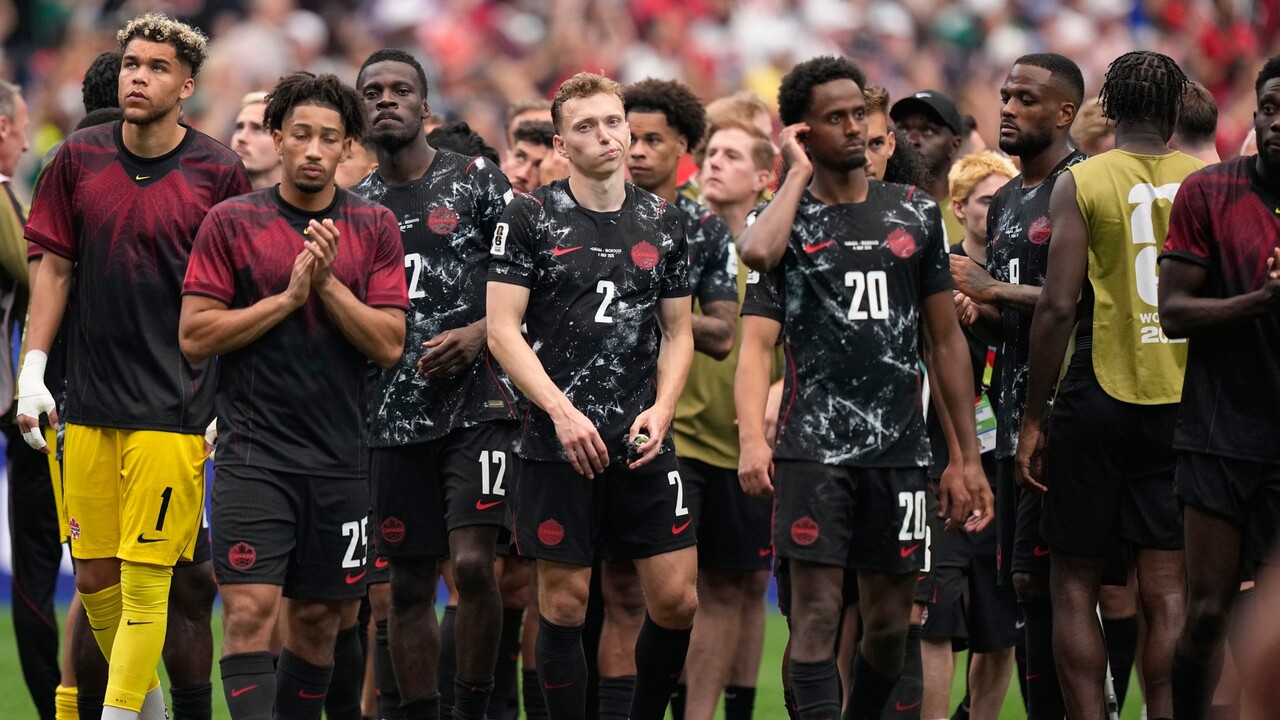

The Canadian men’s team made the entire country stand up and take notice of them at the FIFA World Cup thanks to a memorable run that saw them advance out of the group stage and record their first ever win in a knockout match.
That’s what makes Saturday’s 3-0 loss to Morocco in the round of 16 all the more disappointing.
While it was a scoreline that flattered the Africans, it was, nonetheless, a fair result, and Canada can have little complaint about coming out on the wrong end of things at Houston’s NRG Stadium.
Les Rouges put forth a valiant effort deep in the heart of Texas, but effort only carries you so far. Ultimately, it’s the extra bit of quality and cunning in game management that makes the difference at the World Cup. Canada was sorely lacking in both of those areas against Morocco and now finds itself headed home.
Despite the loss, coach Jesse Marsch was full of praise for his side.
“I think we showed that in this tournament that we can win big games, you know? Since I’ve been here, we won big games at Copa América. … Before the tournament, if we would have said round of 16, I think we would have been pretty satisfied. Before today, if you would have said your team’s going to play like that, I would have said, okay, there’s a good chance we’re going to win the match,” Marsch told reporters in the post-game press conference.
Here are three takeaways from Saturday’s match.
A dominant first half by Canada went to waste
Jesse Marsch didn’t mince words in the buildup to Saturday’s contest, calling Morocco a team with “zero weaknesses.”
Morocco sat No. 7 in the FIFA world rankings ahead of this game, 23 spots above Canada, and is the reigning African Cup of Nations holder. Many top pundits predicted prior to the start of the tournament that the Atlas Lions could make another deep run this summer after reaching the semifinals four years ago in Qatar. By all accounts, this was a major mismatch on paper.
But in fact, the Moroccans looked full of weaknesses through the first 45 minutes of Saturday’s game, and more than a little infallible against a rampant Canadian side that played without fear.
Canada started on the front foot and set the tone early in the match and for the entire opening half. The Canadians played on the edge of physicality and with a systematic press high up the field that frustrated Morocco and had them holding on for dear life right up until the first hydration break. The Moroccans didn’t take their first shot until just before the half-hour mark, such was the difficulty they had in building out from their end of the pitch.
Stephen Eustáquio’s in-swinging corner kick produced a necessary punching save from Morocco goalkeeper Yassine Bounou in the fifth minute. The ball eventually found itself at the feet of forward Jonathan David whose angled effort was blocked by Bounou. A Moroccan giveaway several minutes later saw Canada break forward and Bounou making an important kick save on Tani Oluwaseyi’s shot from inside the penalty area.
Morocco was forced into making a change in the 22nd minute when top scorer Ismael Saibari limped off the field. His early exit did little to help the North Africans who laboured in their build-up play despite all of their careful possession.
Still, for all of Canada’s positive play and a 13-1 edge in touches in the opposition’s box, it only had two shots on target in the first half, the last of which came on Oluwaseyi’s effort in the 11th minute. Not for the first time, Canada was punished for its wastefulness and lack of creativity in front of goal by a resurgent Morocco, who scored three times after the halftime break.
“I thought Morocco had a real tough time dealing with our pressing schemes, dealing with our physicality, and then dealing with our football that we played until the first goal,” Marsch said. “And then the goal changed the game a little bit. We had to push a little bit more, the game then opened up, and then we were a little bit more susceptible on the counter a few times.”
What happened to Canada on Morocco’s opening goal?
After coming out flat footed at the start of the game, Morocco was much more aggressive at the beginning of the second half and was rewarded for its efforts with a goal in the 50th minute.
Canadian centre back Luc de Fougerolles was caught out of position and picked up a yellow card outside his box for a foul on Soufiane Rahimi.
Achraf Hakimi’s ensuing free kick saw him slide the ball to the top of the box to an unmarked Azzedine Ounahi whose low shot through traffic whipped past Canadian goalkeeper Maxime Crépeau and nestled into the bottom-right corner. It was a brilliantly worked set piece that was straight off the training ground, and the goal came on only Morocco’s second shot on target.
Jonathan David was slow to close down Ounahi before he managed to get his shot off. Beyond that, Hakimi’s sly play in finding Ounahi just outside the penalty area caught Canada completely off guard.
“They were really dangerous with a lot of those side free kicks into the near-post zone, so we didn’t want to leave that space open. I think that they just (called an audible) and played a ball back, and we didn’t deal well with it, so it’s a shame,” Marsch conceded.
Marsch also felt that de Fougerolles could have done much better in dealing with Rahimi and didn’t have to give up the foul that led to the Morocco set piece.
“I think Luc could have just stood him up and there was no need to foul him in that situation, because it was almost like they weren’t going to get themselves into the game unless they had a fortuitous situation like this,” Marsch said.
Ounahi’s goal was the turning point in the match as Morocco began to boss the game. Ounahi scored a second goal in the 82nd minute and Soufiane Rahimi found the back of the net deep into injury time.
“They score a goal, and goals change games, and then they can sit back a little bit more. We have to find ways to push a little bit, and then it winds up being two, and then a third at the end,” Marsch offered.
Alphonso Davies’ absence felt by the Canadians
Fifteen minutes. That’s how little Alphonso Davies featured for Canada at this World Cup.
The speedy Canadian captain missed the first three games of the tournament as he was still fighting to regain fitness from a longstanding injury.
But he made up for that when he was subbed on in last week’s round of 32 win over South Africa. Despite having not played since the second leg of the UEFA Champions League in early May, the Bayern Munich star showed no signs of rust against South Africa.
His deft touch and probing play resulted in Canada carving out a pair of scoring chances in quick succession. More importantly, his introduction into the match forced South Africa to change its focus – instead of looking at the big picture, the South Africans were suddenly preoccupied with stopping Davies making inroads down the left side.
As a result, things opened up in other areas of the pitch for Canada, who eventually scored the winner in injury time.
The hope was that Davies would be able to play some role against Morocco and make a similar impact – even if he was just coming off the bench. But Jesse Marsch revealed after the game that Davies wasn’t fully fit to play on Saturday.
“He didn’t feel right yesterday in training, and we got an MRI, and it was clear, so the good news was that there was no injury. But his hamstring didn’t feel right, and we were hoping that by the time this morning he woke up that he would feel better,” Marsch explained.
“But he didn’t, and so we wanted to be cautious and make sure that we weren’t risking anything, and obviously at the 60th minute when it’s one-nil would have been great to have him in the match, or even at halftime. We weren’t able to have him healthy, and it killed him more than anyone, but I think it was the right decision to preserve him in his career and get him fully healthy.”
He later added: “He wanted to play so bad; he went and tried to get going himself at halftime, and he said he just wasn’t right. So, we didn’t want to risk it.”
Editor’s note
John Molinaro is one of the leading soccer journalists in Canada, having covered the game for over 27 years for several media outlets, including Sportsnet, CBC Sports and Sun Media. He is currently the editor-in-chief of TFC Republic, a website dedicated to in-depth coverage of Toronto FC and Canadian soccer.