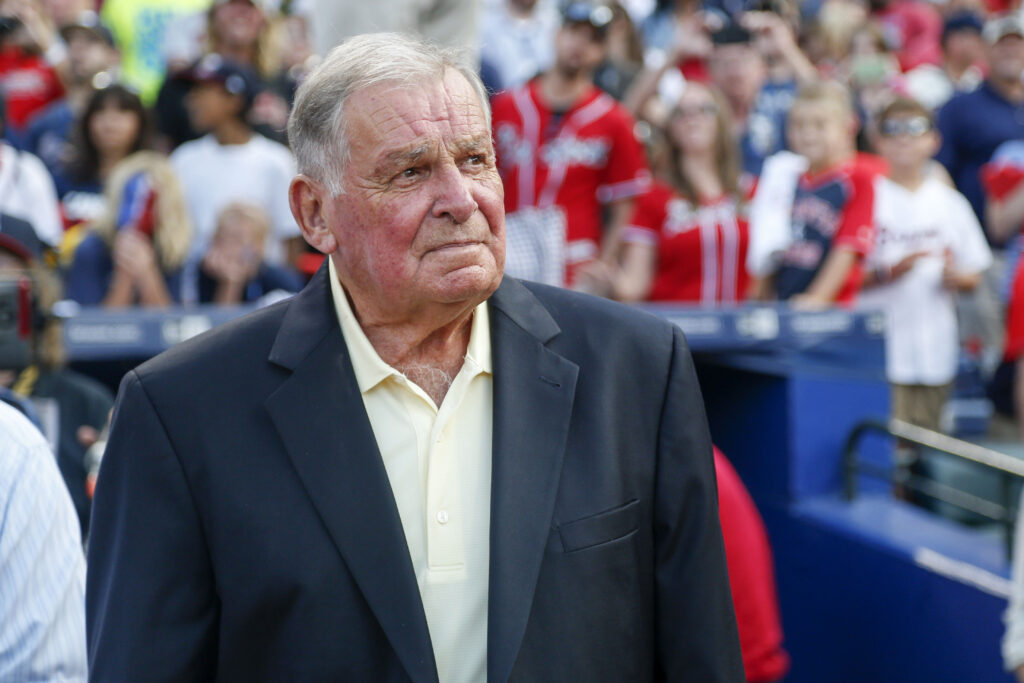

The Braves announced that longtime manager Bobby Cox passed away at age 84. Cox led the Braves to the 1995 World Series title, and his 2504 wins rank fourth on the all-time list for managerial victories. As per the team’s official release to media….
“Bobby was a favorite among all in the baseball community, especially those who played for him. His wealth of knowledge on player development and the intricacies of managing the game were rewarded with the sport’s ultimate prize in 2014 – enshrinement into the Baseball Hall of Fame.
And while Bobby’s passion for the game was unparalleled, his love of baseball was exceeded only by his love for his family. It is with the heaviest of hearts that we send our sincerest condolences to his beloved wife, Pam, and their loving children and grandchildren.”
Before starting his journey to Cooperstown as a manager, Cox spent 12 seasons as a player, spending time in the farm systems of the Dodgers, Cubs, Yankees, and Braves. He broke into the majors for 220 games with the Yankees over the 1968-69 seasons, and the end of his playing career transitioned right into the start of his post-playing career — Cox appeared in four games with the Yankees’ A-ball affiliate in Fort Lauderdale in 1971 while also becoming the team’s manager. After six years of managing in the minors, Cox was the Yankees’ first base coach in 1977 when the team captured the World Series, earning Cox his first championship ring.
The Braves came calling with Cox’s first MLB managerial assignment, but Cox’s initial stint in Atlanta resulted in just one winning record over four seasons from 1978-81. Fired following the 1981 campaign, Cox landed in Toronto as the Blue Jays’ new manager, helping lead the recent expansion team to its first run of success. The peak was the AL East title in 1985, and yet after the Jays fell just shy of their first AL pennant, Cox opted to return to Atlanta, this time as the club’s general manager.
Cox’s five years as GM is an often overlooked chapter of his long tenure in Atlanta, in part because John Schuerholz took over following the 1990 season and was himself eventually elected to the Hall of Fame for his outstanding track record as an executive. But, while the Braves continued to sit below .500 during the 1986-90 seasons, Cox’s front office saw the team draft and acquired many of the players that would become franchise staples during the Braves’ forthcoming glory years.
Cox returned to the dugout partway through the 1990 season, and relinquished GM duties to Schuerholtz to focus solely on managing. With many of the pieces now in place, the Braves went from last place in the NL East in 1990 to NL champions in both 1991 and 1992.
As the media release simply put it, Cox’s “Braves managerial legacy will never be matched.” The 1991 campaign marked the beginning of 14 NL East titles over the next 15 seasons. The only interruption in this astonishing streak was the 1994 season, as the Braves were in second place behind the Expos when the players’ strike prematurely ended the season in August.
The World Series appearances in 91-92 were followed by three more pennants in 1995, 1996, and 1999. Championship glory came in 1995 when Atlanta outlasted Cleveland in six games, highlighted by a 1-0 win in the clinching Game Six that was powered by eight one-hit innings from Tom Glavine.
Atlanta’s NL East title streak finally ended in 2006 when the team went 79-83. Cox’s final five seasons as manager saw the Braves still post three winning records, and they made one final playoff appearance as a wild card team in 2010, falling in the NLDS to the eventual world champion Giants. Cox announced prior to the season that 2010 would be his final year in the dugout, and he remained involved with the Braves in an official and unofficial advisory role for years before health issues arose in the later years of his life.
Beyond his 2504-2001 managerial record, Cox also set an all-time benchmark that is unlikely to be topped — 162 career ejections, the most of any manager in history. Cox’s fiery personality and willingness to stand up for his teams made him both a beloved manager and even a mentor to many of his players, and the clubhouse cohesion (along with tremendous talent, of course) was a key factor in the Braves’ sustained success.
Between Cox’s passing and the passing of longtime Braves owner Ted Turner earlier this week, Atlanta has lost two baseball icons within a matter of days. Their legacies are intertwined amongst one of the greatest runs of sustained success in baseball history, and even after Cox and Turner were no longer directly involved with the organization, a clear path can be drawn between Cox’s teams and the successful Braves teams of recent years.
We at MLB Trade Rumors send our condolences to Cox’s family, friends, and many fans.