
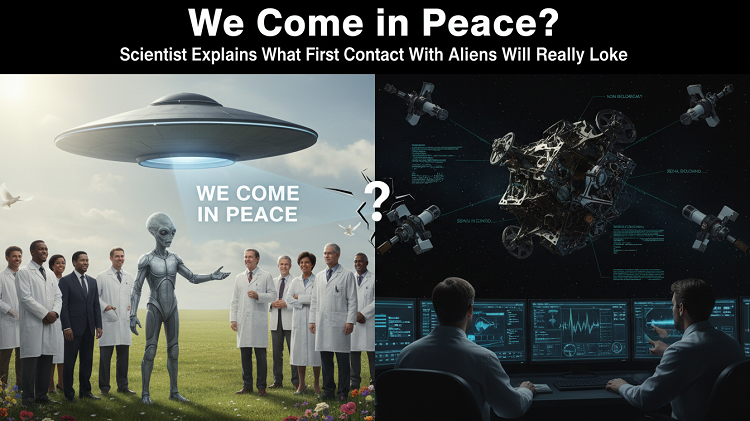
First Contact Won’t Be Like the Movies
As astronomers continue to scour the cosmos for signs of extraterrestrial life, one leading researcher has offered a groundbreaking perspective on what humanity’s first encounter with aliens will actually look like. Contrary to popular Hollywood depictions from hostile invaders to benevolent space travelers the reality, according to scientists, could be far less glamorous and far more sobering.
Dr. David Kipping, an astrophysicist at Columbia University, proposes what he calls the “Eschatian Hypothesis”, a theory suggesting that the first alien civilization humanity encounters is likely to be in its final stages of collapse. Much like stars burning intensely before dying as supernovae, advanced civilizations may flare dramatically just before vanishing, producing signals detectable across vast interstellar distances.
The Loudest Civilizations Are the Most Detectable
In a YouTube discussion, Dr. Kipping elaborated: “Hollywood has preconditioned us to expect one of two types of alien contact either a hostile invasion or a wise, benevolent species bestowing knowledge. But the Eschatian Hypothesis is neither. Here, first contact is with a civilization in its death throes, violently flailing before the end.”
The hypothesis implies that dying civilizations are unusually loud not metaphorically, but in terms of the energy they emit. Just as dying stars shine far brighter than their quieter, stable counterparts, these final stages may produce detectable bursts of radiation, radio signals, or other forms of energy that make them stand out to astronomers scanning the galaxy.
Detection Bias in Astronomy
Dr. Kipping explains that this concept follows a familiar pattern in astronomy: we tend to detect the brightest, most extreme examples of cosmic phenomena first. For instance, although only a tiny fraction of stars are in their final giant phase at any given time, these dying stars are far more visible to the naked eye due to their brilliance. Similarly, supernovae, while extremely rare, are discovered in large numbers annually because their intense energy makes them stand out.
Applying the same principle to civilizations, Dr. Kipping argues that the first aliens we detect are likely to be outliers, exhibiting extreme energy outputs or unusual behaviors that make them impossible to ignore.
Signs of a Civilization in Collapse
A civilization in collapse might produce observable energy bursts through catastrophic events, such as nuclear warfare, planetary-scale engineering failures, or runaway environmental crises. Such disturbances could manifest as detectable anomalies in the electromagnetic spectrum, visible to sensitive telescopes from light-years away.
For example, a nuclear detonation releases enormous energy in multiple wavelengths, and advanced civilizations could inadvertently broadcast signals into space during their final attempts to manage crises or communicate for help. Dr. Kipping likens these signals to a “loud, obnoxious party guest” rare but impossible to overlook.
Why First Contact Won’t Be a Friendly Greeting
Unlike Hollywood scenarios where aliens deliberately make contact with humanity, the Eschatian Hypothesis predicts that any interaction we observe will be unintentional. The first signs of extraterrestrial intelligence may come as last desperate shouts, akin to a civilization broadcasting its struggles rather than its wisdom.
This raises both practical and philosophical questions. Should humanity respond to a civilization clearly in collapse? And how might we interpret these signals without anthropomorphizing their intentions?
The Fermi Paradox and the Great Filter
The Eschatian Hypothesis also provides context for the longstanding Fermi Paradox, which asks why, despite billions of stars and planets in our galaxy, humanity has yet to detect evidence of extraterrestrial intelligence. Dr. Kipping’s theory aligns with the notion of a “Great Filter”, a proposed barrier that prevents civilizations from reaching advanced stages of development without collapsing.
Physicist Brian Cox has similarly suggested that technological progress may inevitably outpace political or societal maturity, leading civilizations to self-destruction. This could explain why advanced civilizations rarely last long enough to establish enduring interstellar communication networks.
Other Explanations for the Silence
Of course, the Fermi Paradox has multiple proposed solutions beyond civilizational collapse. Some researchers believe that intelligent alien species may exist but lack the necessary technology to communicate across interstellar distances. Others argue that even if communication is possible, the sheer distances between stars—often thousands of light-years make meaningful interaction unlikely before one or both civilizations go extinct.
The Zoo Hypothesis offers another possibility: advanced civilizations deliberately avoid contact with Earth, observing humanity as one might observe wildlife, allowing us to develop naturally without interference.
Signals to Watch For
Dr. Kipping urges astronomers to scan the skies more broadly and frequently for brief, unexplained bursts of energy, rather than focusing only on systems thought to be promising candidates. Sudden anomalies, flashes, or signals could indicate a civilization experiencing extreme disequilibrium essentially, a civilization at the edge of collapse trying to leave a mark before disappearing entirely.
He points to historical events like the 1977 “Wow! Signal”, which may have represented one of these last desperate shouts. Rather than expecting coherent messages, scientists might be more successful looking for unusual, intense, and ephemeral energy patterns.
Implications for Humanity
While the idea of first contact with a dying civilization may seem bleak, it also has practical implications. By studying these extreme cases, humanity could better understand the trajectories of civilizations, including our own. Observing how other intelligent life reaches the end of its lifespan might offer crucial insights into sustainability, technological risks, and the dangers of unbridled energy consumption.
Furthermore, the approach challenges the romanticized notion that first contact will be friendly or enlightening. Instead, humanity may find itself witnessing a sobering reality: intelligence in the universe may be spectacular, brilliant, and yet tragically ephemeral.
Conclusion: Listening to the Loudest Voices
The Eschatian Hypothesis reframes our expectations for first contact. It suggests that the most detectable extraterrestrial civilizations will be those in turmoil, broadcasting their final, desperate messages across the cosmos. For astronomers, this means prioritizing vigilance, broad observation, and the study of extreme phenomena over waiting for polite, prearranged greetings from the stars.
In short, if humans are to meet aliens, it is likely to be unlike anything in science fiction, and perhaps more sobering than we have ever imagined. The universe may not greet us with wisdom or warships but with the desperate, luminous final cries of civilizations on the edge of extinction.