
Over the course of WNBA collective bargaining agreement (CBA) negotiations, the biggest point of contention has been and continues to be revenue sharing.
This past Tuesday, the WNBA Player’s Association submitted a counter-proposal to the league’s Feb. 6 proposition, asking for up to 27.5 percent of gross revenue share over the course of the deal, down from their previous ask of 30 percent.
In both the WNBA and the NBA, players receive a certain percentage of Basketball Related Income (BRI) — revenue from ticket sales, broadcasting deals, advertisements, and concessions. Under the current NBA CBA, players are allotted 51 percent of BRI. Under the expired WNBA CBA, players receive a mere 9 percent.
WNBA players are not asking for equal pay, but a more equitable share of BRI. All of these numbers are complicated and abstract to fans not steeped in the economics of professional sports. To illustrate the ask of WNBA players, let’s consider what current NBA players would make under the two latest WNBPA proposals — one in December, the other earlier this week — and the expired WNBA CBA.
According to Sportico, the NBA generated $10.25 billion in BRI in the 2024-25 season. Players receive 51 percent of this number, $5.23 billion, towards their salaries (10.35 billion x 0.51 = 5.23 billion). If that pool shrinks (or expands), salaries shift with it.
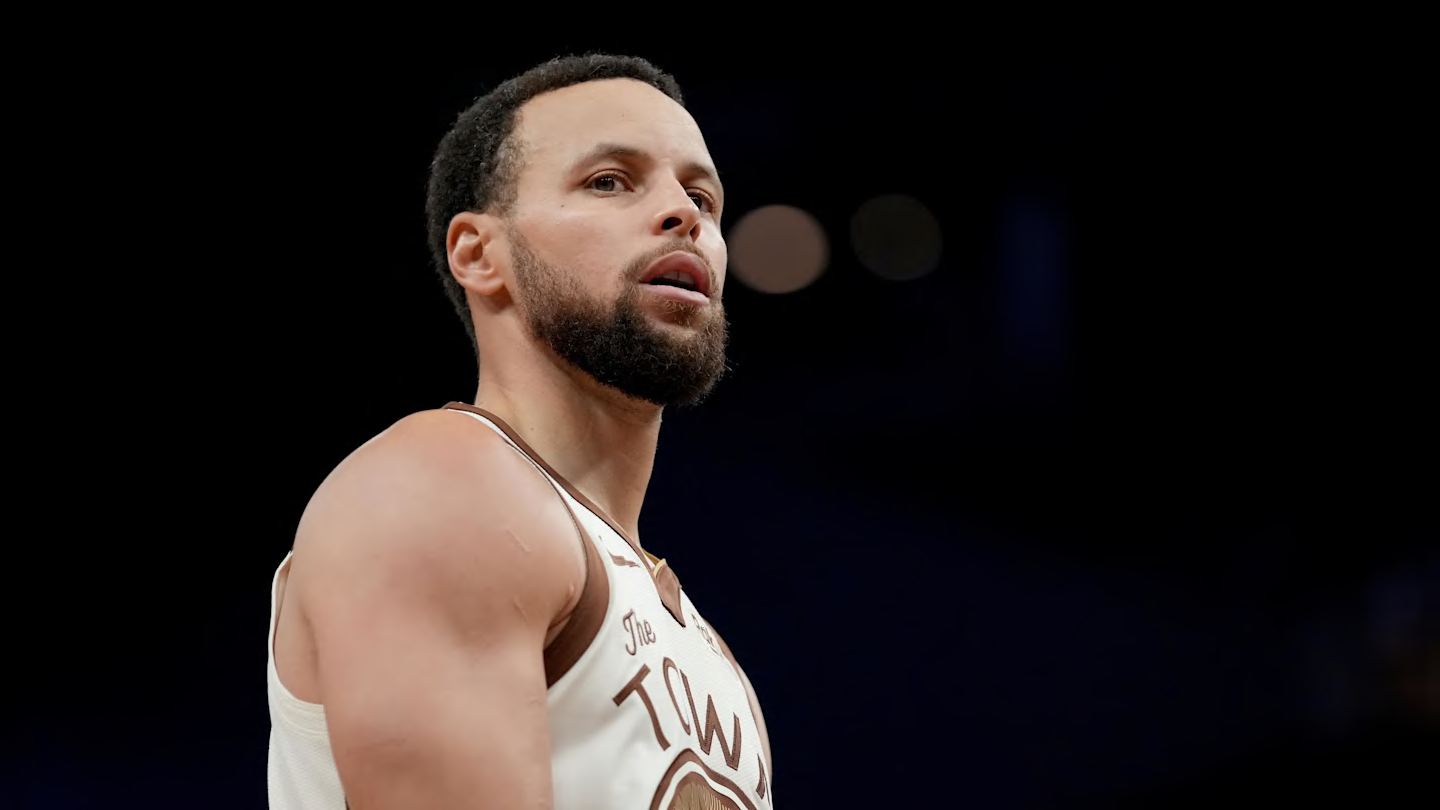
Let’s start with Steph Curry, who was the highest paid player of the 2024-25 NBA season. Curry’s on-court earnings were reported at around $55.8 million, which makes up 1.067 percent of the total player pool. If the NBA restructured its revenue sharing to be more like the WNBA, Curry’s salary would fluctuate as follows: At 30 percent BRI (proposed by the WNBPA back in December), player pool would shrink to $3.08 billion, Curry’s salary to $32.8 million; at 27.5 percent BRI (proposed by the WNBPA earlier this week), player pool would be $2.82 billion, Curry’s salary $30.1 million; at 9 percent BRI (player share under the expired WNBA CBA), player pool would be $923 million, Curry’s salary $9.8 million. Curry’s salary drops by $23 million, $25.7 million, and $46 million, respectively.
Below is a table of how the top ten earners of the 2024-25 NBA season would fare under these three same revenue sharing scenarios:
What NBA stars would make with WNBA-style revenue sharing
|
PLAYER |
2024-25 Salary |
% of Player Pool |
At 30% BRI |
At 27.5 BRI |
At 9% BRI |
|---|---|---|---|---|---|
|
Stephen Curry |
$55.8M |
1.07% |
$32.8M |
$30.1M |
$9.8M |
|
Joel Embiid |
$51.4M |
0.98% |
$30.2M |
$27.7M |
$9.1M |
|
Nikola Jokić |
$51.4M |
0.98% |
$30.2M |
$27.7M |
$9.1M |
|
Kevin Durant |
$51.2M |
0.98% |
$30.1M |
$27.6M |
$9.0M |
|
Bradley Beal |
$50.2M |
0.96% |
$29.5M |
$27.0M |
$8.8M |
|
Giannis Antetokounmpo |
$48.8M |
0.93% |
$28.7M |
$26.3M |
$8.6M |
|
LeBron James |
$48.7M |
0.93% |
$28.7M |
$26.3M |
$8.6M |
|
Damian Lillard |
$48.8M |
0.93% |
$28.7M |
$26.3M |
$8.6M |
|
Jimmy Butler |
$48.8M |
0.93% |
$28.7M |
$26.3M |
$8.6M |
|
Jayson Tatum |
$47.6M |
0.91% |
$28.0M |
$25.7M |
$8.4M |
*Salaries were modeled as fixed proportional shares of total league player compensation. With league Basketball Related Income (BRI) estimated at $10.25 billion and players receiving 51 percent under the current NBA CBA, alternative salary structures were generated by scaling the total player pool to 30 percent, 27.5 percent, and 9 percent of BRI. Salary data can be found here.
Across the board, reducing the revenue share doesn’t just trim salaries: it systematically removes tens of millions per player, turning $50 million stars into $30 million players at ~30 percent BRI and sub-$10M players at single-digit BRI. These estimates assume salaries scale proportionally with changes in players’ share of BRI. In reality, NBA stars might see smaller percentage declines while mid- and lower-tier players absorb more of the adjustment. The purpose of this model is not to predict exact contract outcomes but to illustrate that, regardless of distribution, the overall shift in player compensation is massive.
Players are the engine of NBA and WNBA growth, yet the current WNBA compensation structure returns the vast majority of revenue to ownership. Public discussion often shifts towards affordability, with the league arguing that allocating a higher revenue share to players would threaten the league’s financial stability. Whether the league can pay more is a separate question from how existing revenue is divided. As sports economist David Berri has argued in The New York Times, larger player shares are not inherently incompatible with long-term growth, as seen historically in the NBA during earlier expansion periods. The issue is less about capacity than it is about distribution, and ultimately, player value.
More WNBA news and analysis: