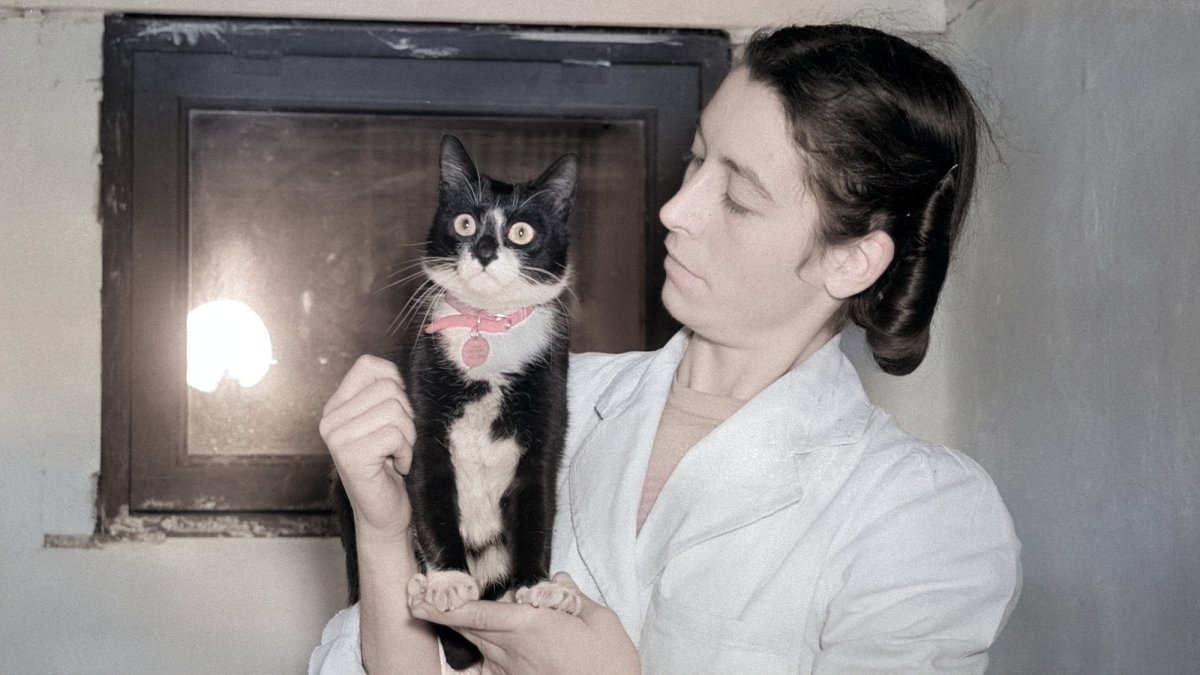

One day in March of 1948, George Hickinbottom, a British sailor, was walking around the docks of Stonecutters Island in Hong Kong. When the 17-year-old spotted a small black-and-white tuxedo cat, barely out of kittenhood, he decided to smuggle the hungry, scrawny animal aboard his ship, the HMS Amethyst.
Hickinbottom didn’t get in trouble. After all, having a cat on board was great for keeping rats out of the ship’s food, and Simon—as the crew named the little cat—soon went to work.
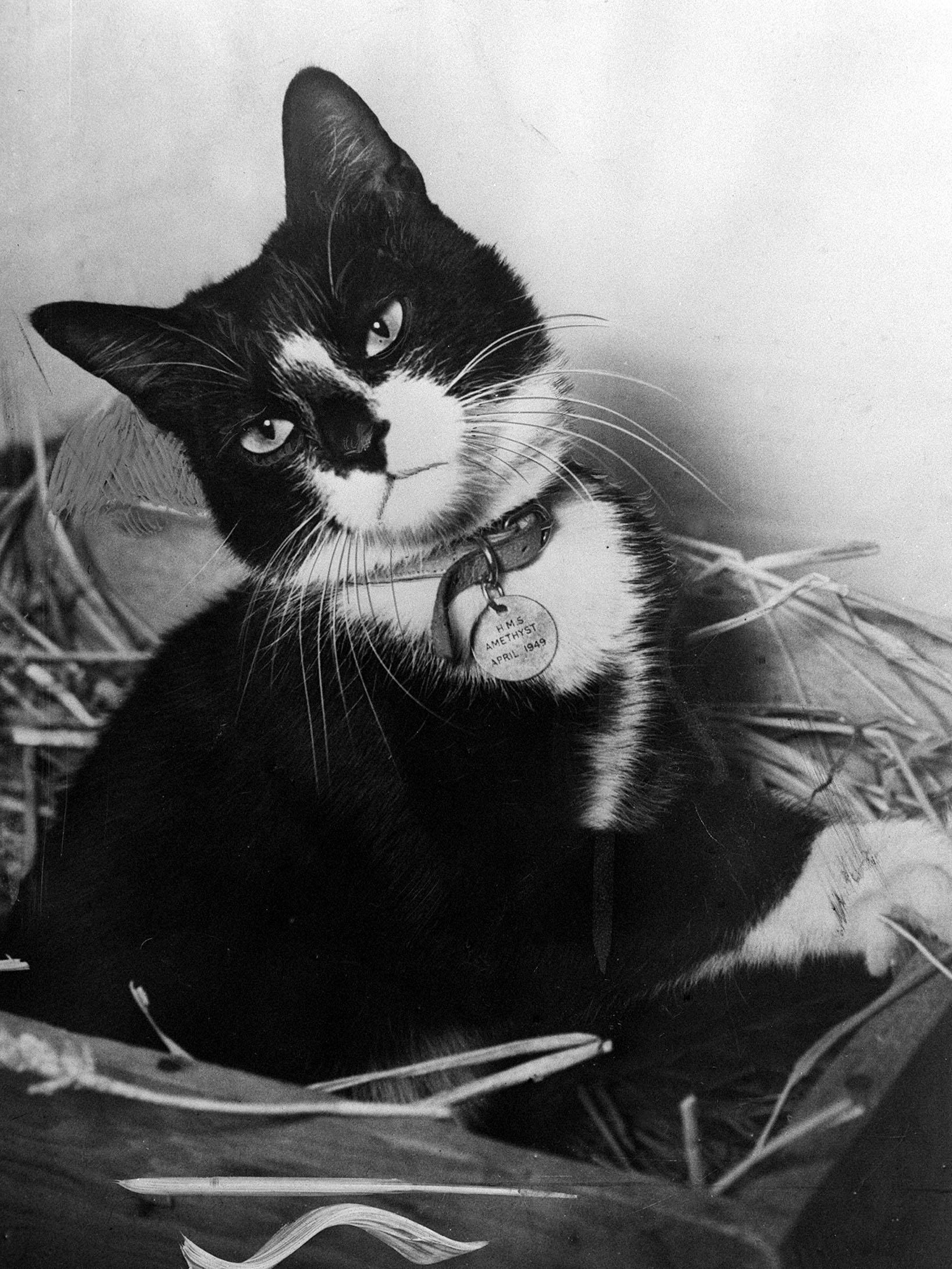
On April 19, 1949, when the Amethyst sailed out towards Nanjing, it carried 183 sailors, Simon, and even a dog named Peggy. But none on board expected the harrowing ordeal that lay ahead. Within mere months, Simon would be a world-famous feline as well as the only cat to ever receive a PDSA Dickin Medal, the highest honor an animal can receive for serving in the armed forces. The Dickin Medal, which is often compared to the British Victoria Cross, is typically awarded to heroic horses, homing pigeons, and dogs. Simon, to this day, remains the only feline recipient.
“When I do school visits, I sometimes have to be careful reading Simon’s story, because I still find it incredibly moving,” says David Long, the author of The Animals’ VC: For Gallantry Or Devotion. “He’s what we call here a ‘moggy,’ which is a really basic family cat. He’s nothing special, and that makes him special.”
Fur under fire
In 1949, China was nearing the end of its civil war between the Nationalist government and the Communist People’s Liberation Army (PLA). The British government had sent the Amethyst to relieve the HMS Consort, which was stationed at Nanjing to protect and evacuate the British embassy, if necessary. Tensions were high, as the Communist forces were expected any day to cross the Yangtze to attack the Nationalist troops on the other side.
On the morning of April 20, artillery fire rained down on the Amethyst from the north bank of the river, causing the ship to run aground. Dozens of men on board were killed or severely injured. Other British ships that attempted to come to the Amethyst’s aid also sustained casualties. Even Simon was seriously injured, with shrapnel damage and burns on his back and face.
What followed was three months of political maneuvering and breathless international coverage, with the Amethyst stuck in the river all the while. The British claimed that they had the right to navigate the Yangtze, based on a century-old treaty. The Communists were insistent that the ship stay where it was until the British took responsibility for sailing into a war zone.
Deadlock, then a daring escape
While the dead and wounded were smuggled to shore and safety, the remaining sailors on board were stuck in sweltering heat, under threat from barrages from the shore, and with dwindling supplies. Diplomatic negotiations between the PLA and the British failed over and over again.
This, however, was Simon’s time to shine. Though his injuries were severe, the sailors watched in wonder as the cat determinedly licked his wounds, then got back to work destroying the rats threatening the ship’s food stores. Simon, says Long, was quite a character. “He would sleep in the officers’ hats, and deposit dead mice and rats in the sailor’s shoes.” And, adds Long, “even when he was injured, he carried on comforting the sailors” with vigorous purring.
Three months later, faced with dwindling supplies and fuel, the trapped ship made a break out of their predicament. Under the cover of night on July 30, 1949, the Amethyst quenched all its lights on board and shadowed a passing Chinese merchant ship, the Kiangling Liberation, following it through the tricky shoals of the river. When the onshore batteries opened fire on both ships, they hit and sank the Liberation, allowing the frigate to shoot past them and make a 104-mile dash for the South China Sea.
Triumph and tragedy
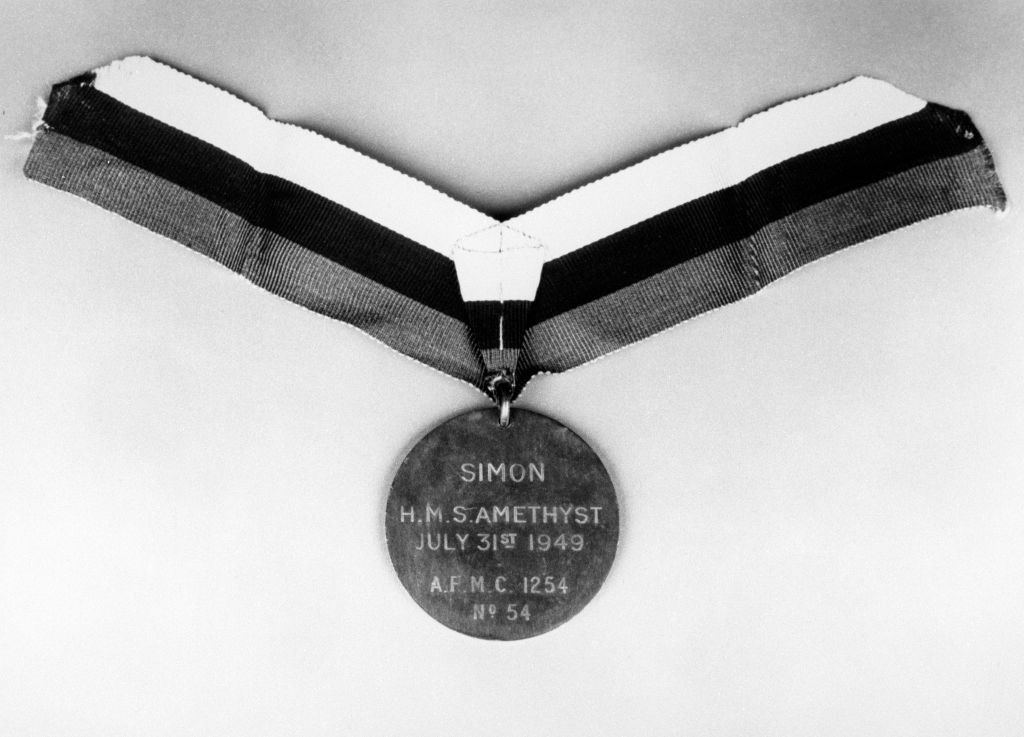
The sailors were greeted as heroes in Hong Kong—as was Simon. Photos of the small tuxedo cat filled newspapers around the world, and the news reached Hong Kong that Simon would receive the Dickin Medal, which had been established six years before by the People’s Dispensary for Sick Animals in London, a charity dedicated to providing medical care for the pets of people in need.
Peggy the dog had also survived the three-month ordeal aboard the Amethyst, but it was Simon, who one newspaper called “the leading pet of the crew,” who sailed back to Britain with the men.
When the crew arrived in Plymouth on November 2, 1949, it was to huge crowds and a celebration—which was enough to send Simon fleeing to hide in the bowels of the ship. After the crowds dispersed, there was a brief panic when Simon snuck off the ship for a day, which The Globe and Mail called “a black mark on his brilliant record of service under fire.” However, he soon ambled back to take a nap.
Simon was now a bona fide celebrity, with so many letters sent his way that one member of the Amethyst’s crew was designated the official “cat officer” to handle his correspondence. But despite the fact that Simon was soon to be a medaled war hero, as a cat from abroad, he still needed to check in for a period of quarantine at a pet hospital.
On November 28, however, Simon abruptly died while in quarantine. At his death, he was likely only two years old. Reports at the time blamed different things for Simon’s premature passing, such as the cold climate, lingering effects of his wounds, and a mysterious intestinal inflammation. But what was undeniable was the global outpouring of grief for the brave little cat. Simon did receive his Dickin Medal posthumously, and he was buried in the Ilford Animal Cemetery in east London with full military honors. His tiny coffin, when it was lowered into the grave, was draped with the Union Jack.
Long says that Simon’s story resonated—and still resonates—with people today for one major reason: “People don’t expect cats to be brave, whereas they might expect a dog to be brave,” he says. Simon’s headstone still stands today, engraved with the words, “Throughout The Yangtse Incident His Behaviour Was Of The Highest Order.”

In That Time When, Popular Science tells the weirdest, surprising, and little-known stories that shaped science, engineering, and innovation.
Related ‘That Time When’ Stories

2025 PopSci Best of What’s New