
March Madness has been the domain of star guards and wings for a long time. Players like Kemba Walker, Carmelo Anthony, and Walter Clayton have put themselves into the history books with hot shooting to carry their teams to championships.
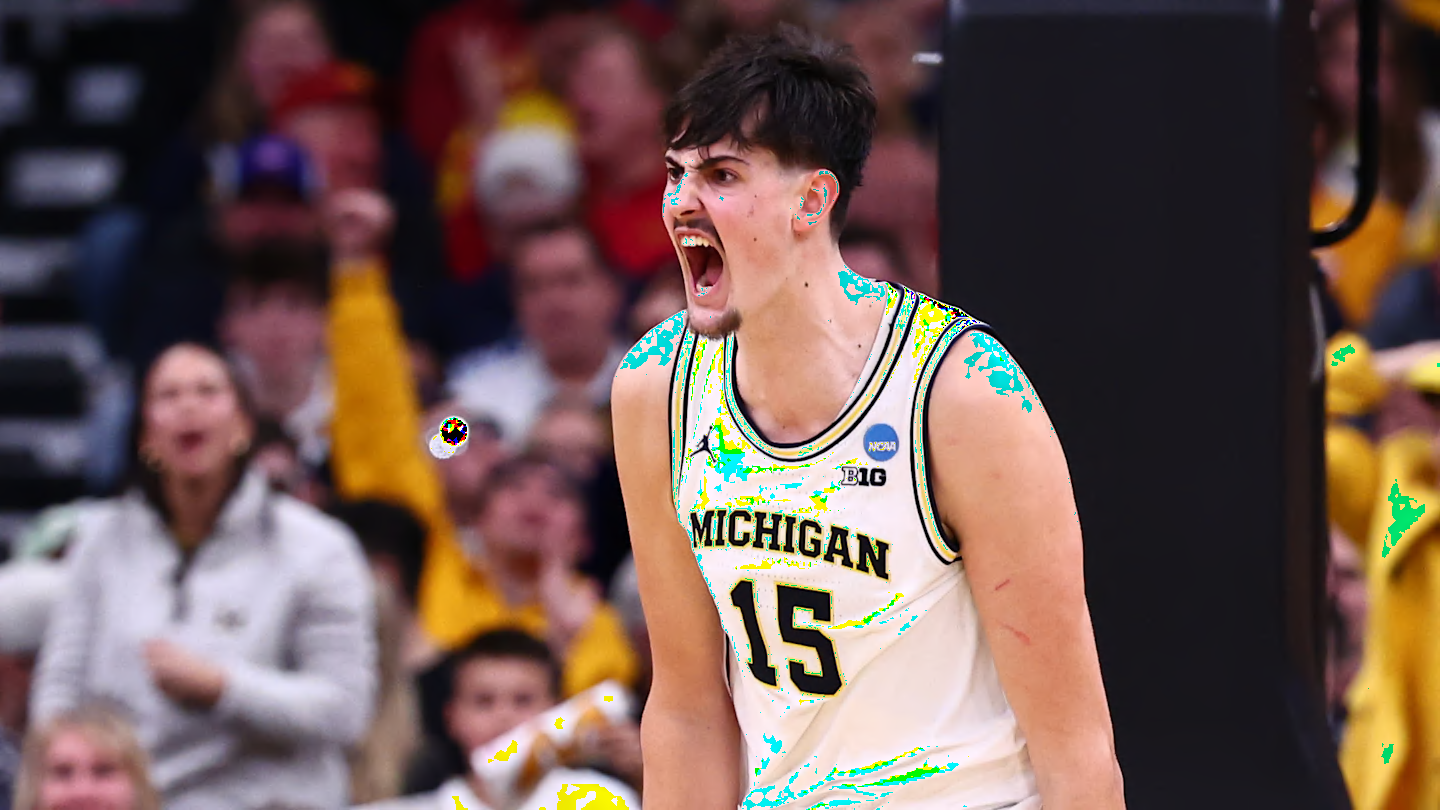
A shorter three-point arc has helped facilitate the elite shooting to get teams through the NCAA Tournament, but this year’s edition of March Madness has skewed considerably bigger. Teams with considerable height in the front court have made deep runs into the dance, with Illinois reaching the Final Four thanks to its considerable strength up front while Duke and Michigan have a chance to join them Sunday.
College basketball’s tallest teams are thriving in March Madness
- Tallest team in March Madness: Illinois, 80 inch average height
- Average team height in college basketball: 77.4 inches
As of early February, Michigan was holding opponents to 31.6 points per 100 possessions with their jumbo lineup on the floor. That’s good for a 39.6 field goal percentage. Illinois ranks as the tallest team in college basketball, with an average height of 80 inches. That clearly paid off for them in the form of a Final Four berth.
But this isn’t just a trend for contenders – the average height in Division 1 is 77.4 inches, and the tallest its been in over two decades.
|
Season |
Height (Inches) |
|---|---|
|
2006-07 |
76.5 |
|
2007-08 |
77 |
|
2008-09 |
76.5 |
|
2009-10 |
76.5 |
|
2010-11 |
76.5 |
|
2011-12 |
76.5 |
|
2012-13 |
76.6 |
|
2013-14 |
76.7 |
|
2014-15 |
76.7 |
|
2015-16 |
76.8 |
|
2016-17 |
76.8 |
|
2017-18 |
76.8 |
|
2018-19 |
76.8 |
|
2019-20 |
76.8 |
|
2020-21 |
76.9 |
|
2021-22 |
77 |
|
2022-23 |
77.1 |
|
2023-24 |
77.1 |
|
2024-25 |
77.2 |
|
2025-26 |
77.4 |
The emphasis on size down low also matters a lot on the glass as offensive rebounding is a big help when it comes to putting points on the board. Having players like Aday Mara, Patrick Ngbonga, Cameron Boozer and Tomislav Ivicic crashing the glass gives their teams a significant advantage in either stopping possessions or creating second chance opportunities if a perimeter shot doesn’t go.
Analytics and a college basketball rule change are why size matters in March Madness

The rise of analytics in today’s game has made a lot of teams focus on creating more efficient shot profiles, eschewing the mid-range jumper for better shots. The mid-range pull up, which was a staple for the likes of Walker and Anthony, is considered to be a less efficient shot than either a dunk or a layup, which has a higher probability of going in due to a shorter distance from the ball to the hoop.
That advanced profile has created a premium on rim protection, requiring more athletic bigs capable of defending the paint against shifty guards. Moore pointed out that a 2023 rule change by the NCAA to clarify the block/charge situation for officials has led coaches to lean more towards verticality defensively, which allows their taller players to go straight up to contest shots without fouling.
That emphasis, combined with the growing skill of fours and fives to step out and shoot, has allowed coaches to not need to play small in order to have enough skill on the floor. Teams like Michigan and Duke have elite rim protectors in Mara and Ngbongba who anchor their defense and can play alongside taller forwards capable of switching, dropping more big bodies towards the rim.
A lot of today’s taller players aren’t built like the bruising centers of yesteryear, when Shaquille O’Neal or Alonzo Mourning would catch the ball on the low block and back down their opponents to the rim. Bigs like Mara and Yaxel Lendeborg are more athletic with tremendous wing spans, allowing them to be more vertical on defense while contesting jump shots if switched onto perimeter players.
Size is a skill that cannot be taught and even the most skilled team cannot match up with taller players if they don’t have some on their roster already. Those matchup problems create a huge edge for the teams that have them in March, which is something to track as we move deeper into the NCAA Tournament.
More March Madness news and analysis: