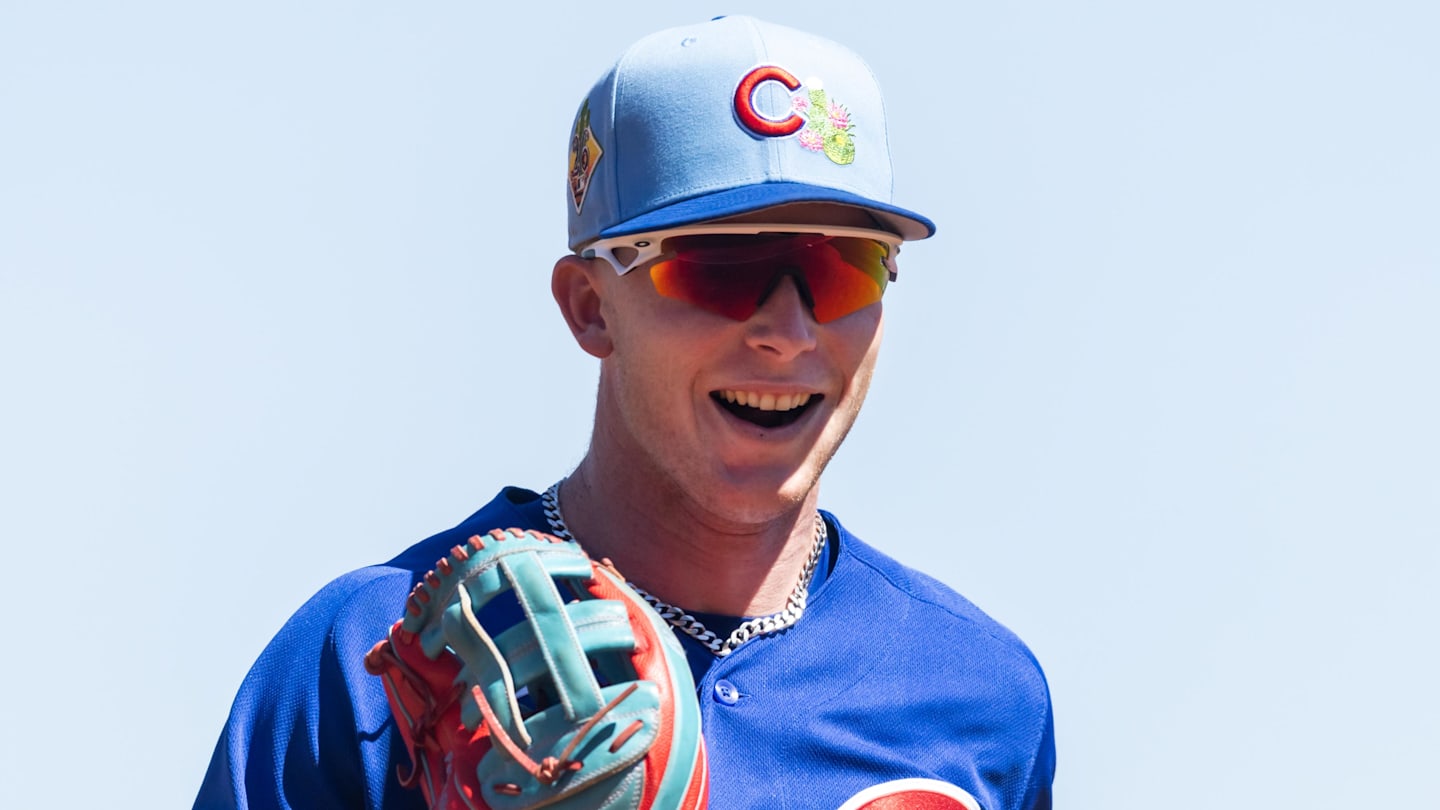

The Chicago Cubs gave fans reason to forget all about their embarrassing Opening Day defeat by extending Nico Hoerner on a six-year, $141 million deal on Thursday evening. They’ve now extended Hoerner and fellow Gold Glover Pete Crow-Armstrong on six-year, nine-figure deals in a matter of days, solidifying that duo as current and future cornerstones.
As is the case with any big-money move, though, there are ripple effects worth keeping in mind. Given that, let’s discuss what these two big-money moves mean for the future.
Cubs extensions put these veterans on the chopping block
It goes without saying that the Cubs spending over $200 million combined on these two players over the next six years makes it unlikely that Chicago will be keeping all of its current core around. The players below might not get traded, but their path to staying put is a lot murkier now.
INF/OF Matt Shaw

Matt Shaw might not be a veteran, but no Cub is impacted more by the Hoerner extension. When the Cubs signed Alex Bregman, the assumption was that Shaw would be a utility player in 2026 and then take over for Hoerner at the keystone when the latter left in free agency next winter. That’s clearly not going to happen anymore, and I don’t know what Shaw’s future holds.
Hoerner is at second base, Bregman is at third base and Dansby Swanson is at shortstop. There’s no room for Shaw in the infield, now or in the foreseeable future. Might he move out to the outfield full-time? Perhaps. Maybe the Cubs want him to be in a utility role long term, giving them depth all over the diamond in the event of an injury. Shaw could also be a high-end trade candidate: His rookie year wasn’t the greatest, but he finished the season strongly and was a high-end prospect as recently as 12 months ago.
The Cubs are clearly entering their World Series window. Trading Shaw for a player who might fit better or be more ready to contribute in the short term could make sense.
OF Seiya Suzuki
Both Ian Happ and Seiya Suzuki are set to hit free agency after the 2026 season. Now that Crow-Armstrong is locked in for the next six years, the odds of them re-signing both Happ and Suzuki are slim to none. Of the two, it’s probably more likely that Happ, the cheaper player who is better defensively and would probably be more willing to take a hometown discount, would be the one extended, thus making Suzuki more likely to leave.
A Suzuki departure would be painful, as he might be the best hitter on the team right now. He shattered previous career highs with 32 home runs and 103 RBI in 2025, and he even received down-ballot MVP votes. Since he’s such a good hitter, though, he’ll probably cost more money than the Cubs would be willing to pay at this point.
With internal options like Shaw, Kevin Alcantara and even Ethan Conrad in the organization, the Cubs will likely justify letting him go.
RHP Jameson Taillon

Jameson Taillon has been the reliable mid-rotation stalwart the Cubs thought they were getting when they gave him a four-year deal ahead of the 2023 campaign. He’s averaged 27 starts and has an ERA under 4.00 in his three seasons with Chicago while averaging a shade under 150 innings annually. That kind of reliability is harder to find than you might think.
With that being said, Taillon is 34 years old, his advanced metrics aren’t particularly great and while he’s been mostly durable in his Cubs tenure, he hasn’t always been the most reliable when it comes to taking the ball every fifth day.
Perhaps re-signing Taillon to be their No. 5 starter would make sense if he has another good year in 2026, but now that Hoerner and Crow-Armstrong are locked in, I have my doubts that a deal will come to fruition. Taillon will be expensive for that role, and the Cubs have internal options like Jaxon Wiggins, Ben Brown and Jordan Wicks that they can turn to for a lot less money.
Cubs extensions make two prospects more important — and two others very expendable
Now that the Cubs have Hoerner and Crow-Armstrong locked up, attention turns to the farm system. Some prospects become more important as the Cubs try to save money in other areas, while others who might be blocked become more expendable.
Ethan Conrad could be the Seiya Suzuki replacement
Ethan Conrad was arguably the best college hitter in last year’s MLB Draft. He’s going to miss the beginning of the year with a back injury, but once his professional career gets underway, he might not need much time before he’s MLB-ready. Conrad might not be the pure hitter Suzuki is, but he has a ton of power while offering more speed and better defense.
At the end of the day, you can’t pay everybody, even when you’re a big-market team like the Cubs. Having a high-end prospect like Conrad waiting in the wings as the Suzuki replacement should make fans feel a bit better about the idea of Suzuki pricing himself out of the Windy City.
Kevin Alcantara is blocked by Pete Crow-Armstrong

Kevin Alcantara can play all three outfield positions, so he isn’t technically blocked by PCA, but what makes him such an exciting prospect is his elite speed and defense. Sure, they could play him in a corner outfield spot, but that’d be suppressing his value, as would using him as a fourth outfielder. Since Crow-Armstrong is a lock to be in center field for the next six years at least, why not trade Alcantara now?
As good a defender and runner as he is, I’m not sold he’ll hit enough to be worth starting in a position that isn’t center field. He’s gone just 5-for-21 in his brief big-league career, and it’s hard to envision him getting regular time at this level in a Cubs uniform without a PCA injury. Trading him for a player who fills more of an immediate need could be a priority.
Jaxon Wiggins will help the Cubs save money in the rotation
Happ and Suzuki’s upcoming free agencies have gotten most of the attention, but Taillon, Shota Imanaga and (likely) Matthew Boyd will all be hitting the open market after this season too. The Cubs have Edward Cabrera, Justin Steele and Cade Horton to lean on moving forward, but they need more back-end rotation depth. That’s where top prospect Jaxon Wiggins comes in.
Wiggins, a 24-year-old who has made it up to Triple-A, could be MLB-ready sometime this season. I don’t know if he’ll crack the Cubs’ rotation given the depth they have right now, but he’ll certainly have a chance to do so in 2026. While trading top prospects for win-now pieces is always tempting, keeping young talents who will only make the minimum is even more tempting for a team trying to save money after handing out two large extensions.
Jefferson Rojas is blocked by Nico Hoerner

Jefferson Rojas has been a top prospect in the Cubs’ system for years now, and he’s finally made it to Double-A. He didn’t hit well last season at that level, but if he can get it going offensively in 2026, Rojas could be big-league ready by the end of the year or early in 2027. He seemingly had a pathway towards the starting second base job with Hoerner’s contract up after the year, but what happens now?
Hoerner is locked in through 2032. Rojas has played shortstop more than second base, but Swanson is locked in through 2029. Rojas has even played some third base, but Bregman is locked in through 2030. He could be kept as a utility infielder, but there’d probably be more value in trading him for a win-now piece, now that his path to being a starter in Chicago is pretty non-existent.
What do Cubs extensions mean for future free agent pursuits?

The short answer to this question is that we don’t know what the extensions will mean for future free-agent pursuits. On the one hand, the Cubs are a big-market team that generates a ton of revenue and can spend big money on just about anyone who becomes available, even with these contracts on the books. On the other hand, owner Tom Ricketts has always been frugal, and it’s honestly surprising that the Cubs were able to agree to terms with Crow-Armstrong and Hoerner.
What we do know, though, is that these contracts are within the top ten richest deals in Cubs history. When adding in the deals Bregman and Swanson signed, Chicago has four of the nine richest contracts in its history on the books past 2026. Is Ricketts really going to allow a big deal in addition to that? Cubs fans would say he should, but we need to be realistic.
If the Cubs find a player who they believe is worth the cost, they won’t hesitate to pull the trigger. That’s why Crow-Armstrong was extended years before they had to pay him. They won’t go out of their way to spend, though, especially now that a lot more money is committed to this core long-term.
More MLB news and analysis: