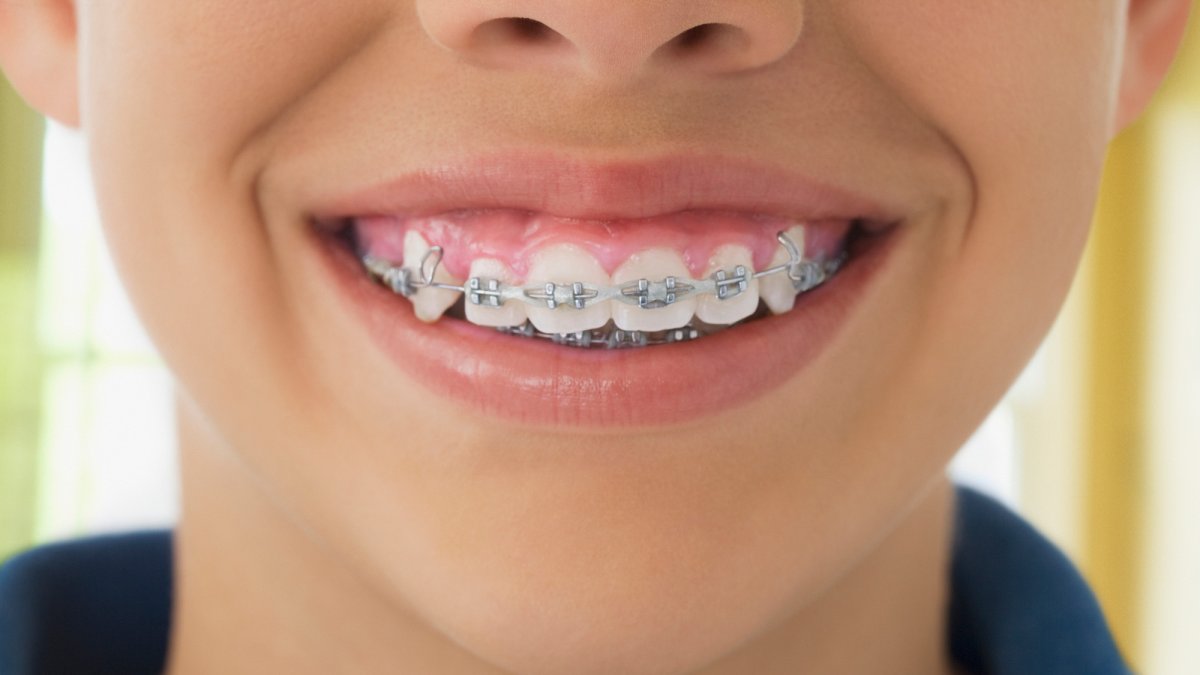

Today braces are something of a rite of passage. But for hundreds of thousands of years, our ancient ancestors didn’t need them. So what gives? Why do we need braces?
On a new episode of the Ask Us Anything podcast, we explore just that. So, buckle up: The answer has actually nothing to do with teeth—and everything to do with what we eat.
Popular Science’s Ask Us Anything podcast answers your most outlandish, mind-burning questions—from the everyday things you’ve always wondered to the bizarre things you never thought to ask. So, yes, pregnancy changes your body forever and no, water picks won’t damage tooth enamel. If you have a question for us, send us a note. We love answering weird questions.
This episode is based on the Popular Science article “Why our ancestors had straight teeth without braces.”
Subscribe to Ask Us Anything
Listen and follow Ask Us Anything on your favorite podcast platform:
Spotify | Apple Podcasts | YouTube | Or wherever you get your podcasts.
Full Episode Transcript
Sarah Durn: What was it like having braces on your teeth?
Amanda Meier: A memory that I have of having braces is getting to pick the colors of the little brackets that go on your teeth. And I remember stressing out that they wouldn’t match my clothing, which is silly now, but that was a big deal.
J. Edwards: So one specific memory about my braces: I was within the first three weeks, I woke up one morning and realized that the teeth at the top part of my gum and my upper lip had actually started to move down into where people normally have the row of teeth.
Lindsey Ramsey: For me, having braces was a very traumatic time. You’re a preteen and already riddled with anxiety. Then add on braces plus headgear that I’d also have to wear at sleepovers. It was so embarrassing.
Edith Colbert-Haburchak: I have braces right now and I like them. I’m glad that I have them, or else I would need to remove my teeth.
SD: Welcome to Ask Us Anything from the editors of Popular Science, where we answer your questions about our weird world from “Why aren’t there insects in the ocean,” to, “How come only some people get motion sickness?” No question is too offbeat or seemingly simple. I’m Sarah Durn, an editor of Popular Science.
AC: And hello, I’m editor-in-chief Annie Colbert.
SD: Hello, Annie! Here at PopSci, we can’t resist a head-scratching question.
AC: And this week we’re wondering: Why do modern humans need braces on their teeth?
Sarah, you’re familiar with this, so please tell us: What’s up with our mouths. What went wrong during evolution that now we have to install metal brackets on our teeth?
SD: Yeah, so I just edited a story on this, so the short answer is nothing went wrong exactly. It’s more like a mismatch. Our teeth are basically the same size they’ve always been, but our jaws, they’ve gotten smaller.
AC: Wait, our mouths shrank, but our teeth didn’t get the memo?
SD: Exactly. Thousands of years ago, humans were chewing really tough, fibrous foods all the time, and that constant workout actually helped our jaws grow bigger and stronger.
AC: So ancient humans were basically doing like jaw exercises?
SD: Yeah, pretty much.
But once we started eating softer, processed foods—think applesauce, peanut butter, especially as kids—our jaws just didn’t grow as much. Less chewing, less stimulation equals smaller jaws.
AC: And suddenly there’s not enough room for all your teeth.
SD: Right. So they crowd, overlap, twist. Then enter braces.
AC: Hmm. So this isn’t just about straight teeth, it’s about how modern life has reshaped our entire faces.
SD: Yeah. And it turns out that shift might be causing more than just crooked smiles.
AC: Woo. Okay. So being a person who had braces, not once, but twice, I’m officially intrigued.
SD: Oh no. Twice.
AC: Twice.
SD: So before we dig into how applesauce may have ruined our jaws, we want to know what questions are keeping you up at night.
If there’s something you’ve always wanted to know, submit your question by clicking the “Ask Us” link at popsci.com/ask. Again, that’s popsci.com/ask, and click the “Ask Us” link.
AC: We want your questions!
SD: We want them. And with that, we’ll be back after a quick break with all the delectable details about why our ancestors didn’t ever need braces.
AC: Wait, ever?
SD: Ancient humans had surprisingly straight chompers.
AC: The story just gets more and more interesting.
SD: Welcome back. So Annie, tell us about your braces experience.
AC: Uh, reluctantly, yes, I will share. As I mentioned up top, um, I had braces twice. The first time I had them was as a teen, and my jaw was so tiny that they actually pulled four of my adult teeth, so I have fewer teeth than many people.
And then, of course, I failed to wear my retainer in my twenties, as many of us do. I probably lost it four or five times and I didn’t have the money to pay for a new one. So then I needed Invisalign in my late twenties…
SD: Oh no.
AC: …in order to fix my teeth again. How about you?
SD: Yeah, I actually had like a cute little gap between my teeth when I was little. I remember the dentist saying I could either keep it or get rid of it with braces.
AC: So I’m looking at you so I can guess what you chose, but please confirm.
SD: Yes. For those who can’t see me, I ended up deciding to close my gap, but I think if I went back now, I probably would’ve kept it.
AC: Yes.
SD: But you know, it was like middle school and I think I wanted to fit in.
AC: Yes. Very relatable. Now, before we get into why so many of us ended up needing braces, like Sarah and I. I want to take a quick step back because humans have been fixing tooth problems for a very long time.
SD: How long are we talking?
AC: Like prehistoric long. Dentistry actually dates back to about 7,000 BC in the Indus Valley civilization.
SD: Wait, so people were going to the dentist before the invention of the wheel?
AC: Yes, exactly. The wheel wasn’t invented for another couple more millennia.
SD: That’s so wild to think about.
AC: Yes. But I will say “dentist” might be a generous term for what was happening. Early on, people thought tooth decay was caused by tiny worms in your teeth.
SD: Oh, yikes. Don’t like that.
AC: Yeah, right. Yuck. But that idea stuck around for thousands of years, all the way into the 1700s.
SD: Wow. That’s a commitment to a theory.
AC: Yep. But over time, people started getting more scientific about it.
SD: Probably a good approach.
AC: Yes. We always support more science. So ancient Greek physicians like Hippocrates and Aristotle wrote about treating tooth decay.
And by the 1500s, we finally got the first book entirely devoted to dentistry.
SD: Okay, so when does all of this start to look like modern dentistry?
AC: Yeah, so dentistry as we know it really kicks off in the 1700s with a French surgeon named Pierre Fauchard. He’s often called the father of modern dentistry.
SD: Hmmm. Are teeth thank you, Dr. Fauchard.
AC: He wrote this massive book. It was laying out how to care for teeth. It identified sugar as a cause of decay, and, this is key for our story, he also invented one of the earliest orthodontic devices.
SD: Oh, okay. Thank you very much, doctor.
AC: Yes, it was called the Bandeau, and it was basically a horseshoe-shaped piece of metal that you’d put in your mouth to help expand your palate and straighten your teeth.
SD: Ooh, that sounds so uncomfortable.
AC: Yeah, it sounds a little bit like a torture device. And I will say, expanders still aren’t terribly comfortable. My eight-year-old is just about to get one, and she is not excited at all. So sorry. Tangent. But yes, early dentistry was not exactly a spa experience.
SD: Yeah, no laughing gas. No tiny TV.
AC: No. But from there, things start to snowball. By the 1800s, dentistry becomes a real profession. There are dental schools, regulations, toothbrushes, toothpaste.
SD: Ooh, toothbrushes. So when do people actually start brushing their teeth?
AC: Eh, eventually. Fun fact: Most Americans didn’t adopt regular brushing habits until after World War II.
SD: No.
AC: Yeah.
SD: As someone who really likes dental hygiene, that is not good.
AC: I know. But around the late 1800s and into the early 1900s, we also start seeing braces that we’d recognize today.
SD: So goodbye Fauchard’s metal horseshoe. Hello, metal brackets.
AC: Exactly. A guy named Edward Angle developed a system for classifying different types of crooked teeth, and he helped standardized orthodontics.
So by the early 1900s, dentists were using brackets and wires to actually move teeth into place.
SD: Okay, so braces, as we know them, are actually pretty recent.
AC: Very recent. Which raises a big question: If humans have had teeth for, you know, hundreds of thousands of years, why did we suddenly need all this hardware to fix them? What changed?
SD: Yeah, and so here’s the twist. For most of human history, people didn’t need braces.
AC: Which is wild.
SD: So wild. It’s not that ancient humans had better dentists or just, you know, put up with crooked weird teeth, it’s that their mouths were actually built differently.
AC: How so?
SD: So back in the early days of human history, we actually had bigger jaws.
AC: Okay, but why?
SD: So it all comes down to what early humans were eating, as we said in the intro, and how hard they had to work to eat it.
AC: How hard are we talking?
SD: So imagine you’re a human living tens of thousands of years ago. There’s no processed foods, no smoothies, no mashed potatoes. Everything you eat—plants, meat, roots—is tough and fibrous and requires serious chewing.
AC: So every meal is a jaw workout.
SD: Exactly. And that constant chewing actually stimulates your jaw to grow bigger and stronger. The bones respond to that stress by expanding in all directions.
AC: So it’s like going to the gym, but for your face.
SD: Yeah, pretty much.
But here’s the key. Your teeth don’t do that.
AC: Mm.
SD: Their size is basically set by genetics.
AC: So your jaw can grow bigger, but your teeth stay the same size?
SD: Right. So in ancient humans, you have these big, well-developed jaws with plenty of room for all your teeth to come in nice and straight.
AC: No crowding, no overlaps, no gaps.
SD: Exactly. Wisdom teeth had plenty of space. No impacted teeth. Everything just fit.
AC: Meanwhile, us modern humans…
SD: Yeah, modern humans are eating way softer foods, especially as kids when your jaw is still developing. So think purees, toast, pasta, applesauce.
AC: I mean delicious but terrible for jaw growth.
SD: So without that constant chewing stress, our jaws don’t grow as large.
AC: But our teeth are still the same size as our ancestors.
SD: Exactly. So when our teeth come in, they’re basically trying to fit into a space that’s too small.
AC: Cue the crowding.
SD: Crowding, twisting, overlapping: All the things braces are designed to fix. Scientists actually have a name for this: It’s an evolutionary mismatch. Our bodies evolved for one set of conditions—tough diets, lots of chewing—but we’re living in a totally different environment now.
AC: And our mouths, they didn’t keep up.
SD: Right.
It’s not just about crooked teeth either. Smaller jaws are also linked to things like impacted wisdom teeth, and even issues like sleep apnea.
AC: Oh, yes.
SD: And because there’s less room in your mouth overall, including for your tongue and airway structures, sleep apnea is way more common today than it likely was for our, you know, ancient ancestors.
AC: That’s a lot riding on jaw size,
SD: It really is. So braces, you know, they aren’t just cosmetic. They’re often solving a structural problem that didn’t really exist for our ancestors.
AC: All right. That makes me feel a little bit better about my high school braces era.
SD: Yeah, same. Applesauce: I mean, it’s cursed us all.
AC: That especially sucks because I love applesauce.
SD: Oh, applesauce plus peanut butter: It’s one of my favorite snacks.
AC: Oof. Love it. All right, well, I’ve learned a lot about braces today and feel better about my braces experience.
But when we come back, Sarah’s going to be chatting about another facet of early dental discoveries with epidemiologists Erin Welsh and Erin Allmann Updyke, hosts of the fascinating science podcast, This Podcast Will Kill You.
SD: Stay with us. We’ll be right back after this quick break.
And we’re back with epidemiologist Dr. Erin Welsh and Dr. Erin Allmann Updyke. Together, they host the popular science podcast, This Podcast Will Kill You. Welsh is a full-time science communicator, and Updyke is a board certified family medicine physician.
The pair met as grad students studying disease ecology, and since launching their podcast in 2017, the show has been an Apple chart-topper and been featured in The New York Times, The Today Show, and even on the CDC’s website.
Welcome Erin and Erin!
Erin Allen Updyke: Hello.
Erin Welsh: Thank you. Thanks for that really lovely introduction. Wow.
EAU: Yeah, we’re excited to be here.
EW: Yeah.
SD: Excited to have you guys! So not super long ago you guys delved into all things fluoride from its natural origins to all its benefits in modern dentistry. So what was the most surprising thing you learned while doing your research for those episodes?
EW: I think for me, just like John Green says, everything is tuberculosis. So the dentist who discovered fluoride and started to go down this rabbit hole, moved from the northeast to Colorado Springs where it was drier and warmer to treat his tuberculosis.
And it was there that he noticed in Colorado Springs, a Colorado stain or this brown teeth mottling and it happened to be in people who were living in areas with heavily fluoridated water.
But with these stains, he noticed that they had no cavities. And so that’s sort of what set him off to understand what’s causing the stain that’s also preventing cavities.
SD: Yeah. I had no idea that fluoride was naturally occurring.
EAU: I had no idea either before we started researching this episode, and especially to know just how high the levels of fluoride can be in naturally occurring sources, compared to the level that we artificially fluoridate the water in communities where we do water fluoridation for for dental prevention. We fluoridate the water to like 0.7 parts per million. But in some places, like in Colorado Springs, it was like over 4, over 5, like really, really high concentrations.
EW: There was one place that was 12 that he discovered, which is like very high fluoridation.
EAU: And we do sometimes see negative health consequences at really high fluoridation levels, but we don’t see negative health consequences at the levels of fluoridation that we fluoridate water at.
Which I think is one of the big things that I took away from the research on that episode because there’s so much misinformation out there about fluoridation and the potential for negative health impacts as opposed to the incredible public health impact that it has had.
SD: Well, Erin and Erin, thank you so much for making the time to chat with us. Where can listeners hear more about what you’re up to?
EW: Ah, well, we’ve got a website: thispodcastwillkillyou.com, but you can also find us wherever you get your podcast: Spotify, Apple Podcast. And we have some of our, most of our newest episodes on YouTube, so you can check us out there through the Exactly Right Media YouTube channel.
SD: Amazing. You guys, thank you so much for making the time to chat with us.
EAU: Thank you. We’re thrilled. This is fun.
EW: Thanks so much for having us. Yeah, this is great.
AC: Oh, they’re so cool.
SD: Yeah, I love them. They were fun.
AC: It all really does come back to tuberculosis. All right, that’s it for this episode. And now I’m feeling pressure to wear my retainer tonight. And if you also have a retainer, definitely wear it. Anyway, we’ve got more episodes of Ask Us Anything live in our feed right now!
Follow or subscribe to Ask Us Anything by Popular Science wherever you enjoy your podcasts, and if you like our show, leave a rating and review.
SD: Did you also have to suffer through braces? You know, let us know in the comments.
Our theme music is from Kenneth Michael Reagan, and our producer is Alan Haburchak.
This week’s episode was based on an article written for Popular Science by Sara Kylie Watson.
AC: Thank you team for the great episode. Thank you braces for the straight teeth. And thank you everyone for listening.
SD: And one more time, if you want something you’ve always wondered about explained on a future episode, go to popsci.com/ask and click the “Ask Us” link.
Until next time, keep the questions coming!

2025 PopSci Best of What’s New