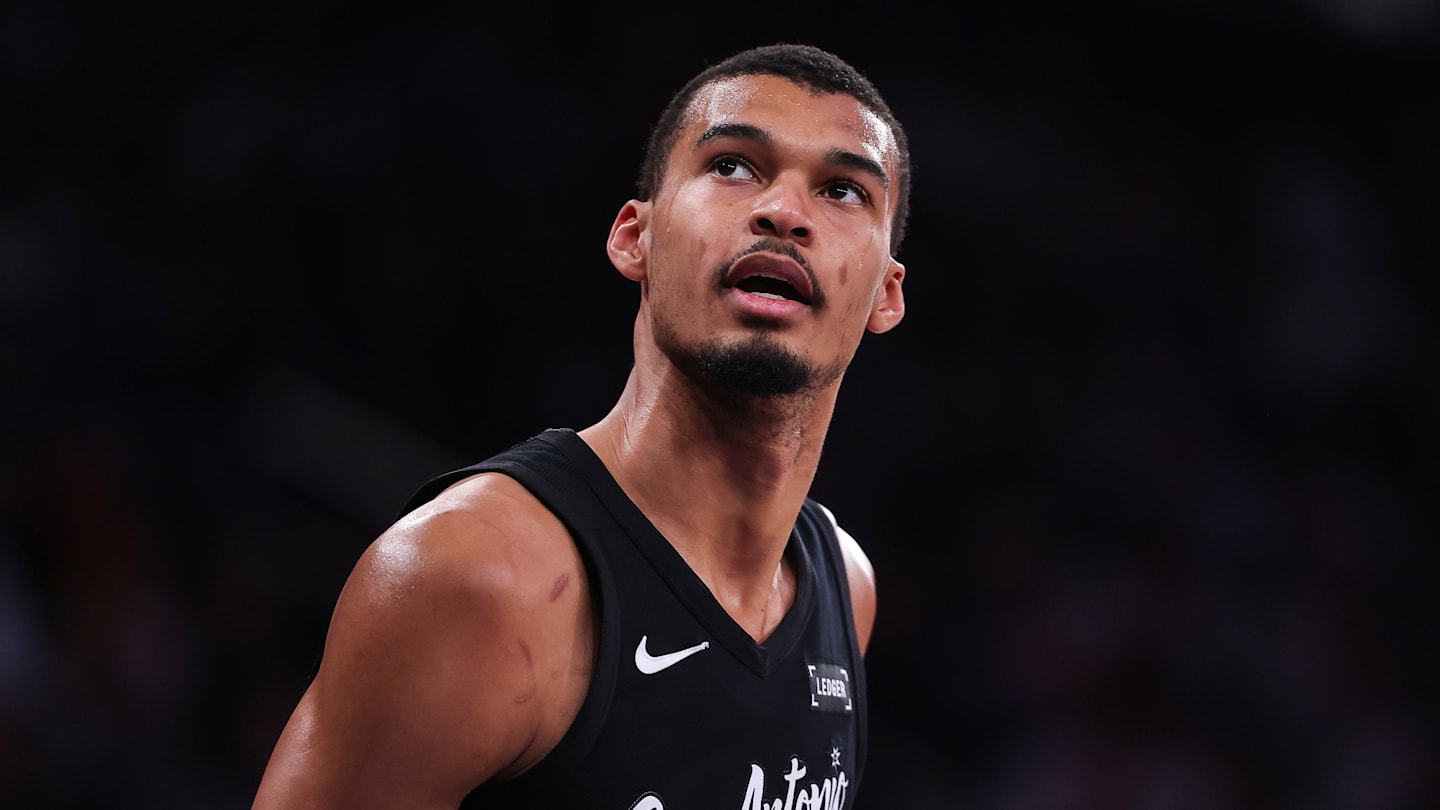

If the season ended today, there would be no debate over the Defensive Player of the Year award. It would belong to San Antonio Spurs center Victor Wembanyama — just like it almost did last season, before an injury cut his season short.
Wemby has put together another unparalleled rim protection display in San Antonio, where he anchors the NBA’s third-ranked defense. He leads the league in blocks (2.9), but his impact stretches so far beyond the counting stats. At 7-foot-4 with an endless 8-foot wingspan and effortless agility in tight spaces, it’s damn near impossible to find daylight when driving against the former No. 1 pick.
But what if this is all for naught? The 22-year-old fell short of the NBA’s 65-game minimum for awards last season. He’s dangerously close to failing to meet that threshold again.
How close is Wemby to becoming ineligible for DPOY?

Wembanyama has appeared in 47 of San Antonio’s 61 games so far. He has missed 14 of a possible 17 games in order to still qualify for Defensive Player of the Year (and potentially MVP, but that’s another discussion for another day). That means he can miss no more than three games over the final month-plus of the regular season.
All signs are go for Wemby at this point. The Spurs are largely careful with his minutes and he puts more meticulous work into joint flexibility and maintenance than just about any other 7-footer in NBA history. If he can get through the next five weeks unscathed, the award will have Wembanyama’s named engraved on it weeks in advance.
That said, it’s hard to proceed with absolute certainty here. Wemby dealt with a calf injury earlier this season, which caused him to miss three weeks. Given the recent trend of calf injuries preceding Achilles tears — and given Wemby’s unique anatomy — the Spurs ought to proceed with the utmost caution. What if the 44-win Spurs, currently 5.5 games ahead of third-place Houston in the West, clinch their postseason spot a few games early. Would there be any benefit to playing Wemby extra games just to secure the hardware? That sort of difficult decision could be coming down the pipeline.
Who overtakes DPOY leaderboard if Victor Wembanyama misses games?

Just based on the odds at FanDuel, OKC forward Chet Holmgren is the clear next man up if Wemby fails to reach 65 games. Wemby (-900) has what is essentially an insurmountable edge over Holmgren (+650) if he maintains eligibility. There’s no closing the gap for Holmgren. But, should Wemby suffer an unfortunate injury, or should the Spurs decide to rest him down the stretch, the path opens up for Holmgren.
It’s hard to argue with Holmgren’s second-best candidacy. OKC is once again the most dominant defense in the NBA. While the Thunder are stocked with elite stoppers across the board, Holmgren is the thread that connects it all — a mobile, impossibly long free safety who can lurk on the weak side, mirror ball-handlers on the perimeter, and muck up pick-and-rolls as the middle man. Opponents shoot 5.1 percent worse at the rim with Holmgren on the floor, per Cleaning the Glass.
Wemby and Holmgren are cosmically linked in a way — top-two picks a year apart, former foes on the international stage, and aesthetically quite similar. Both are impossibly skinny, yet extremely competitive and unbelievably attuned to the defensive machanations of this sport. Their instincts, their ability to erase space and recover from almost every disadvantage, makes them a uniquely impossible equation for opposing offenses. Wemby just happens to hold, um, a few slight physical advantages.
The surface-level stats naturally aren’t quite as exciting with Holmgren (7.1 defensive rebounds, 1.9 blocks, 0.5 steals) but it’s impossible to watch OKC and not come away appreciating just how thoroughly Holmgren effects his opponent’s execution on a nightly basis, even if it does not show up in the box score.
Best non-Wemby DPOY candidates

5. Ausar Thompson, Detroit Pistons
Detroit is second only to Oklahoma City in defensive rating (108.4), which is the foundation of its regular season dominance in the East. The Pistons defend by committee, with excellent buy-in across the board, but Ausar Thompson is the real chaos engine. A one-percent athlete, Thompson can guard four positions without blinking. He erases gaps as a helper. He fights over screens and contests shots with levitation, and kickstarts transition offense with his frequent interceptions. Expect both Thompson twins to frequent this conversation for years to come.
4. Scottie Barnes, Toronto Raptors
Scottie Barnes not-so-surprisingly drives a lot of the winning in Toronto, making substantial contributions on both ends. We’ve seen Barnes show off his immense defensive ceiling in the past, but this is his best season to date. He’s averaging 1.4 blocks and 1.6 steals, bodying 7-footers in the paint and switching seamlessly onto the perimeter. Barnes is so sharp with his anticipation, able to cycle chameleon-like between various roles depending on the Raptors’ personnel. Need him to protect the rim? Need him to guard the opponent’s best scorer? Need him to play free safety on the help side? He can get the job done.
3. Derrick White, Boston Celtics
Credit to Neemias Queta, Jaylen Brown and others, but there is simply no way the Celtics roster, as it’s currently constructed, should own the NBA’s seventh-best defense. Derrick White deserves the bulk of the praise, averaging 1.2 steals and 1.5 blocks (as a guard…). The man is everywhere, always tracking sight lines and pouncing on mistakes. He’s strong enough to handle bigger wings and nimble enough to choke ball-handlers at the point of attack. He flies in from the weak side to punish unaware slashers. There is not a more impressive player to watch on defense, with the exception of Wemby and Chet.
2. Rudy Gobert, Minnesota Timberwolves
Yeah, I know, yawn. But Rudy Gobert is still awesome (basketball-wise), no matter how hard we try to paint him as not awesome. Minnesota’s defense has regressed ever so slightly this season, but it’s perched comfortably in the top 10. Opponents’ effective field goal percentage drops a whole five percent with Gobert on the floor this season, the second-best mark of his illustrious career. He’s a hellacious rebounder, a still-omnipresent rim protector (1.6 blocks), and pretty much the foundational text for all future wannabe DPOY candidates at the center position.
1. Chet Holmgren, Oklahoma City Thunder
See above. The case checks out numerically, in the eye test, and if that’s not enough, he gets the age-old “best defender on best defense” narrative boost.
More NBA news and analysis: