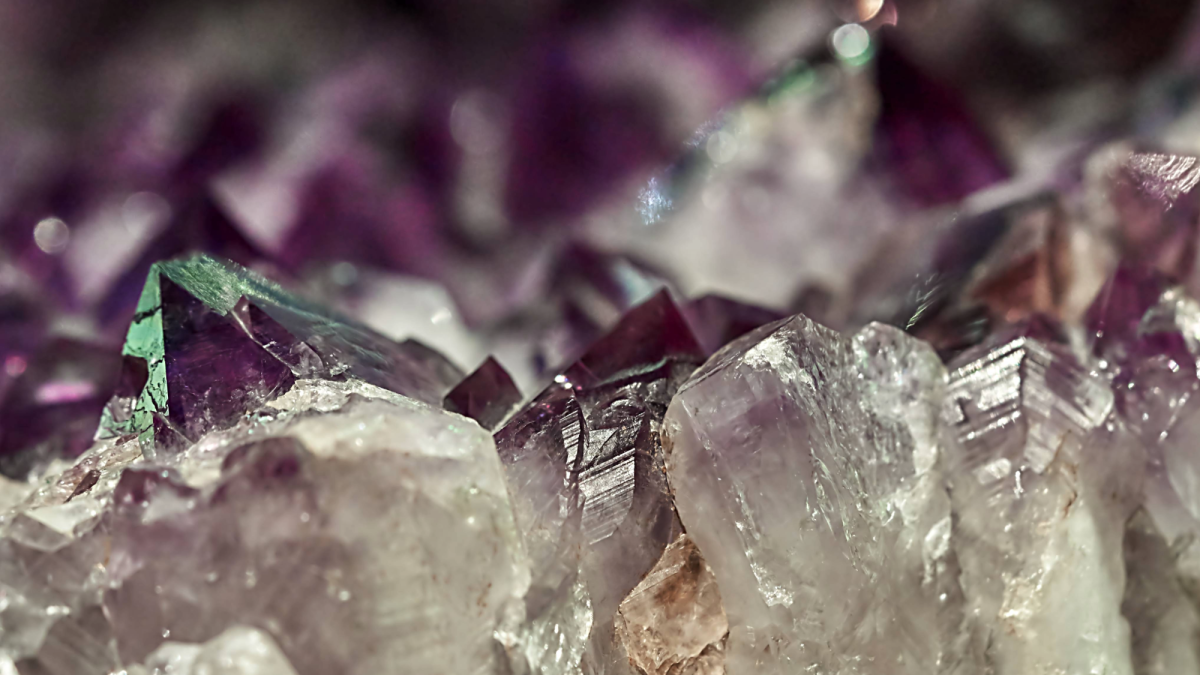

Primates of all stripes really love their crystals. Archeologists have found the shiny rocks at dig sites dating back as long as 780,000 years ago. Although, we are still not sure if our ancestors used them as tools, weapons, or jewelry.
To learn more, a team of scientists in Spain turned to one of our closest primate ancestors—chimpanzees. Their experiments revealed that chimps raised alongside humans can tell the difference between crystals and other stones. The findings are detailed in a study published today in the journal Frontiers in Psychology, and could reveal more about our own fascination with these shiny symmetrical stones.
“We were pleasantly surprised by how strong and seemingly natural the chimpanzees’ attraction to crystals was,” Juan Manuel García-Ruiz, a study co-author and crystallographer at Donostia International Physics Center, said in a statement. “This suggests that sensitivity to such objects may have deep evolutionary roots.”
Crystal vs. rock
Our species derived from chimpanzees between six and seven million years ago. However, we still share a lot of DNA—about 98.8 percent—and behavioral similarities. To see if a fascination with crystals is one of these shared pastimes, the researchers studied two groups of enculturated chimpanzees, or apes that are raised in environments that are enriched by humans. Manuela, Guillermo, Yvan, Yaki, and Toti were in group one, while Gombe, Lulú, Pascual, and Sandy in group two. Both groups were given access to crystals.
In the first experiment, a large crystal was placed on a platform alongside a normal rock of similar size. Initially, both objects caught the chimps’ attention. Soon after, theydiscarded the rock and the crystal became their favorite. Once they removed the crystal from the platform, all of the chimps inspected it by rotating and tilting it so that they could view it from a variety of angles. Yvan from group one then picked up the crystal and carried it to the animals’ dormitories.
The chimps were most interested in the crystal soon after exposure, but interest gradually declined over time. Humans exhibit this same pattern, when the novelty of an object fades. When the caretakers tried to retrieve the crystal, they had to exchange it for the chimps’ favorite snacks, yogurt and bananas.

Toti analyzing the shape of the crystal
Pick a crystal, any crystal
In the second experiment, the caretakers presented the team with a pile of 20 rounded pebbles. They then added quartz, pyrite, and calcite crystals to the pile and the chimps could identify the crystals within seconds.
“The chimpanzees began to study the crystals’ transparency with extreme curiosity, holding them up to eye level and looking through them,” García-Ruiz said.
The chimps repeatedly examined the crystals for hours at a time. For instance, Sandy from group two carried pebbles and crystals in her mouth over to a wooden platform where she then separated them.
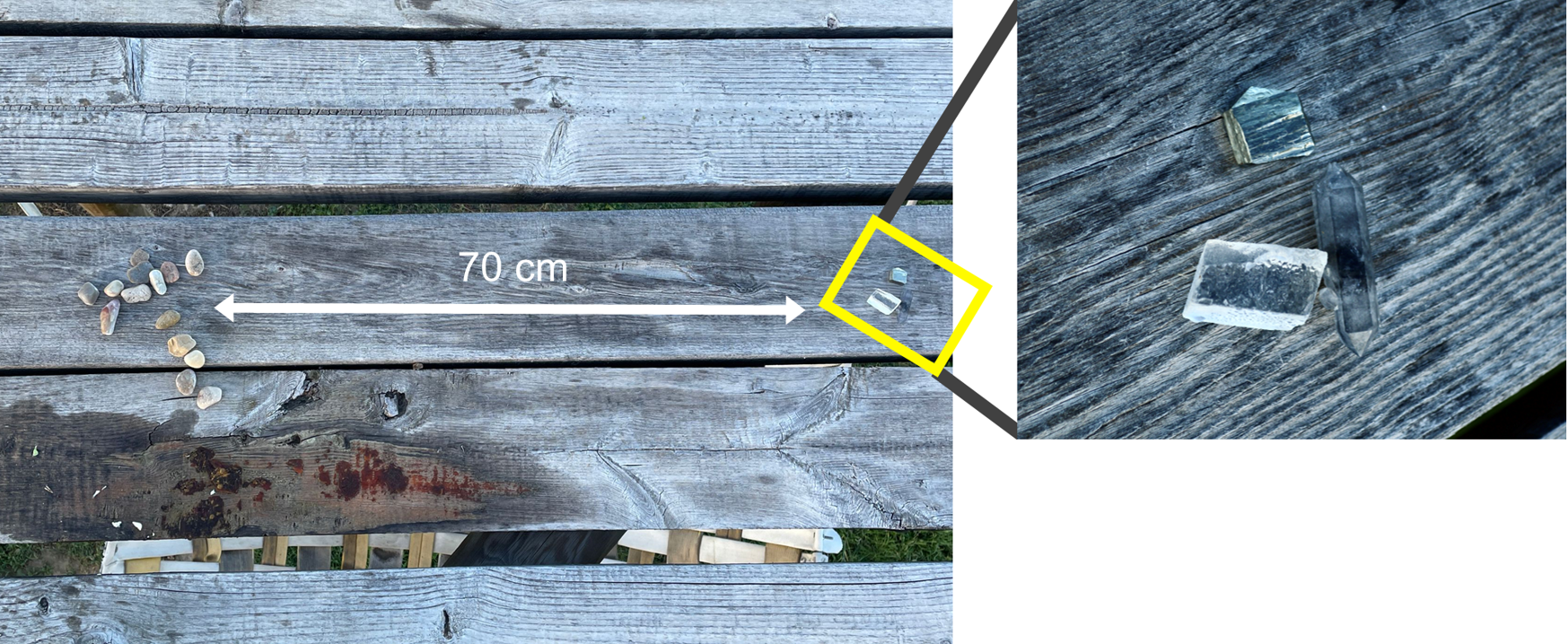
“She separated the three crystal types, which themselves differed in transparency, symmetry, and luster, from all the pebbles. This ability to recognize crystals despite their differences amazed us,” García-Ruiz said.
According to the team, chimps do not usually use their mouths to carry objects. This behavior could mean that they were hiding them, which is consistent with treating the crystals as valuable objects.
The team did not examine if some chimpanzees were more interested in specific crystals or laid a claim more than others. The team believes that future studies could take their personalities into account.
“There are Don Quixotes and Sanchos: idealists and pragmatists. Some may find the transparency of crystals fascinating, while others are interested in their smell and whether they’re edible,” García-Ruiz explained.
The animals in this study are also human contact and familiar with objects that are not seen in the wild. Conducting the same experiments with wild apes could reveal more about this behavior in natural settings.

Yvan analyzing transparency of crystals
Six million years of fascination
Overall, crystal transparency and shape were the most alluring properties during the experiments. These may be the same qualities that first attracted early humans to these rocks. The clouds, trees, mountains, animals, and rivers that surrounded our ancestors were more curved, so seeing an object with straight lines and flat surfaces may have been appealing. Crystals are the only natural solids with many flat surfaces, and early humans’ brains may have been drawn to these patterns that were unlike what they knew.
“Our work helps explain our fascination with crystals and contributes to the understanding of the evolutionary roots of aesthetics and worldview,” concluded García-Ruiz. “We now know that we’ve had crystals in our minds for at least six million years.”

2025 PopSci Best of What’s New