
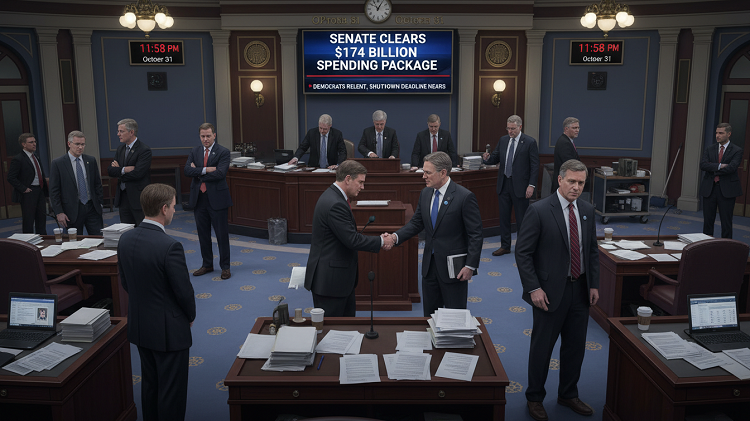
Washington, D.C. After days of procedural stalling and mounting political pressure, the U.S. Senate on Wednesday approved a $174 billion package of federal spending bills, sending the legislation to President Donald Trump’s desk as Congress races against time to avert a partial government shutdown.
The move represents meaningful progress toward funding the federal government for the remainder of the fiscal year, but lawmakers acknowledge it is only a partial victory. With the January 30 deadline looming, Congress must still pass several major appropriations bills most notably funding for the Department of Homeland Security (DHS) to avoid disruptions that could ripple across federal agencies and services.
While both parties publicly downplayed the drama surrounding the vote, the behind-the-scenes maneuvering underscored how fragile the bipartisan consensus remains, particularly as disagreements over immigration enforcement and DHS oversight intensify.
Democrats Drop Delay Tactics as Pressure Mounts
Senate Democrats initially attempted to slow the chamber’s progress using procedural delays, voicing strong objections to recent actions by the Trump administration involving DHS operations in Minnesota and Colorado. Several lawmakers used floor speeches to criticize what they described as aggressive enforcement tactics and a lack of accountability within the department.
However, with senators eager to leave Washington for a scheduled recess and wary of the political consequences of another shutdown Democratic resistance ultimately gave way. The Senate moved forward with the vote, passing the spending package and advancing three critical funding bills in one coordinated push.
Lawmakers from both parties were acutely aware of the fallout from last year’s shutdown, which stretched to 43 days and became the longest in U.S. history. That episode damaged public confidence in Congress and contributed to plummeting approval ratings that continue to haunt lawmakers as the next election cycle approaches.
What’s Inside the $174 Billion Minibus
The approved legislation is part of what lawmakers refer to as a “minibus,” a bundled set of appropriations bills that allows Congress to fund multiple agencies at once. This particular package includes funding for:
-
Commerce, Justice, and Science agencies, covering everything from the Census Bureau to federal law enforcement and research institutions
-
Energy and Water Development, including infrastructure projects, water systems, and energy research
-
Interior and Environment agencies, which oversee national parks, environmental protection, and public lands
Compared to other funding measures still awaiting action, this minibus was widely seen as one of the easier lifts politically. Most of the programs it funds enjoy long-standing bipartisan support, making compromise more attainable than in more contentious policy areas.
President Trump is expected to sign the package promptly, clearing the way for continued operations across the affected agencies.
DHS Funding Emerges as the Biggest Obstacle
Despite the Senate’s progress, funding for the Department of Homeland Security remains unresolved and is widely viewed as the most significant threat to avoiding a shutdown.
Democrats have expressed outrage over DHS actions tied to immigration enforcement, particularly following the fatal shooting of Renee Nicole Good by an Immigration and Customs Enforcement (ICE) agent. Progressive lawmakers are demanding restrictions on DHS funding, arguing that Congress must impose guardrails to prevent future incidents and ensure accountability.
Senate Majority Leader John Thune, R-S.D., acknowledged the difficulty of the task but expressed optimism that negotiators could reach a deal.
“Appropriators are working on another package of the four remaining bills,” Thune said on the Senate floor. “I hope it will receive the same bipartisan backing that has characterized the appropriations cycle so far. Before the end of the month, the Senate must process all of these funding bills and send them to the president’s desk.”
Short-Term Funding Extension on the Table
Behind closed doors, many lawmakers concede that a short-term funding extension known as a continuing resolution, or CR may be unavoidable, particularly for DHS.
Homeland Security Appropriations Chair Sen. Katie Britt, R-Ala., confirmed that Republicans have sent Democrats a counterproposal addressing their concerns, though negotiations remain stalled.
“What I want to do is actually pass a bill,” Britt said, emphasizing her preference for a long-term solution over temporary fixes. She also questioned whether Democrats would truly want to grant the Trump administration what they’ve described as a “slush fund” through an unrestricted CR.
“Time is of the essence,” Britt added. “We need to find a pathway forward that works for everyone involved.”
Democrats Demand Accountability Measures
Sen. Chris Murphy, D-Conn., Britt’s Democratic counterpart on the committee, acknowledged that DHS funding is “obviously the hardest” issue on the table. However, he argued that Democrats are not seeking to resolve every dispute at once only to ensure that DHS funding includes enforceable accountability measures.
“A CR doesn’t stop the violence. It doesn’t stop them from terrorizing our citizens,” Murphy said. “But a budget without any constraints on DHS isn’t likely to get a lot of Democratic votes either.”
Murphy suggested that carefully crafted language could require oversight and reporting mechanisms that would be difficult for the administration to ignore, even if it resists policy changes outright.
House Advances Its Own Spending Packages
The Senate vote followed action in the House of Representatives, where lawmakers passed a separate two-bill spending package totaling approximately $80 billion. That legislation funds the State Department and related national security operations, as well as federal financial services and general government agencies.
The House measure passed by an overwhelming 341–79 vote, signaling broad bipartisan support. It now heads to the Senate for consideration.
House appropriators are also preparing to release text for what is expected to be the largest and most complex minibus yet. That forthcoming package would fund the Departments of Defense, Labor, Education, Transportation, and Health and Human Services, among others.
House GOP leaders aim to advance that bill next week while the Senate is in recess, though questions remain about whether DHS funding will be folded into the measure or addressed separately.
No Clear Bipartisan Path for DHS Yet
House Minority Leader Hakeem Jeffries, D-N.Y., summed up the current impasse succinctly.
“Right now, there’s no bipartisan path forward for the Department of Homeland Security bill,” Jeffries said.
With less than two weeks remaining before the funding deadline, lawmakers face a narrowing window to resolve their differences. Whether Congress can bridge the gap on DHS or whether it will once again rely on a stopgap measure remains uncertain.