
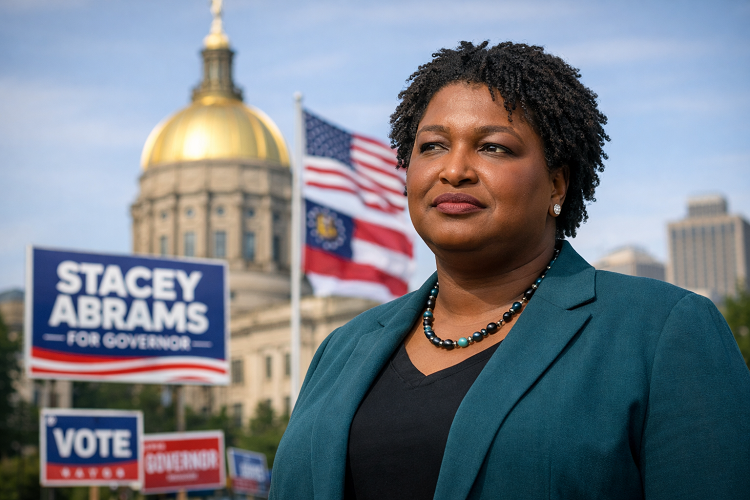
Democratic activist and former Georgia legislative leader Stacey Abrams has decided not to pursue a third consecutive run for governor in 2026, marking a significant turning point in the political career of one of the most recognizable figures in modern Georgia politics. After suffering back-to-back defeats to Republican Gov. Brian Kemp in 2018 and 2022, Abrams announced that she will sit out the upcoming race and instead focus her energy on defending democratic institutions nationwide.
Her decision ends months of speculation about whether Abrams would once again seek Georgia’s top office in what is expected to be a highly competitive open-seat election. With Kemp term-limited and unable to run again, both parties are preparing for a fierce contest that could help determine the political direction of one of America’s most closely watched swing states.
A Statement That Signals a Strategic Shift
In a statement shared with The Atlanta Journal-Constitution, Abrams emphasized that her current priorities lie beyond campaigning. She argued that the country is at a critical moment and that her skills are best applied through civic engagement rather than electoral ambition.
“Americans are in pain, but they are ready to act,” Abrams said. “This is the moment to reconnect people to what is at stake and what remains possible. After deep reflection, I believe the most effective way I can serve right now is by continuing this work, not by seeking elected office in 2026.”
Abrams has increasingly framed her public role as one focused on safeguarding democracy, warning that political polarization and institutional erosion pose long-term risks to the nation.
The Near-Historic 2018 Campaign
Abrams first captured national attention during the 2018 Georgia gubernatorial race, when she came within a narrow margin of becoming the first Black woman elected governor in U.S. history. Her contest against then–Secretary of State Brian Kemp was one of the tightest races in the country that year, ultimately decided by roughly 55,000 votes.
The aftermath of that election proved just as significant as the race itself. Abrams declined to formally concede, arguing that voter suppression and election administration failures had undermined the fairness of the contest. Her stance energized Democrats nationwide and elevated her status as a leading voice on voting rights.
However, it also cemented her reputation as a divisive figure, drawing intense criticism from Republicans who accused her of undermining confidence in elections.
Building a National Profile Through Voting Rights
Following her 2018 loss, Abrams founded Fair Fight, an organization dedicated to combating voter suppression and expanding access to the ballot box. Through the group, she became one of the most influential Democratic activists in the country, shaping conversations around election laws and voter participation.
Her organizing efforts played a key role in reshaping Georgia’s political landscape. Abrams was widely credited with helping President Joe Biden narrowly win the state in the 2020 presidential election the first Democratic victory there in nearly three decades.
She also contributed to Democratic victories in the January 2021 U.S. Senate runoff elections, which gave the party control of the chamber and cemented Georgia’s reputation as a true battleground state.
The 2022 Rematch and a Decisive Defeat
Despite her growing national profile, Abrams’ second run for governor in 2022 proved far less competitive than many Democrats expected. She raised more than $110 million, making her one of the best-funded gubernatorial candidates in the country.
Yet Kemp, now an incumbent with a strong governing record and crossover appeal, won reelection by nearly eight percentage points. The loss was decisive and raised serious questions about Abrams’ electoral ceiling in Georgia.
For many observers, the result marked a turning point signaling that Abrams’ influence might be stronger as an organizer and advocate than as a statewide candidate.
Political Infrastructure Shows Signs of Strain
In the years following the 2022 defeat, parts of Abrams’ political network began to weaken. The New Georgia Project, an organization she helped establish, shut down after being fined $300,000 for violating campaign finance laws tied to her 2018 campaign.
While Abrams quietly explored the possibility of another gubernatorial run, the political environment had shifted. Donor enthusiasm cooled, and new Democratic contenders emerged, making a third bid both riskier and more complicated.
A Crowded Democratic Primary Without Abrams
With Abrams officially out of the race, the Democratic field is now wide open. Former Atlanta Mayor Keisha Lance Bottoms has emerged as the leading contender, bolstered by her tenure in the Biden administration and strong national connections.
Other candidates include former Lt. Gov. Geoff Duncan, a onetime Republican who has since aligned with moderate Democrats, as well as former state Rep. Ruwa Romman and former DeKalb County CEO Michael Thurmond.
The diversity of the field reflects the evolving coalition within Georgia’s Democratic Party and underscores the competitiveness of the primary.
Republicans Prepare for a High-Stakes Battle
On the Republican side, Lt. Gov. Burt Jones enters the race with the endorsement of President Donald Trump, giving him a powerful advantage among GOP primary voters. Attorney General Chris Carr and Secretary of State Brad Raffensperger are also vying for the nomination.
Political analysts expect a closely fought general election. The Cook Political Report rates the race as a toss-up, while other outlets give Republicans a slight edge highlighting Georgia’s razor-thin partisan balance.
Abrams Refocuses on Defending Democracy
Although Abrams will not appear on the ballot in 2026, she has made clear that she is not retreating from public life. She continues to warn that the United States is drifting toward authoritarianism and has urged Americans to actively engage in protecting democratic norms.
“The antidote to authoritarianism has always been democracy,” Abrams said. “But democracy only works when it has committed defenders. When government fails, the consequences are felt by everyone.”
For Georgia Democrats, Abrams’ decision marks the end of a defining chapter. For Abrams herself, it signals a deliberate shift from candidate to guardian of democratic participation at a time when she believes the stakes could not be higher.