
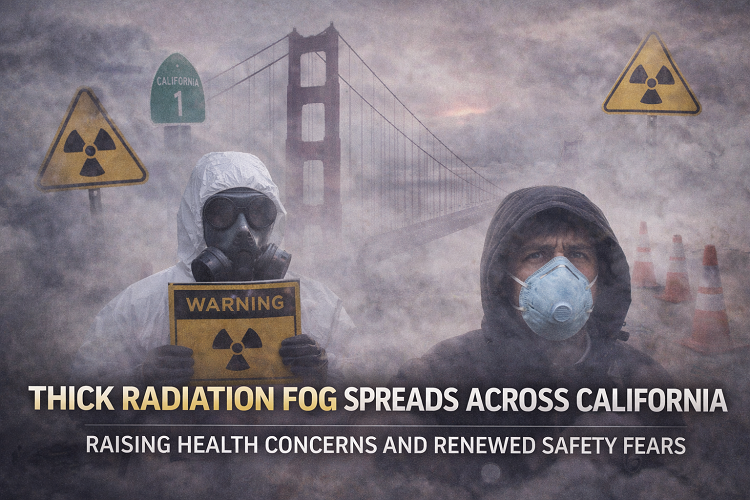
A dense blanket of what meteorologists call “radiation fog” has crept across large portions of California’s Central Valley in recent weeks, reducing visibility, disrupting daily life, and prompting growing concern among residents who say they are experiencing unexplained respiratory and skin-related symptoms. The fog, which has stretched across more than 400 miles and affected over 20 counties, has lingered far longer than usual, reigniting discussions about air quality, pollution, and the health risks associated with prolonged winter inversions.
Radiation fog often referred to locally as Tule fog is a naturally occurring weather phenomenon that typically appears during late autumn and winter in California’s low-lying valleys. It forms on calm, clear nights when the ground rapidly loses heat after sunset, cooling the air directly above it. As moisture condenses near the surface, a thick fog develops that can persist for hours or even days if weather conditions remain stable.
Although the term “radiation fog” has led to confusion among some residents, experts stress that it has nothing to do with nuclear radiation. Instead, the name refers to the loss of heat through radiation from the Earth’s surface. Even so, the fog’s unusual density and persistence this season have alarmed many Californians.
Residents Report Mysterious Symptoms
Several residents have taken to social media to share their concerns, describing coughs, congestion, headaches, and flare-ups of chronic conditions that they say appeared shortly after the fog settled in. Gerald Deperalta, a resident of Tracy, said his family has been dealing with persistent respiratory issues for more than a week.
“We’ve been coughing nonstop, and the congestion just won’t go away,” Deperalta said. “We’re keeping the kids’ inhalers close and trying to keep them indoors as much as possible.”
In videos posted online, Deperalta showed his car coated in what appeared to be a white film after driving through the fog. As he wiped the surface, residue clung to his fingers, leading him and others to question whether pollutants were present in the air.
Comments beneath his videos revealed similar experiences from people across the Central Valley. One mother said her children’s eczema had worsened noticeably since the fog arrived. Another resident reported recurring headaches — something they said was entirely new for them. Others mentioned sore throats, chest tightness, and fatigue that seemed to persist despite medication.
Michael Washington, another California resident, described weeks of coughing that had not improved despite antibiotics, inhalers, and prescription cough suppressants. “Nothing seems to be working,” he wrote, echoing a sentiment shared by many commenters.
Experts Urge Caution Against Jumping to Conclusions
Health professionals and meteorologists have cautioned against assuming the fog itself is the direct cause of illness. Fog, they explain, is simply a collection of microscopic water droplets suspended in the air and does not inherently contain harmful substances.
However, what fog can do especially during temperature inversions is trap pollutants close to the ground.
During a radiation fog event, a layer of warmer air settles above colder air near the surface. This creates what scientists often describe as a “lid,” preventing vertical air movement. As a result, pollutants from vehicles, factories, fireplaces, and agricultural activity accumulate near ground level instead of dispersing.
“These conditions can significantly worsen air quality,” experts say, particularly for people with asthma, chronic obstructive pulmonary disease (COPD), heart conditions, and other respiratory vulnerabilities.
The white residue some residents reported is not a natural feature of fog, which consists of pure water droplets that evaporate once temperatures rise. Specialists suggest the substance may instead be dust, soot, industrial emissions, smoke, or other particulate matter suspended in the trapped air.
PM2.5: A Hidden Danger
One of the most concerning aspects of these fog events is the buildup of fine particulate matter known as PM2.5 — tiny particles small enough to penetrate deep into the lungs and even enter the bloodstream. Prolonged exposure to PM2.5 has been linked to asthma attacks, bronchitis, cardiovascular disease, and increased hospital admissions during winter months.
Hospitals in the Central Valley often see spikes in emergency room visits during prolonged fog and pollution events, particularly among children and older adults. According to public health data, poor air quality combined with stagnant weather conditions can aggravate both respiratory and heart-related conditions.
The World Health Organization has identified air pollution as one of the leading environmental risk factors for premature death worldwide, affecting millions annually.
A Serious Threat to Drivers
Beyond health concerns, radiation fog presents extreme dangers for motorists. Visibility can drop to near zero in seconds, making highways especially hazardous. California has a long history of deadly chain-reaction crashes linked to Tule fog.
One of the most devastating incidents occurred on November 3, 2007, when dense fog along Highway 99 near Fresno triggered a 108-vehicle pileup. The crash killed two people, injured more than 40, and shut down the highway for over 12 hours. More recently, a 40-car crash in January claimed two lives and injured nine others under similar foggy conditions.
Residents familiar with Central Valley winters describe Tule fog as some of the thickest on Earth, often persisting until late morning or early afternoon when sunlight finally warms the ground enough to break the inversion.
When Will the Fog Lift?
Forecasters say the only reliable way to clear radiation fog is through a strong weather system capable of mixing the atmosphere. This typically involves wind, rain, or a significant temperature shift that disrupts the inversion layer.
Meteorologists predicted a possible system arriving around December 17, but uncertainty remains about whether it will be strong enough to fully disperse the fog. Until then, the low clouds may continue to blanket large portions of the valley during overnight and early morning hours.
A Changing Climate and Cleaner Air
Interestingly, researchers from the University of California, Berkeley found in a 2019 study that California now experiences fewer days of thick Tule fog than it did several decades ago. The reason, they say, is improved air quality.
Fog droplets form around microscopic particles in the air. As California’s stricter clean-air regulations have reduced pollution levels, fewer particles are available to support widespread fog formation. Still, southern parts of the Central Valley which tend to have higher pollution concentrations continue to experience denser fog events.
“We see more fog in areas where air pollution remains higher,” said Ellyn Gray, a graduate researcher involved in the study.
A Reminder of Environmental Vulnerability
While radiation fog itself is a natural phenomenon, its interaction with modern pollution underscores the delicate balance between weather, environment, and public health. As the fog lingers, officials urge residents to limit outdoor activity during poor air-quality days, use air purifiers indoors, and drive with extreme caution.
For many Californians, the thick fog serves as a visible reminder of the invisible particles they breathe and the importance of ongoing efforts to protect air quality in one of the nation’s most productive yet environmentally vulnerable regions.