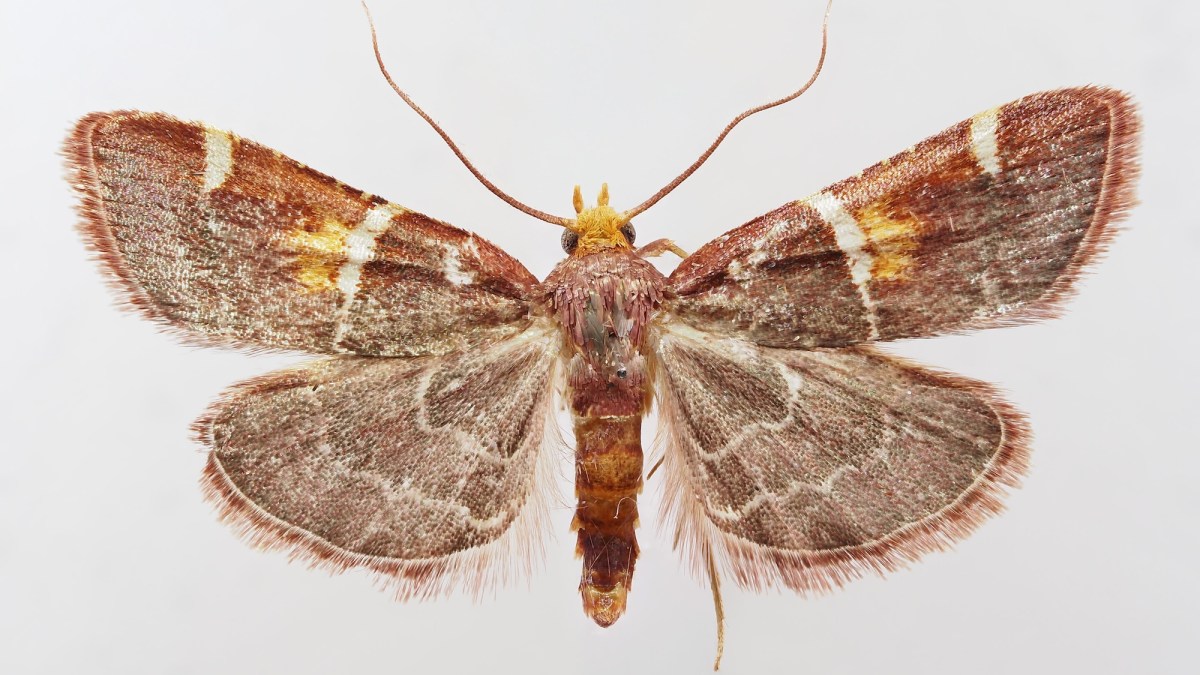

Pope Leo XIV receives gifts from visitors from all over the world every year, but a newly identified insect may be the first papal tribute of its kind. In the journal Nota Lepidopterologica, entomologists describe a striking moth species recently discovered on the rocky Mediterranean island of Crete. With its royal color scheme and ecological significance, the winged insect lives up to its scientific name—Pyralis papaleonei, or the Pope Leo moth.
“The Pontiff is a strong advocate of climate and environmental protection, and we hope that his voice may serve as an example for humanity,” the study’s authors wrote.
P. papaleonei is the latest in a series of taxonomic revisions within the Peralis regalis species group. Although common across Europe, their widespread presence has proven a liability for entomologists. Recent re-evaluations have uncovered multiple unique subspecies among these often overlooked moths. P. papaleoni represents the newest addition to the family, after researchers from Austria’s Tyrolean State Museum, the Finnish Museum of Natural History, and the Bavarian State Collection of Zoology analyzed numerous specimens from the White Mountains located in the western region of the Greek island of Crete.
With a roughly 0.75 inch wingspan, the Pope Leo moth is a moderately sized insect within its group. Its particularly distinctive features include purple forewings accented by multiple white bands and deep orange spots. Molecular analysis showed about a six percent genetic divergence from the next closest relative—more than enough to earn it a new species classification.
For now, researchers know little else about the Pope Leo moth’s lifecycle and biology, although they seem most active around the month of June and appear endemic to Crete. That said, a single specimen observed in October suggests either a prolonged flight season or possible multiple generations over the course of a few months.
About 700 moth species are discovered every year, although most are located in tropical habitats. This makes the Pope Leo moth’s identification particularly noteworthy, but also serves as a vital reminder of the planet’s precarious ecological health.
“We are facing a global biodiversity crisis, yet only a fraction of the world’s species has been scientifically documented,” explained Peter Heumer, the former head of Tyrolean State Museums’ natural science collections and a study co-author. “Effective conservation of biodiversity requires that species are first recognized, described, and named.”
Heumer’s comments echo the Pope Leo moth’s namesake. While speaking at a global church summit on climate change last year, the pope urged a societal transition, “from collecting data to caring, and from environmental discourse to an ecological conversion that transforms both personal and communal lifestyles.”

2025 PopSci Best of What’s New