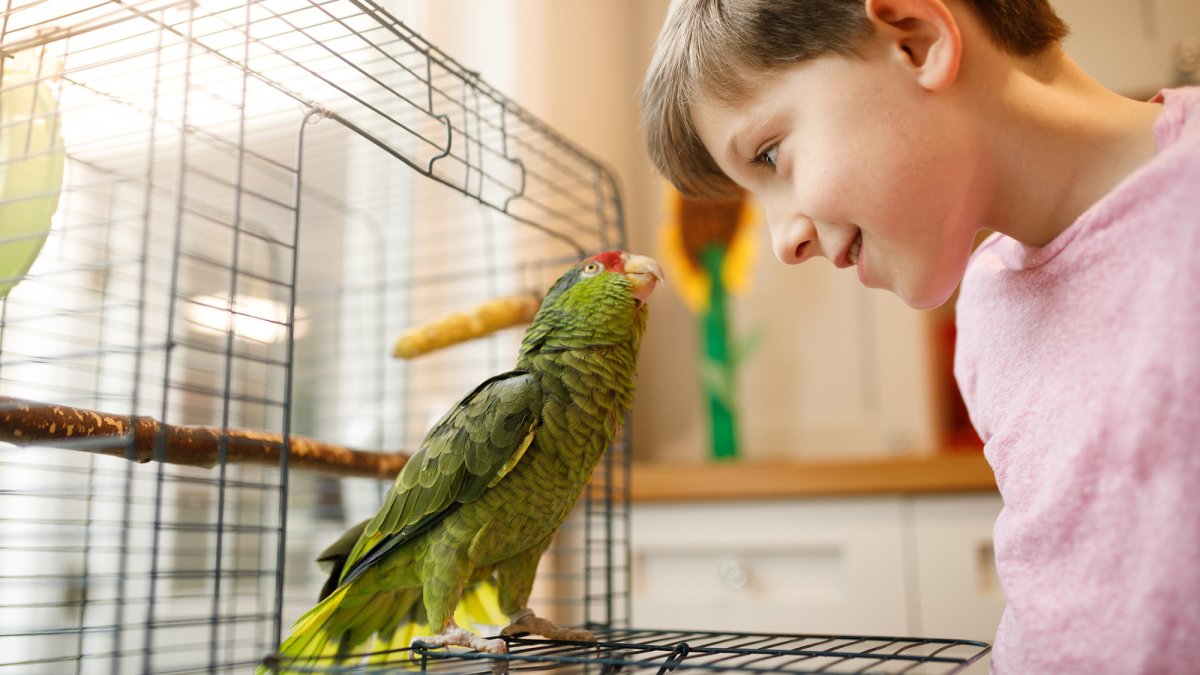

The internet is chock full of talking birds, whether they’re squawking at a vet, singing “You are my sunshine,” or annoying cats while barking like a dog (naturally). But why are some birds so chatty? The answer, which we explore on a new episode of the Ask Us Anything podcast, has more to do with love than you might think.
Ask Us Anything by Popular Science answers your most outlandish, mind-bending questions—from the everyday things you’ve always wondered to the bizarre things you never thought to ask, from “Were there any venomous dinosaurs” to “Why cavemen and women had straight teeth.” If you have a question for us, send us a note. Nothing is too silly or simple.
This episode is based on the Popular Science article “From chirps to ‘hellos’: Why some birds talk like people.”
Subscribe to Ask Us Anything
Listen and follow Ask Us Anything on your favorite podcast platform:
Spotify | Apple Podcasts | YouTube | Or wherever you get your podcasts.
Full Episode Transcript
Sarah Durn: Today, we are so lucky to have some very chatty podcast guests. Cosmo?
Bird: Was that good?
SD: That was so good. Care to elaborate? Anyone else?
Bird: You so cute.
SD: Aw, thank you. You’re cute too. Now, do you guys wanna introduce yourselves properly?
Bird: I’m a banana.
SD: Bananas? Yeah. I don’t think that’s right somehow, and you guys aren’t coming in super clear either.
Maybe you should check your tiny little bird mics? Okay, well let’s cue that theme music anyway.
Bird: Happy birthday to you. Happy birthday…
SD: Again, not quite right. Welcome to Ask Us Anything from the editors of Popular Science, where we answer your questions about our weird world.
From “Why can’t we remember being babies” to “Why do cats hate water,” no question is too wacky or too simple.
I’m Sarah Durn, an editor at PopSci.
Annie Colbert: And hello, humans and birds. I’m Annie Colbert, editor-in-chief.
SD: Welcome, Annie. Here at Popular Science, we can’t stop thinking about all the world’s strangest questions.
AC: And this week we’re wondering why some birds can be so chatty. So Sarah, please explain: What’s happening with all these talking birds?
SD: Yeah, well the answer’s actually really sweet. Birds mimic what you say and even how you say it because they love you.
AC: Hmm. Really?
SD: You sound so skeptical. Really. Birds like parrots talk because they’re trying to connect. It’s not them doing a weird party trick for attention. It’s more like they’re saying, “Hey Annie, you’re part of my flock.”
AC: Ugh, sounds so lovely to have bird friends.
SD: It is, but the way they actually pull this off—their brains, the anatomy, the whole setup—is even wilder.
AC: Alright, I’m in, despite my very hot and cold relationship with birds, which we will get into later, I promise. But before we dig into all the bird facts, we want to know: What questions are pecking at your brain?
If there’s something you’ve always wanted to know, submit your question by clicking the “Ask Us” link at popsci.com/ask. Again that’s popsci.com/ask, and peck at the “Ask Us” link.
SD: And we’ll be right back after this quick break to chirp through all the birdie details.
Welcome back. Okay. Before we get into the science, Annie, you need to tell us: What is up with you and birds?
AC: Yes. As I hinted at earlier, I have a very complicated relationship with birds that started when I was about five or six and we ended up being the home of this very chatty parrot named Polly that my granny had acquired somehow. I’m unclear of how my granny even ended up with a parrot, but the parrot ended up living at our house and Polly and I were sworn enemies.
SD: Oh no.
AC: Because every time I wanted to sit down and watch cartoons, she would start yelling and squawking, so I couldn’t hear the TV. And we’d end up in this shouting match of us yelling, “No! Shut up!” at each other just at full volume. Like it really soured my relationship with parrots, especially.
SD: Yeah, it’s coming through.
AC: As you can imagine, this did not thrill my parents having a screaming child and a screaming parrot, so they found a new home for Polly. She went to go live with an experienced parrot owner who I would like to point out confirmed that Polly was the loudest parrot she had ever met.
SD: Wow. I mean, how loud is loudest?
AC: Yes. I mean, parrots are loud, but she would scream. You know, we lived in a house and my sister would be walking home from school and could hear us from down the street.
SD: Oh my gosh.
AC: Screaming “No! Shut up!” at each other. It wasn’t good. It wasn’t good.
SD: Yeah. You’ve been holding onto that for a while.
AC: Yes. Yeah, that was very nice to get off my chest and share. She was very smart, but we were not a good match. How about you? Do you have any parrot encounters?
SD: Not a ton of parrot encounters, but I did have a really, really fun encounter with a raven at the Cleveland Natural History Museum.
AC: Ooh, do tell.
SD: Yeah. They have this outdoor wildlife center. It’s actually really, really nice where they rehabilitate wounded animals and they had this massive raven sitting on a perch. And I noticed on the little info panel, his name was Blackjack. And to be polite, I said, “Hi Blackjack.”
AC: Oh, very friendly.
SD: Yeah. And then Blackjack answered me saying “Blackjack!”
AC: Whoa.
SD: I know. I was with my mom and we both kind of jumped a little and we had this whole little back and forth with him. It was actually really sweet and you know, kind of moving. I mean, it’s like so magical to be able to say words to another animal and for them to say something back that you understand.
I would love to, you know, do that with my dogs or cats, but birds, you know, they can actually do that.
AC: Oh, totally. It’s a very Disney movie. And it also leads to our big question today, which is why do some birds talk?
SD: Well, first off, we have to define what we mean by talking, because technically almost all birds talk.
AC: Wait, what?
SD: Yeah. Most birds have their own language. They use calls and sounds to say things like, “There’s a predator nearby,” or, “Hey, let’s pair up.”
AC: So birds are constantly talking, just not in a way that we can understand.
SD: Exactly. But when we say talking birds, what we really mean is birds that can mimic human speech.
AC: Mm. Little overachievers.
SD: Totally. And that ability mimicking sounds, including human words, is actually pretty rare. You mostly see it in parrots, but also in birds like crows, ravens, starlings, and mynahs.
AC: So why them? Why do some birds pick this up, but others don’t?
SD: A huge part of it comes down to social behavior.
Parrots are incredibly social animals. In the wild, they form really, really strong bonds with other parrots, often mating for life.
AC: Ah, another Disney movie moment.
SD: I know so much Disney. They’re also constantly communicating with their partner and flock.
AC: All right, so how do humans come in then?
SD: Well in captivity, these birds don’t have a flock. Instead they have us, you know?
AC: Oh, so we become their flock?
SD: Right, When a parrot starts mimicking your voice, it’s not just about copying sounds for fun. It’s about trying to connect with you. It’s saying, “Hey Annie, you’re my person now and I’m going to learn your language.”
AC: Oh no. So my parrot was not trying to annoy me. It was trying to be my friend?
SD: Maybe.
AC: Alright, I’m skeptical and now I feel a little bad. But I also want to know how are birds doing this? I imagine copying human speech is not easy.
SD: Yeah, this is where things get really cool. Birds that mimic human speech have a specialized part of their brains called the song system.
It’s basically a neural network that helps them learn and produce complex sounds.
AC: So they’re wired to learn different sounds?
SD: Exactly. And then there’s the hardware. The thing actually making the sound,
AC: The beak?
SD: Not quite. It’s an organ called the syrinx. It’s basically their version of a voice box. The syrinx sits deep in their chest, and it’s actually way more efficient than our larynx.
AC: More efficient how?
SD: It allows birds to control airflow and vibrations in really, really precise ways so they can produce a huge range of sounds—even sounds that don’t exist in their natural repertoire, like human speech.
AC: So they have the brain and the instrument to say words.
SD: Exactly.
AC: Okay, but when a bird says something like “hello,” or “no,” or “shut up,” does it actually know what it means?
SD: Okay. This is where things get a little fuzzy. Birds are really good at forming associations, so they might learn that saying “hello” gets a reaction, or saying “cracker” gets them food.
AC: So they’re connecting words to outcomes.
SD: Exactly. But that doesn’t mean they necessarily understand language the way we do.
They don’t know what “cracker” means. They just know what happens when they say it. At least that’s what researchers can confirm at this point.
AC: So they might be able to understand more?
SD: Potentially. Take the example of Puck the Budgie. Puck learned an astounding 1,728 English words before passing away at the young age of five in 1994.
He even got a Guinness World Record for largest human vocabulary of any bird.
AC: Oh, yay. Go Puck!
SD: Right? And Puck could even form sentences. Researchers have also documented how birds can categorize things like colors or shapes. And in the wild, some birds use specific calls to communicate that say there’s a threat nearby.
Like chickadees, they use varying numbers of “D” notes in their calls to indicate possible threats. The more “D” notes they use, the higher the risk. So maybe there’s more going on than researchers currently understand.
AC: Okay. I’m reluctant to say that birds are kind of brilliant, even if they scare me a little.
SD: They really are! And it gets even cooler. So maybe I’ll convince you to give them a second chance. Some birds in the wild even develop regional dialects.
AC: No way.
SD: Researchers have found the parrots in different places actually sound different, kind of like human accents. They also can develop calls that mean specific things in specific places.
AC: So birds have like their own slang versions of yinz and y’all.
SD: Yeah. Bird slang is absolutely real, and it’s learned, not genetic. Kind of like how people say sub versus hoagie.
AC: All right, I love that.
SD: Right. So to bring it all together, birds are wired to learn sounds, bond with others, and communicate. And when humans enter the picture, we become part of the flock.
AC: Aww. So when birds talk, it’s their way of bonding with the person they’re closest to.
This is all incredibly wholesome, and I don’t know if I’m fully sold on parrots. But we do love to learn.
SD: We do. And also very fair. And with that, we’ll be back with one final bird fact that honestly might change how you see parrots forever, Annie.
AC: Hmm. Skeptical.
SD: Okay. Well that’s coming up after this quick break.
And we’re back! After all this talk about parrots mimicking humans, I have one last delightful update from the bird world.
AC: Alright, hit me.
SD: Researchers recently found evidence that some parrots may actually use names.
AC: Really?
SD: Yep. Names—as in, like specific labels for specific individuals.
AC: All right, hold on.
So like, “Hi Steve. Hello, Frank.”
SD: Kind of. Yeah, scientists looked at reports from hundreds of companion parrots and found that many birds seem to learn and use names properly—for humans, other pets, and sometimes other birds. We’ll link to the story on popsci.com in the show notes.
AC: I mean, I gotta hand it to ’em that is impressive.
SD: Right? And it makes sense when you think about it. Parrots are super social animals. Humans use names to manage complicated social lives, and parrots also live in complex social groups.
AC: Yeah. So if you have a whole flock to keep track of, names are useful.
SD: Exactly. And parrots don’t just use names the way we do.
AC: How so?
SD: Well, and I kind of love this, researchers found that some birds repeatedly say their own name to get attention.
AC: Oh.
SD: So did your childhood parrot Polly ever scream her own name?
AC: Come to think of it, she did. And she also spoke in the third person a lot, a little bit like Elmo. So she would say the classic “Polly want a cracker,” and I feel like she would just say her name to mimic, or I think as I thought as a child, mock us, now that I’m thinking back on it.
SD: Ooh, very intense mockery. So to recap: Parrots can bond with you. They can mimic your voice, and they may even call you by your name.
AC: Okay. I hate to admit it, but I can’t help but be impressed.
SD: You’re coming around.
AC: Let’s not get carried away.
And that’s it for this episode. But don’t worry, we have more episodes of Ask Us Anything live in our feed right now.
Follow or subscribe to Ask Us Anything by Popular Science, wherever you enjoy your podcasts. And if you like our show, leave a rating and a review.
SD: Our producer is Alan Haburchak. This week’s episode is based on articles written for Popular Science by Laura Kiniry and Margherita Bassi.
AC: Thank you team. Thank you birds. Not all birds. And thank you to everyone for listening.
SD: And one more time, if you want something you’ve always wondered about explained on a future episode, go to popsci.com/ask and click the “Ask Us” link. Until next time, keep the questions coming!
Bird: Thank you baby.
SD: Wait, Annie, before you go, you have to hear the most impressive parrots I’ve yet to share on the episode.
May I introduce the Rihannas of the bird world!
AC: You may!
Bird: I’m friends with the monster that’s under my bed. Get along with the voices inside of my head.
SD: It’s like actually good.
AC: It’s very good. I’d listen to this on Spotify. Put this on Spotify.
I can’t sing in human, so I also cannot sing in bird.

2025 PopSci Best of What’s New