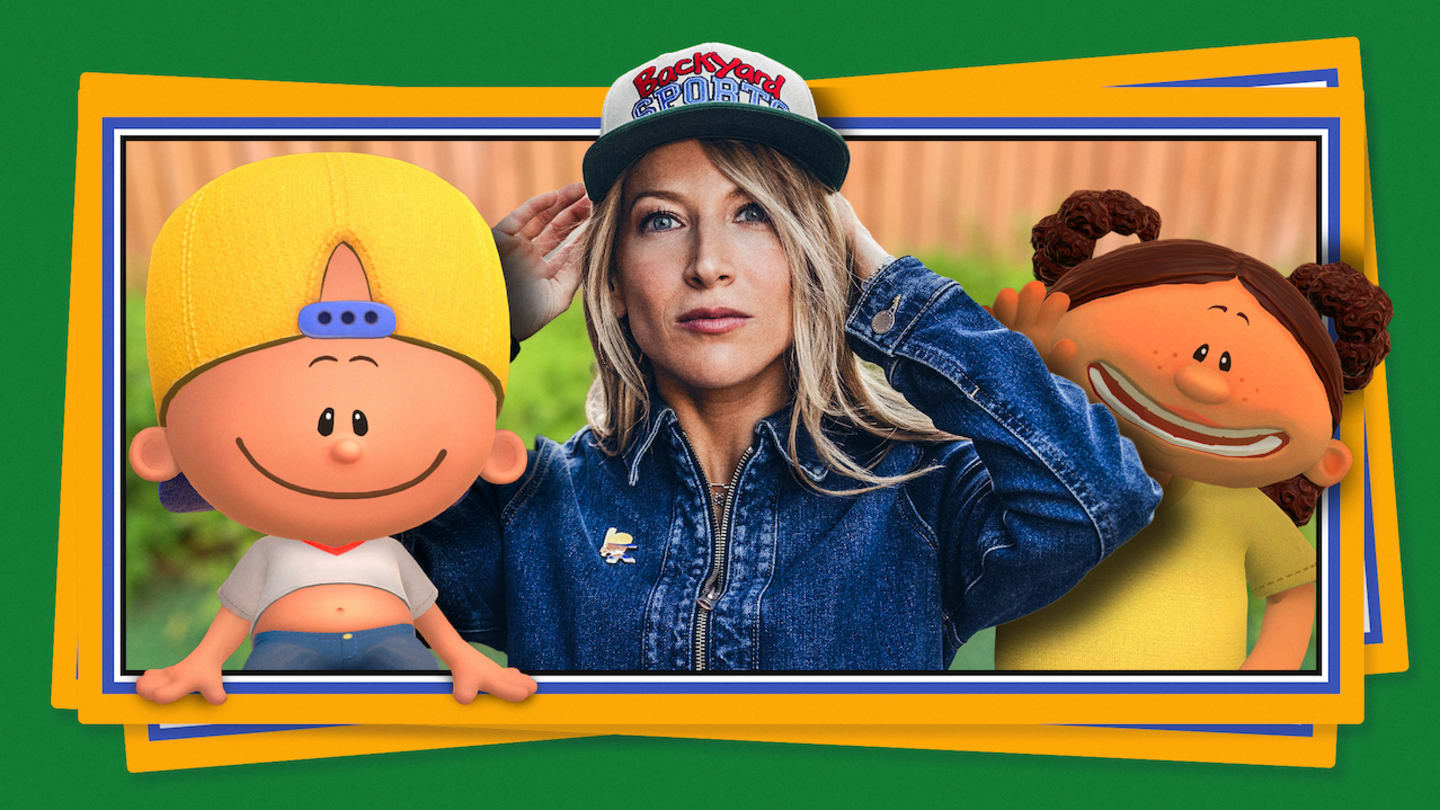

If you were a kid in the ‘90s, you know the name Pablo Sanchez. He wasn’t just a short, pudgy kid with a crop top who could rip 400-yard bombs. He was a core memory, from a time when sports felt sillier, looser and more imaginative. Pablo Sanchez was Backyard Baseball, a shared generational experience around computer rooms and family desktops.
The genius wasn’t just Pablo though. It was the neighborhood around him. Pete Wheeler had speed. Kiesha Phillips had power. Stephanie Morgan had her backwards hat and bubble gum. Kenny Kawaguchi pitched from a wheelchair. Before the pros arrived in later editions, the stars were the kids themselves: short, fast, loud, quiet. Half were girls, half were boys. They were kids of different races, kids with different bodies, kids who looked nothing like traditional sports heroes.
This neighborhood of 30 fictional kids was filled with enough personality that we still remember their songs and voice lines decades later. Pablo’s theme song alone is practically a Millennial memory trigger.
But what if I told you that to bring the neighborhood back to life, a Millennial second-grade school teacher had to hire a private investigator to track down the Backyard Sports IP?

A teacher looking for better screen time
During the early days of the pandemic, Lindsay Barnett, now CEO of Playground Productions, was remote teaching, searching for content her students could engage with on their own. She had high standards: a Northwestern degree in TV, film and animation, a master’s in education focused on digital media for kids, and nearly a decade teaching second grade in Chicago. It had to be something safe, fun, asynchronous and actually worthwhile.
Backyard Baseball felt like the perfect answer. She grew up on it, after all. There was just one problem: It wasn’t anywhere to be found.
Backyard Baseball launched in 1997 under Humongous Entertainment, built from an idea by Nick Mirkovich and developed by programmer Rich Moe and artist Mark Peyser. The success of the original led to a full slate of titles, including football, basketball, hockey and more through the late 1990s and 2000s. By the early 2010s, new Backyard Sports games had stopped coming out. The franchise had been passed from company to company and was ultimately carved up in Atari’s 2013 bankruptcy. Backyard Sports was sold off on its own to a private equity firm, while the rest of the Humongous catalog scattered across different buyers. Old CDs and memories were what was left.
Barnett realized that if she wanted to see great children’s programming return, she was going to have to build it herself — and getting into kids’ entertainment was always the ultimate goal. “I called a lawyer to see if it was in the trademark system, and they were like, this is very strange, it isn’t. You should hire a private investigator and track this thing down. And that’s exactly what I did,” Barnett said.
Eventually, the PI successfully found the rights holders, and Barnett convinced them she was the right person to shepherd the franchise.
The problem was what she actually got: not a game, just a name. No code, no archived builds, no creative assets. No roadmap for what Backyard Sports had been. “I didn’t have a box of source code or any types of legacy scripts or anything,” she said.

Rebuilding a game that no longer existed
The game people remembered didn’t exist anymore, but the memory of it did. For Barnett, that was learning formations, play-calling and positions. “The purpose of the games was to teach the rules of different sports to kids. I learned to play football through Backyard Football. I asked for a football for my birthday and wound up playing outside, because I knew how to do it.”
That was the magic. For many kids of the ‘90s, the game unlocked real play. For me, the Backyard suite of computer games exists in a core memory file right next to wiffle ball nights in our backyard with my siblings and neighbors.
Facing the prospect of potentially rebuilding the games (and the nostalgia along with them) entirely from scratch, Barnett caught a break. While interviewing developers, she met Mega Cat, an independent studio specializing in video game preservation. They offered a technological miracle: “They were able to reverse engineer the games, build new code and make them playable.”
This allowed Barnett’s new company, Playground Productions, to resurrect the classic titles and release them to modern devices earlier than anticipated. Backyard Baseball ’97 was re-released in September 2024, then expanded to new platforms like iOS and Android devices and Nintendo Switch and PlayStation in the first half of 2025.
The revival wasn’t just about getting the game running again, it was also about reintroducing the ecosystem. As the franchise came back, brands like Wilson Sporting Goods and Louisville Slugger signed on, dropping a Backyard Baseball collection that includes gear for T-ball and elite travel players alike. Pablo Sanchez even signed with Wilson. All to connect the digital game back to real play.

What changed while Backyard Baseball disappeared
In the years since Backyard Sports disappeared, kids’ entertainment and youth sports have both changed rapidly. Youth sports have become increasingly professionalized. Kids are asked to specialize earlier, train harder, commit more. “It wasn’t that serious at that time, you know, it was just about fun,” Barnett said.
Sports feel more serious, and of course, screen time feels heavier. “Over the past 10 years, we’ve seen kids kind of forced to grow up faster with social media,” Barnett said. “They’re doing things that aren’t really celebrating what being a kid is all about.”
The modern screen time landscape can feel like a minefield for parents. With her academic foundations set, Barnett rebuilt the franchise with fun in mind, but also with intention. “Our content celebrates the best parts of being a kid. The storytelling is around real kid problems in a kid world with kid imagination.”
That means the Backyard Sports universe relies heavily on genuine, relatable childhood dialogue and playground dynamics. In launching its first animated special (from the animation studio behind Rick and Morty and Bob’s Burgers: The Movie, with Tiffany Haddish as Kiesha Phillips and Arturo Castro as Pablo Sanchez), instead of giving the characters adult-sized drama to deal with, the conflict revolves around a purely childhood crisis: What to do when your lucky bubble gum goes missing. To a kid with sports superstitions, losing their lucky gum is a massive, world-ending problem, which makes for a highly relatable and age-appropriate lesson, she says.
There were other non-negotiables for Barnett too: Remembering her students’ frustration about games that locked progress behind paywalls, or turned play into pay, she explicitly banned microtransactions from Backyard Sports. “You’re not going to have to pay for anything additional to win the game,” she insisted. And to stop financially burdening families, the games will not require an annual repurchase; they will simply receive continuous updates and expansion packs.
On July 9, Playground will launch the first brand-new installment in the Backyard franchise in 15 years with a 3D version of Backyard Baseball. Barnett’s team took the exact proportions and designs of the 2D figures to preserve their iconic looks. She often jokes that her main job title is “Pablo Sanchez’s manager,” and it’s clear the deep responsibility she and her team feel to preserve the game’s authenticity. “I realize how precious the characters are in this franchise, and how much they need to be taken care of,” she said.
Classic 2D elements, like the original player cards, remain untouched. Barnett calls it “2.5D,” a blend of old and new that preserves what people remember.
It’s a reminder that sports can still be loose, silly, more imaginative. Because at the end of day, Pablo Sanchez isn’t playing thousand-dollar travel ball, but he is hitting 400-yard dingers, in the backyard, where a love of sports begins.
 Add us as a preferred source on Google