
How do you lose basketball games? You turn the ball over, panic under pressure and fail to use the tools at your disposal. Duke was three-for-three on those catastrophic blunders in the final minutes of their stunning NCAA Tournament loss to UConn. The Blue Devils ripped the Huskies to shreds in the first half and then gave the game away.
That’s not hyperbole either. Duke literally gave the game to UConn by giving them the ball via turnovers twice in the last 1:05 of play. Cameron and Cayden Boozer were outstanding for the Blue Devils for most of the game, but when it mattered most, they stumbled. And so did their coach.
Duke had looked shaky at times during the tournament but they always showed the necessary grit to win in each of their previous games. They overcame deficits and were the better team late in wins over Virginia, Sienna and St. John’s. It made them look like a team with a championship mentality. That was before everything went wrong against UConn.
1. Turnovers cost Duke the game vs. UConn

How on earth did Duke let UConn cut into their comfortable lead in the second half? It’s really simple: Turnovers. Duke committed eight in the second half alone — three in their last seven possessions.
The most costly turnovers were courtesy of the Boozer brothers. Cameron lost the ball with Duke up 70-66 and a minute on the clock. UConn turned that into an Alex Karaban triple to cut the deficit to one. Cayden’s turnover was even more costly. With 10 seconds to go, the Blue Devils inbounded the ball with a two-point lead. The point guard tried to loop the ball up the court but it was tipped and recovered by the Huskies. And then Braylon Mullins called game.
If you want one stat to sum the collapse up, it’s this: UConn had 16 points off turnovers in the second half. Duke had zero.
Duke vs. UConn second half stats
|
Team |
Turnovers |
Points Off Turnovers |
Fouls Committed |
Off Rebounds |
2nd Chance Points |
|---|---|---|---|---|---|
|
Duke |
8 |
16 |
12 |
6 |
8 |
|
UConn |
1 |
0 |
7 |
2 |
2 |
There will be a lot of attention on Jon Scheyer and the fact that Duke choked in a second-straight tournament. And that’s totally fair (more on that in a second). But it’s always good to remember that players are also responsible for making these kinds of errors on the court.
2. Duke players didn’t understand the situation
Silas Demary Jr. hit his free throws to make it 72-70 with 10 seconds left. Duke seemed like they were in a rush to get the ball up the court, possibly because they didn’t want to get a 10-second violation. But when Cayden Boozer got the ball near the logo all he had to do was hold onto it and waste time until he was fouled. The urgency to get the ball was not needed. With 10 seconds on the clock, the Blue Devils weren’t ever going to get a 10-second violation.
College basketball’s 10-second rule: “A player or team shall not be in continuous control of a ball that is in their backcourt for 10 consecutive seconds.”
If Boozer had been aware of the situation, it’s likely the game ends very differently. He is a 79.7 percent free throw shooter and he’d made 6-of-6 on the night. Going to the line could have put Duke up by three. At worse, he misses one and UConn has six or so seconds to get the ball up the court for a last-second heave. Probabilities were on the Blue Devils’ side.
Instead, Boozer tried to get the ball over the top of Demary and Braylon Mullins, who looked like middle blockers on a volleyball court. The end result was Mullins getting the ball against a discombobulated Duke defense for an uncontested three-pointer.
3. Jon Scheyer failed to use his timeout
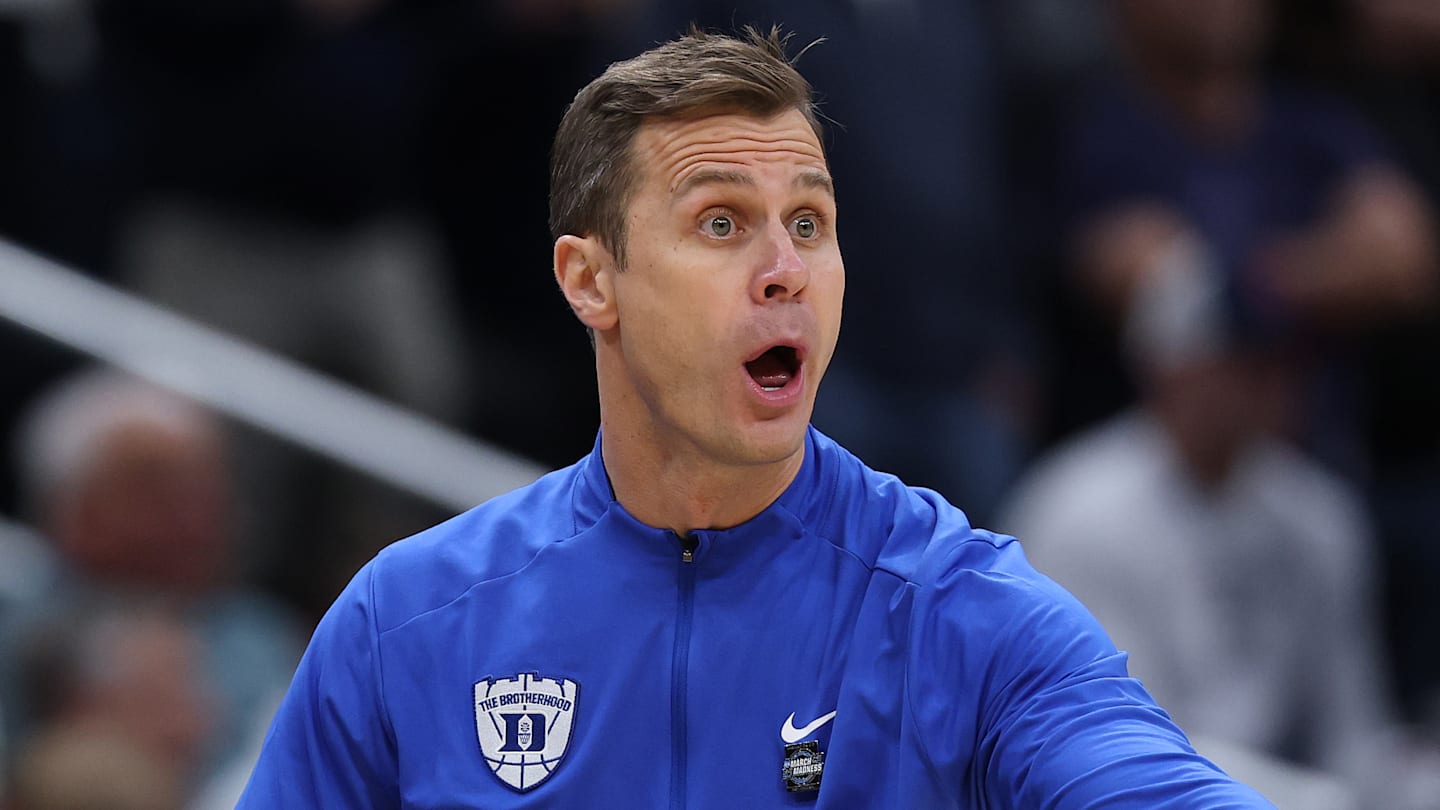
The turnovers and the poor on-court tactics were the most acute causes of Duke’s untimely demise, but one person had the power to prevent his players from losing the game. That’s Jon Scheyer, who straight-up mismanaged the end of the game.
Jon Scheyer and Cam Boozer with the lead pic.twitter.com/N2uLGGDBVS
— Daydrink (@daydrinkmedia) March 29, 2026
Duke had a timeout available. That timeout could have fixed everything.
Scheyer could have called timeout as soon as Demary hit his second free throw, before his team inbounded the ball. There were 10 seconds to go. Duke had three freshmen and two sophomores on the court. That would have been a great time for the head coach to give them a break and walk them through the tactics for the final stretch.
Even if he didn’t call the timeout before the inbounds, there was another chance to settle his team. Once the Blue Devils had possession, he could have called it then, particularly when Cayden got the ball and three UConn players were collapsing on him. A timeout there stops the clock at seven seconds and creates an inbounds pass that would leak a few more off the board before the Huskies could hope to foul. And that’s in addition to giving Scheyer the chance to get his guys ready for the final sequence.
There were clear ways for Duke to avoid this loss, ways that were directly in Scheyer’s control. His inaction put his players in the position to choke.
More March Madness news and analysis: