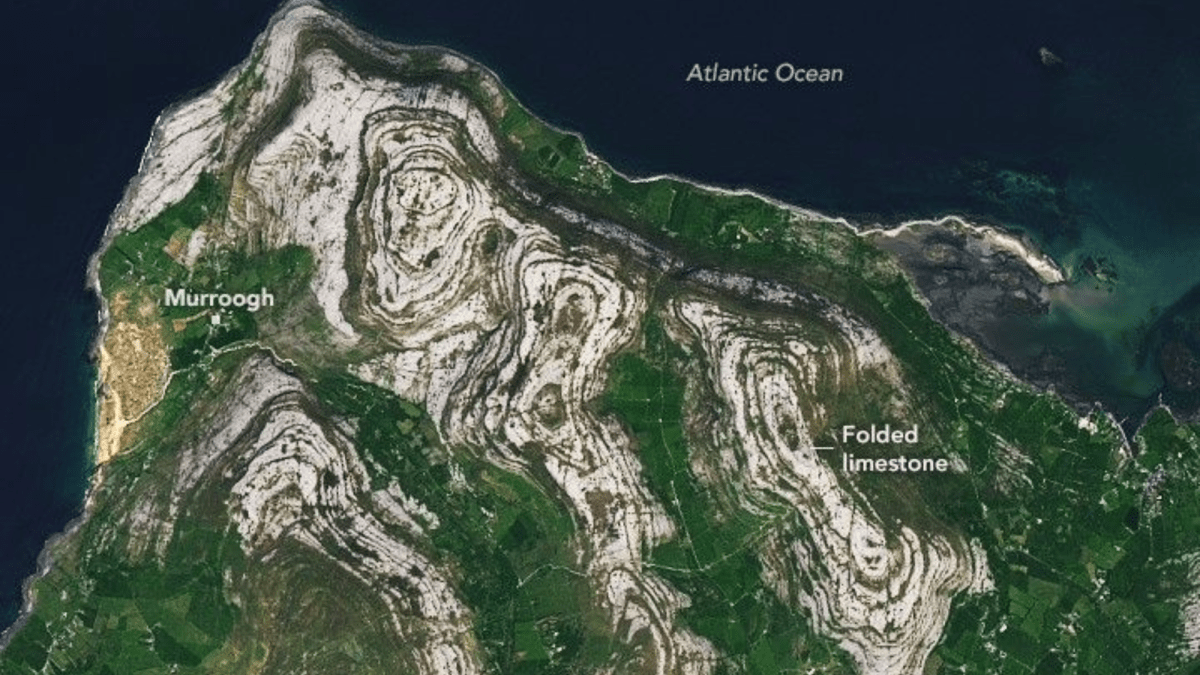

Happy St. Patrick’s Day—from space. While Ireland’s natural landscape is known for every shade of green imaginable, a different color dominates one part of Ireland. Along the Burren Region on the country’s western coast, gray limestone pavement covers the rocky and treeless landscape.
NASA’s Operational Land Imager (OLI) on the Landsat 8 satellite captured a view of Burren, showing the rocky landscape and an 860-foot-tall limestone hill called Moneen Mountain. The limestone that makes up these gray outcrops was deposited on what is now Ireland roughly 325 million years ago during the Carboniferous Period. At this time, Ireland was much further south near the equator and underneath warm and shallow seas.
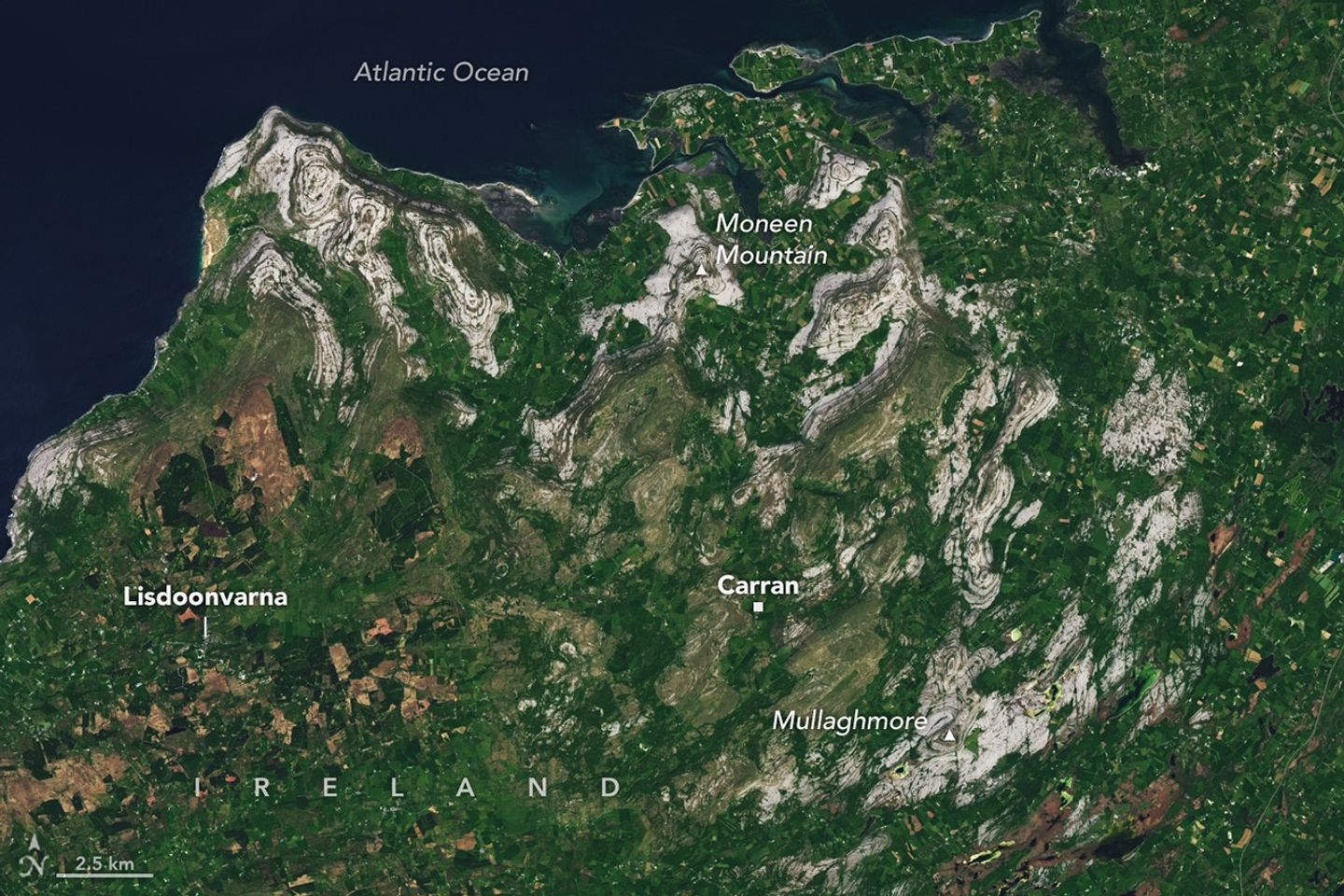
Initially, the limestone was deposited in flat and horizontal layers along the seafloor. It later buckled into the folds during a period of mountain building called the Variscan Orogeny that began about 250 million years ago. Over about 100 million years, the continents of Euramerica (Laurussia) and Gondwana collided to form the supercontinent of Pangaea. In present-day Burren, the folds in the tilted rock layers and differences in their erosion rate gives the limestone the step-like appearance we see today. The more erosion-resistant layers of rock are the ones that remain as ledges. Glaciers also sculpted the landscape, scraping away soil and rock sediment to expose the limestone pavement and smoothing over the hills.
Limestone is prone to chemical weathering over time. The weathering produces an irregular terrain called karst, with sinkholes, caves, and fissures called grikes dotting the landscape. Many of the grikes in Burren collect soil and have become footholds where vegetation can grow. While the individual grikes are too small to see in the image taken by Landsat, groups of them are dotted along the rock layers. These grike groupings are responsible for the concentric vegetation patterns seen in the NASA image. Clovers, ferns, and other plants are often found growing in the grikes. With a bit of luck, you may even find a four-leafed clover growing amidst the gray rocks.

2025 PopSci Best of What’s New